Little Bitty Noggins

When my first child was born she was in a bit of a hurry and arrived 4 weeks before her due date.  She was a tiny little one at first, weighing in at only 5 pounds. She measured a mere  12 inches around her little noggin.

My hands are not very big, but I could cup the entire back of her head in my palm.  I remember being amazed that such a tiny fragile being could be as alive and robust as she was.  She is now grown to be a busy, healthy and energetic young girl.

Many full-term newborns in  impoverished nations around the world are no bigger than my child was, and some are much tinier and far less robust.  There are multiple challenges facing these babies and their mothers.

I wanted to design a special hat pattern to support the efforts for the Save the Children Caps for Good campaign.  This is a program to provide hats for newborns in many countries where keeping a tiny head covered can make a real difference.  A baby that isn’t using energy to stay warm can use that energy instead to grow and gain critical survival weight.

The only payment I ask for the use of this pattern is that you donate at least 2 caps to the Save the Children program or, after February 28, 2011, to a similar program that you know of in your community to help newborns.  Thank you for helping to warm up some babies.

Little Bitty Noggin Cap by Andee Graves

Materials: Yarn – Any  Sport or Light worsted weight  yarn can be used. Samples used approximately .6 oz (56 yards) of  Red Heart Designer Sport, CYCA #3 weight, 100% acrylic. Colors used are Iced Violet (discontinued), Sky (discontinued) and #3820 Denim.  Hook size H-8 (5 mm).
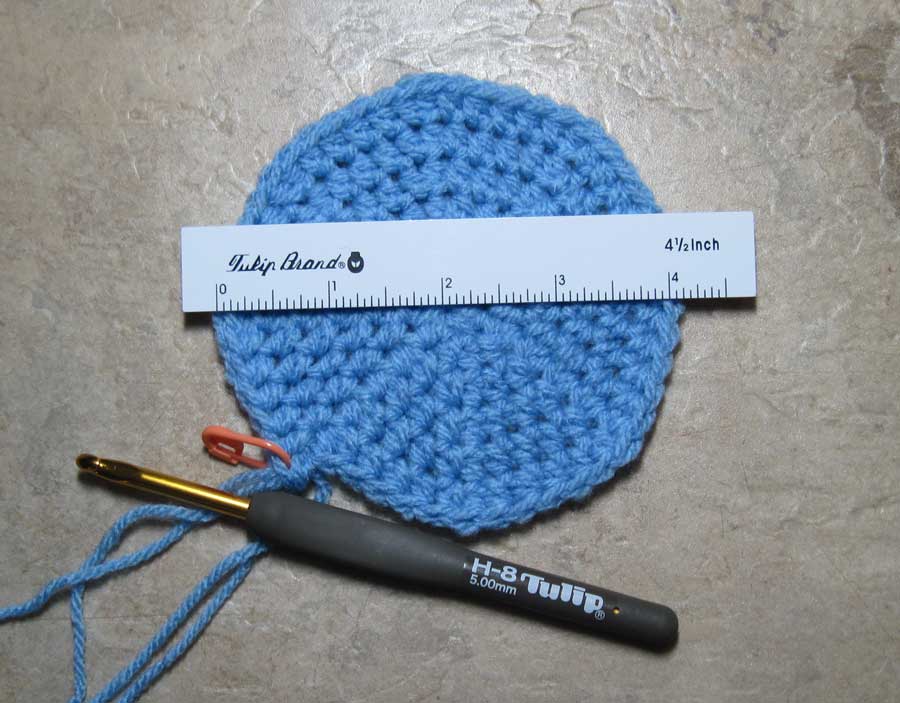
Gauge: First 6 rounds should be 4 inches in diameter.

Stitches used: Chain (ch), slip stitch (sl st), single crochet (sc), half double crochet (hdc), front post half double crochet (fphdc), and back post half double crochet (bphdc).

Special Stitches: Increase (Inc) – hdc thru both loops of next st, hdc  in back loop of same st.

Notes: Cap is worked from the center crown down to brim. Rnds 1 thru 15 are worked spirally. Use a stitch marker in the last st of each rnd and move up as rnds are completed.

Instructions:

Rnd 1: Ch 2, sc and 7 hdc in 2nd ch from hook.

Rnd 2: (Hdc in next st, hdc in bk lp of same  st) 8 times [16 hdc]

Rnd 3: (Hdc in next st, Inc in next st) 8 times [24 hdc]

Rnd 4: (Hdc in next 2 sts, Inc in next st) 8 times [32 hdc]

Rnd 5: (Hdc in next 3 sts, Inc in next st) 8 times [40 hdc]

Rnd 6: (Hdc in next 4 sts, Inc in next st) 8 times [48 hdc]

Rnd 7:  Hdc in each st of round [48 hdc]

Rnd 8 – 14:  Repeat Rnd 7

Rnd 15: Repeat Rnd 7, sc next st, sl st next st

Rnd 16: Ch 2,( fphdc next st, bphdc next st) 24 times, sl st to 2nd ch of beg ch 2. [48 hdc]

Rnd 17 : Repeat Rnd  16, fasten off

Weave in ends.

Getting something off my Chest

Think Pink it’s Breast Cancer Awareness Month.

Yes, not a humorous topic, and something that many may be tired of hearing about.  Still it needs to be said.  I now have the privilege of having lived long enough to know a number of Breast Cancer survivors. Their stories can be heart-rending, and a few of them are still battling the big C.

Cancer is scary stuff, expensive to treat and all around not something anyone wants to think about tangling with.  Some folks get a lousy draw of the cards and others are just exposed to the wrong combo of environmental or food influences that cause cancer to visit them.

Any way you look at it though one thing is quite clear.  The earlier cancer is detected the better your prognosis is (Prognosis is basically Doctor-speak for “your chances for survival” which seemed a bit grim for even me).

So ladies, and any gentlemen reading this, take the appropriate steps to be on guard for cancer in its early stages.  Self Exams, awareness of what is “normal” for how your skin and breasts appear.  Regularly visiting your healthcare practitioner for wellness check-ups and appropriately scheduled testing like PAP smears and Mammograms.

And make an effort to learn what you need to know about your family health history and how simple lifestyle changes can position you for optimal health and wellness your entire life.

Now we will return you to our regularly scheduled drooling over yarn, crochet design, chocolate and art.

Plarn Experiment #1

Plarn Spring Basket

I had never heard of “Plarn” until I read Amy Swenson’s book “Not your Mama’s Crochet.”  In it was a pattern for a hand bag made with plarn.  I thought the idea was genius.

After all, the number of plastic bags that routinely take over my household pantry is ridiculous.  And this is in a household that uses our own market bags for much of our shopping.

Our newspaper is delivered in green plastic bags most of the time.  We reused them for various things, but I kept thinking that they are a great color for making Plarn.

I gathered a bunch together in my crocheting area, as I knew it takes quite a few to make a significant length of plarn.  Unfortunately, before I could do anything with them, my husband and father-in-law cleaned out the recyclables and tossed my collection.

So I started collecting again. This time I made sure that all my family understood these were being saved for a purpose.  I kept gathering them and placed them all safely in a container in my crafting room.  Then life got a bit busy…our second child arrived,  I found Ravelry, time kept marching forward.

A few months ago I joined the Laughing Purple Goldfish Group on Ravelry.  Sharon Maher , who is Laughing Purple Goldfish Designs, is a wonderful and inspiring voice for designing and encouraging the use of “up-cycled” materials in our fiberwork.  Each month she has been having challenges to get folks to look at non-traditional materials for crafting supplies.

The challenge for May was to create something using the “Ubiquitous Plastic Bag.”  The demo project used a technique for fusing plastic bags (which I plan to try out sometime too), but I decided to finally experiment with Plarn.  I went to my container of plastic bags and picked out a handful of bags to use.

Cutting Plastic Bags for Plarn

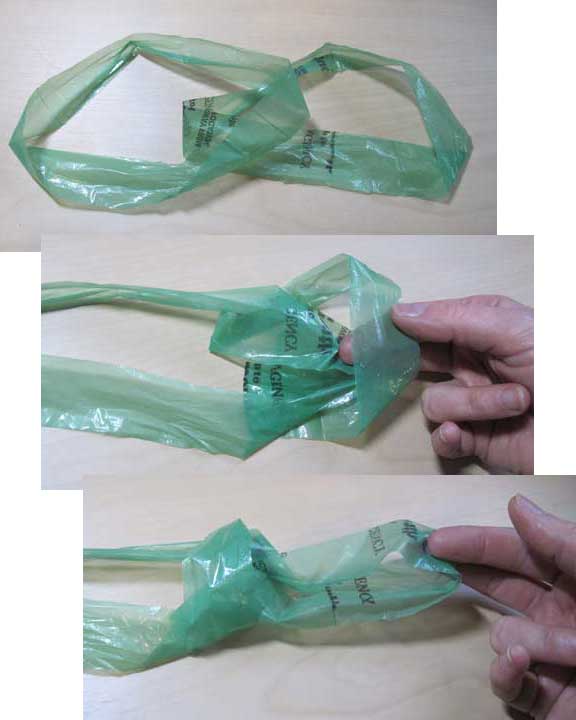
To cut the loops I first slit the sealed bottom of each bag.  Then I folded the bag in half, cut at the fold and repeated that until I had a bunch of one inch wide loops.

I then joined the loops together, by overlapping and pulling the bottom loop thru the top loop, then back under itself like so:

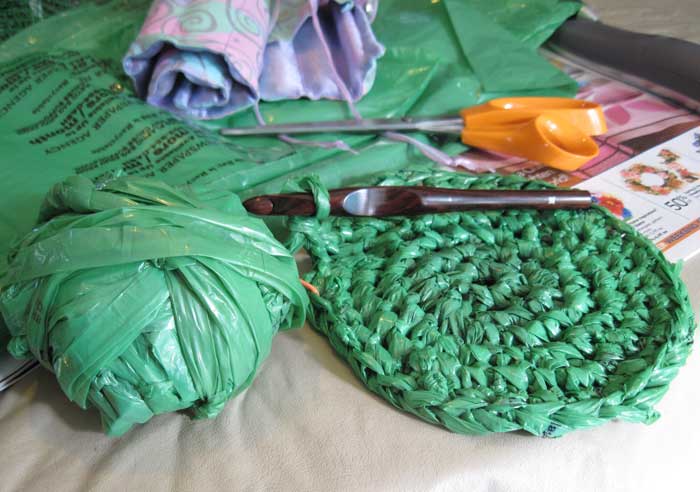
After awhile I had a decent sized ball of plarn and began crocheting a circle.

Beginning of Basket

The really fun thing about working on this project was that I could create more plarn as I needed by joining more loops onto the end of the working plarn.

Adding on more Plarn loops

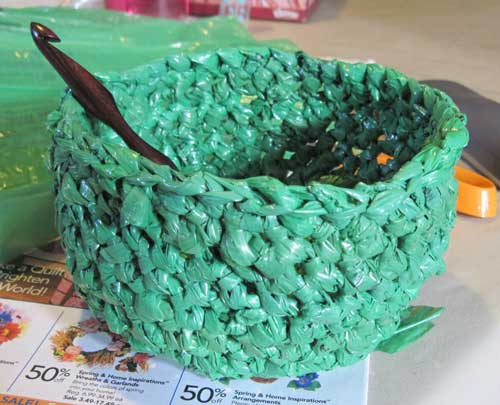
I did find working with the thickness I had a bit difficult and wouldn’t consider plarn to be very hand friendly.  A  wooden crochet hook seemed to be the best tool for the job.  My plastic and metal hooks both “stuck” too much to the plarn.

Finished Plarn part of Basket

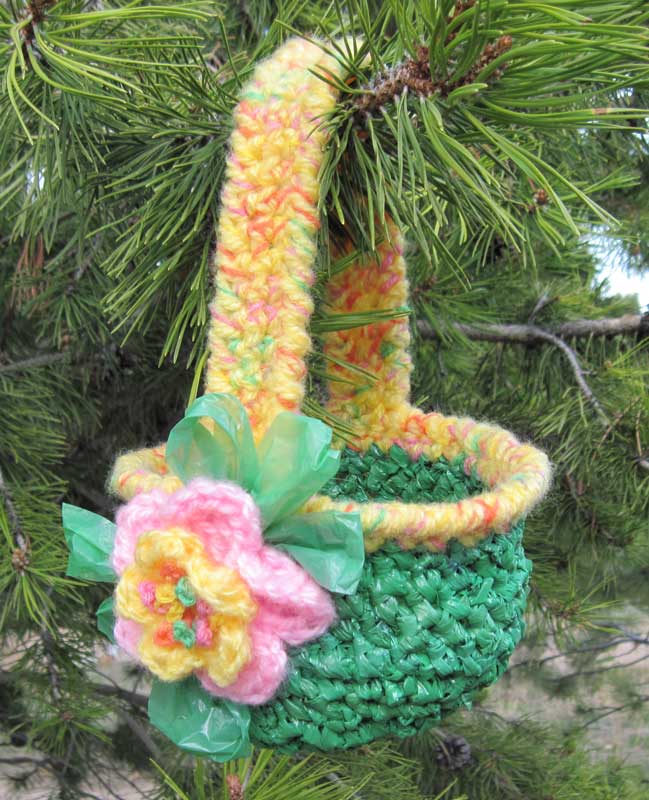
I had in mind an idea of making an easter basket using the plarn and adding some scraps of yarn from my stash.  I also added a flower.

Finished Basket

I learnt a number of things working on this project.  I didn’t like working over the knots where the loops joined. And, as the loops were short,  there was a knot to deal with frequently.  Next experiment I will try working with strips of plarn and possibly will cut them thinner too.  I’m too enthralled with the idea to give up quite yet.

The Importance of Compassion

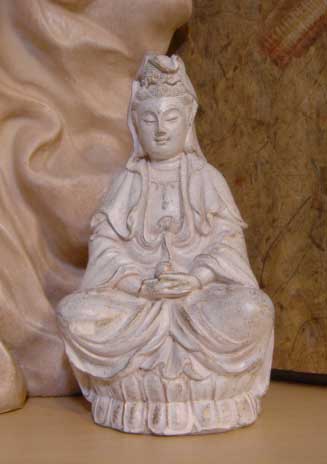
Small ivory and gold colored statue
Kuan Yin - Bodhisattva of Compassion

Often I have written about going to PJ Jam at the LambShoppe in Denver.  It is the 3rd Saturday of each month and a wonderous and fun evening surrounded by fellow fiber/yarn enthusiasts.  The enthusiasm is mirrored by the entire staff at the shop and their willingness to talk yarn and stitching.

One employee in particular is noteworthy to the experience for me.  This is the lovely Angie.  A young mother who, when I last saw her in January, was 4 months pregnant with her second child.

I missed PJ Jam in February as my family and I were ill with a stomach bug.  I didn’t want to share our germs with my friends, so stayed home.

When I attended PJ Jam in March I was distressed to learn that Angie was in hospital and quite critically ill.  It turns out that Angie has a rare disease called Moya Moya.  This was un-diagnosed before recent events lead to her being hospitalized and having emergency neurosurgery.

Angie has other surgeries ahead of her, as well as long stays in hospital and rehabilitative care on her road to recovery.  This whole process will likely be quite expensive for her and her family. So the staff of the LambShoppe have organized a Fundraiser to help raise money to defer the costs.

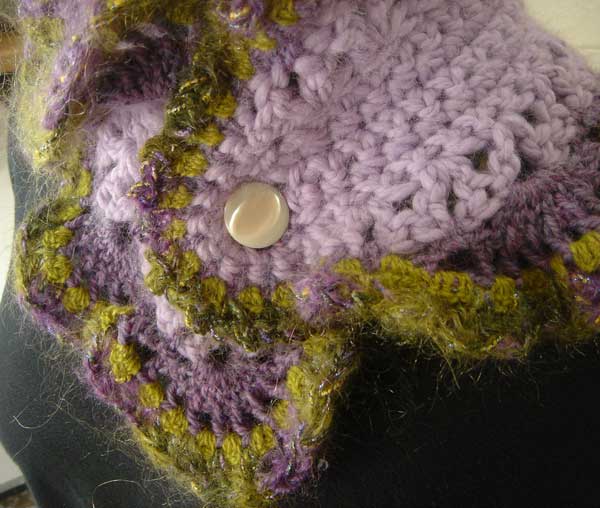
Some of the yarn I was showing off from my March trip is going to be used to create a FreeForm crocheted neck cozy for the Silent auction portion of the Fundraiser. 

If you are in the Denver area and would like to contribute to or attend the Fundraiser it is being held at Noon on April 18th at Pomegranate Place, 750 Clarkson St.  Ravelry members can read more here.

Maybe the hardest part for many of us is the absolute inexplicable nature of it all.  How completely horribly wrong it seems that something like this could happen to such a sweet person and one seemingly the picture of health.

“Unfair” “Heart-breaking” “Horrible” are all words I’ve heard used to describe this tragic turn of events.  And all these words are true.  But it is a reminder.   Life is often unfair, heart-breaking and horrible.  Our tenure on this plane of existence comes with no guarantees.

Which is why making the effort to live our lives with kindness and tolerance towards each other is so important.  The only fairness and justice that truly exist are the ones we create for each other. 

So, even if you are not at a place to do something to help Angie, please remember to live each day with compassion toward yourself and your fellow tenants in life.