Cold Little Fingers

Another week, another snow storm.  If your household is anything like mine many of the hats, mittens and gloves from the previous cold season have either been outgrown or have fallen into that black-hole that all laundry rooms seem to have.
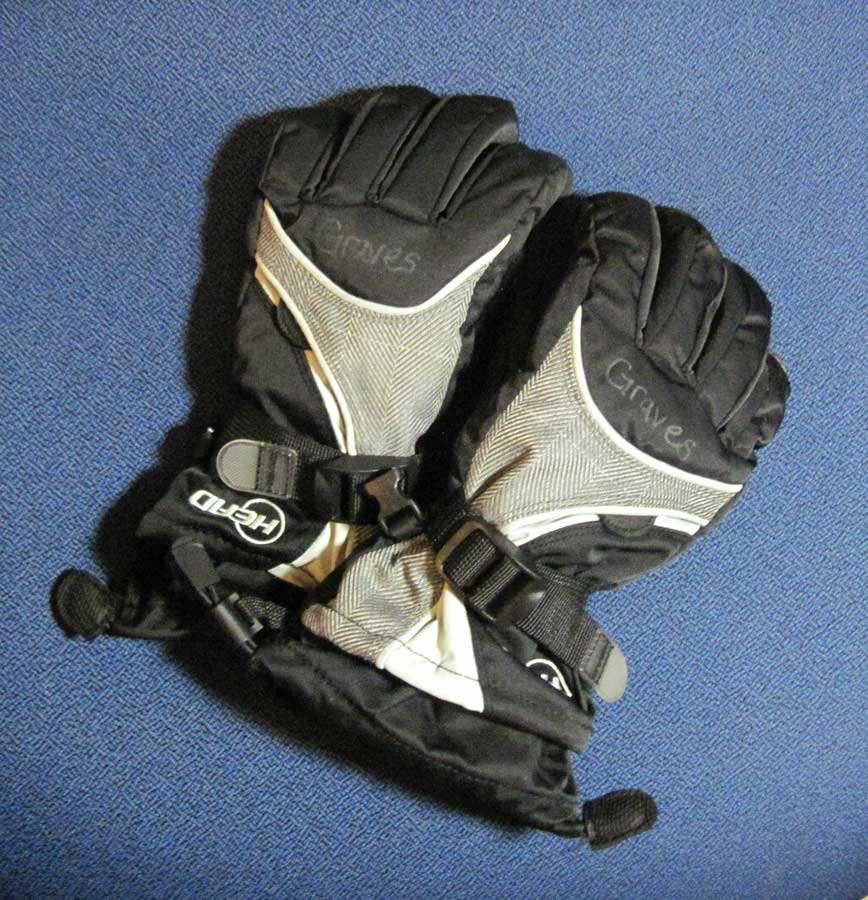
I had a mad search for warm hand gear for my boys after our most recent snow storm. I found some good ski-gloves that still fit my oldest, but all I could find for my youngest was a pair of polar fleece mittens.  He loves to play in the snow, but is not terribly fond of how cold his little fingers get when his mittens get wet. 

I decided that he needed some wool mittens, which stay warmer when wet than polar fleece. I knew I wanted the fabric to be felted to allow for a bit better water-proofing, but I didn’t want to crochet the mittens and then felt them.

I grabbed my box of left-over felt pieces from when I was playing around with felting thrift-shop sweaters.  I remembered I had a couple of felted sleeves that I thought would be ideal. What I really loved about these sleeves was the rolled detail at the end of the sleeves.

Of course for this sewing task I needed a pattern. I drew around my little guy’s hand, then sketched some shaping.  I wanted to utilize the fold in the side of the sleeve to minimize the length of the final seam, so I did some manipulating to create a straight edge along the side opposite the thumb.
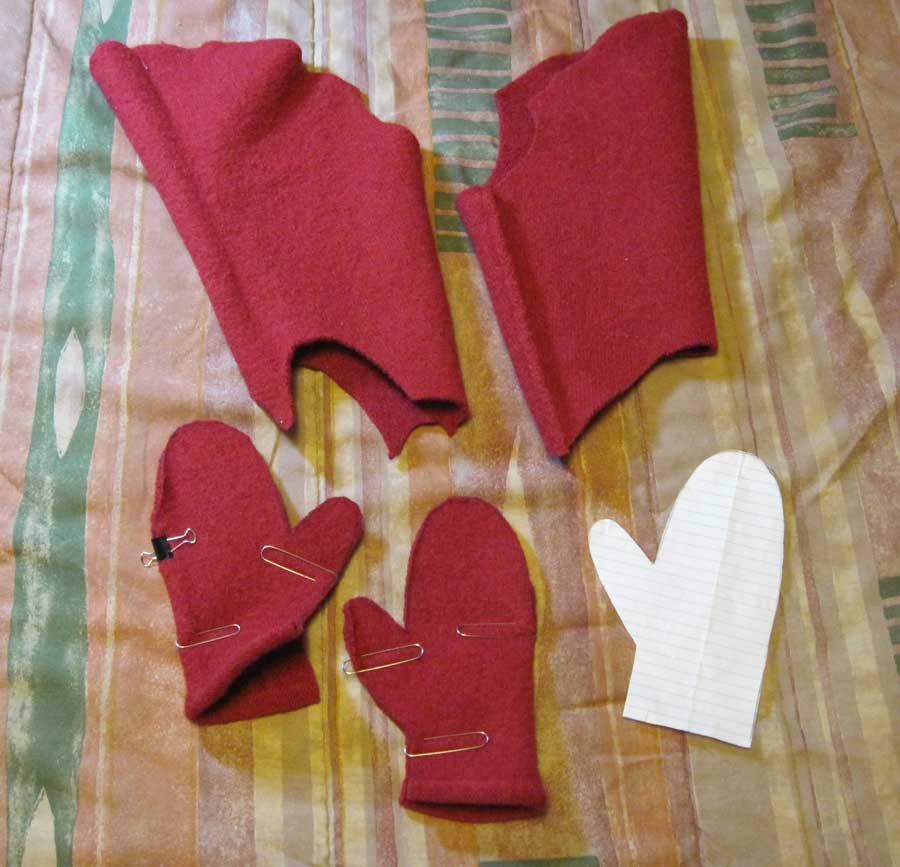
Then I turned the sleeves inside out and traced my pattern piece on the felt with a marker. Once that was done I cut out each mitten.

I used some sharp-pointed scissors to trim out a 1/4 inch of the cording in the cuff trim so the edges could be finished cleanly.

I dug out some matching thread and using a tight whip-stitch sewed an 1/8″ seam around the cut edges starting at the folded side of the mitten.  To be sure no gaps would develop along the seam, I overlapped my stitching whenever I had to re-thread my needle.

I used a simple mattress stitch to enclose the raw edges of the corded trim on the cuff to create a smooth join.
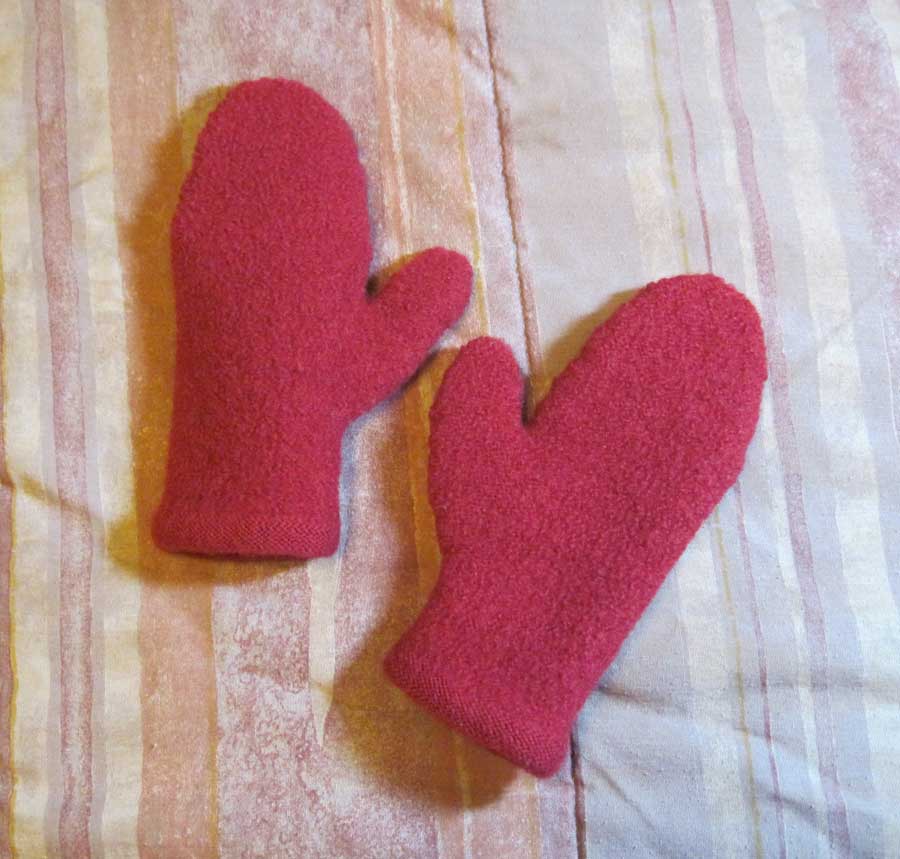
Voila’ a wonderful pair of mittens to keep some cold little fingers warm.

Pi Recipe

For you that know me well, you know that isn’t a spelling error. I’m really not one for cooking or baking, and no one wants a recipe for Pie from me.

But when it comes to recipes for crocheting creativity that are related to applied geometries, that is a whole nuther story.

Some of you may remember that old equation from your school days of  “Pi R square” (and the standing joke was, “No, Pie are Round”).  Pi is literally the secret to understanding circles, and the secret to making hats that fit perfectly.

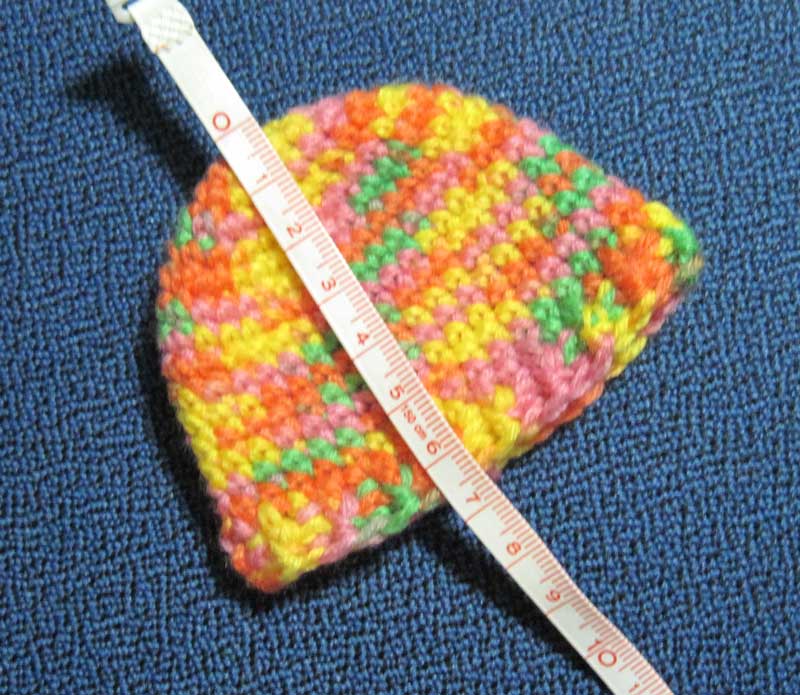
Baby Doll's New Hat

Pi = 3.14  in reality it is a much longer decimal than that.  But taking the number to 2 decimal points is more than sufficient for our purposes.  In fact, with a little adjustment to our calculations, taking away the decimals all together works too.

I love making hats as gifts and often they are my “go-to” project when I just need some instant gratification crochet. I don’t know that I have ever made a hat from the brim up. I much prefer the ease of working with top down construction.

My favorite thing about working top down is how simple the foundation is. Start with an adjustable slip knot, then chain a couple stitches, work the first round of stitches into the first chain…Voila! You are off and running. Crown down construction also allows for some really simple decorative stitch work for the brim.

There are lots of fabulous hat patterns out there, and you can make sure that your hat fits yourself or your giftee perfectly by using some simple math. 

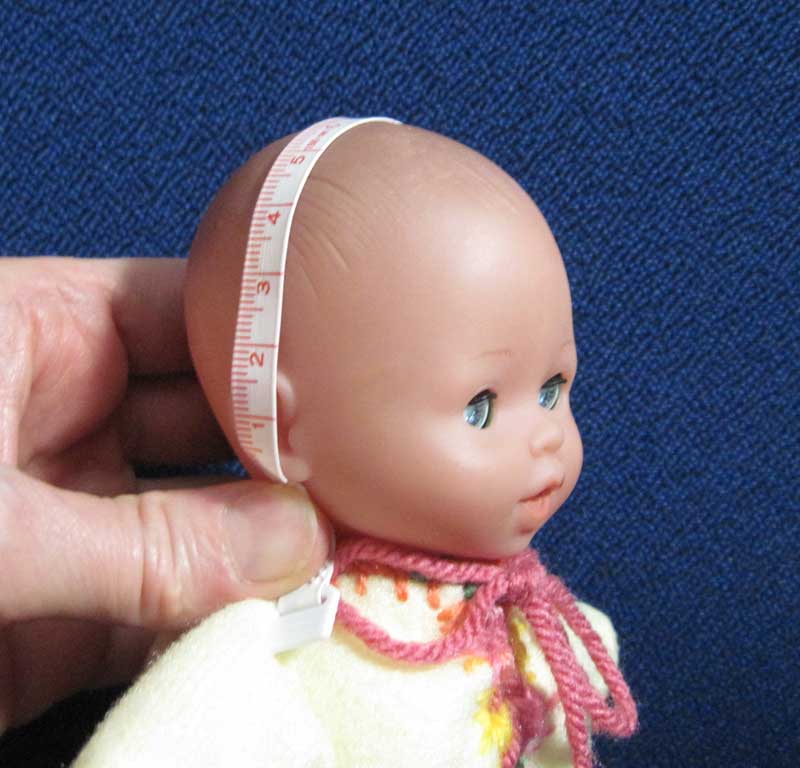
Baby Doll's Head Circumference Measurement

You are going to need a couple of measurements.  You need the circumference of their head, which means the distance around their head measured at eyebrow level. 

Baby Doll's Hat Depth Measurement

And you’ll need the “depth” measurement, which is referring to the length of the finished hat from middle of the crown to the edge of the brim.  Being I like my ears covered by my hat I measure to the bottom of the earlobe.

Target Diameter Measured

Baby Doll’s head circumference is 17.5 cm and her “depth” measurement is 6.5 cm.  So my calculation for figuring out how big to work my beginning circle is: 17.5 divided by 3.14 = 5.57 cm. Which I round down to 5.5 cm.

If you are making a gift hat and can’t measure the recipient’s head there are a couple of online sites that  have some helpful measurements for averages.  TotToppers, Wooly Wormhead,

Some other things to consider when personalizing a hat are preferences of the wearer: how snug they prefer their hats to be, if they want the hat to cover their ears, if they like extra coverage over their ears.

Typically you want a hat to be a bit smaller than the head circumference.  This is called “negative ease”.  Negative ease depends on the fabric of the finished hat (or garment) to have some stretch to it. The amount of stretch needed is dependant on how much negative ease is planned for.

Target Depth Measured

Once I achieve my target size for the diameter of my circle I will then continue working rounds without increases until I reach the depth (or length) that I want.  If I am just winging the depth, I’ll stop when I think I am nearing the length I want. Then flatten the hat so the center of the crown is halved I measure the length.

Now it’s your turn.  Using a hat pattern you love see if you can make a hat that fits you perfectly. Or try winging a hat using your favorite stitch in the round.

Plarn Experiment #1

Plarn Spring Basket

I had never heard of “Plarn” until I read Amy Swenson’s book “Not your Mama’s Crochet.”  In it was a pattern for a hand bag made with plarn.  I thought the idea was genius.

After all, the number of plastic bags that routinely take over my household pantry is ridiculous.  And this is in a household that uses our own market bags for much of our shopping.

Our newspaper is delivered in green plastic bags most of the time.  We reused them for various things, but I kept thinking that they are a great color for making Plarn.

I gathered a bunch together in my crocheting area, as I knew it takes quite a few to make a significant length of plarn.  Unfortunately, before I could do anything with them, my husband and father-in-law cleaned out the recyclables and tossed my collection.

So I started collecting again. This time I made sure that all my family understood these were being saved for a purpose.  I kept gathering them and placed them all safely in a container in my crafting room.  Then life got a bit busy…our second child arrived,  I found Ravelry, time kept marching forward.

A few months ago I joined the Laughing Purple Goldfish Group on Ravelry.  Sharon Maher , who is Laughing Purple Goldfish Designs, is a wonderful and inspiring voice for designing and encouraging the use of “up-cycled” materials in our fiberwork.  Each month she has been having challenges to get folks to look at non-traditional materials for crafting supplies.

The challenge for May was to create something using the “Ubiquitous Plastic Bag.”  The demo project used a technique for fusing plastic bags (which I plan to try out sometime too), but I decided to finally experiment with Plarn.  I went to my container of plastic bags and picked out a handful of bags to use.

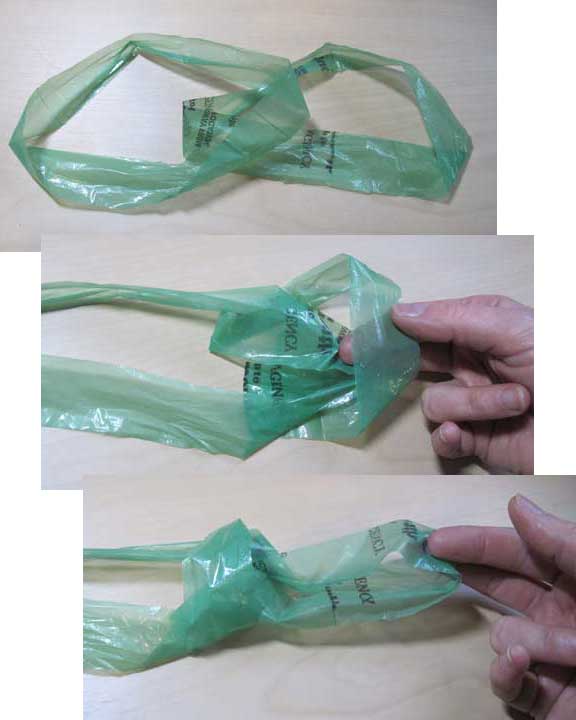
Cutting Plastic Bags for Plarn

To cut the loops I first slit the sealed bottom of each bag.  Then I folded the bag in half, cut at the fold and repeated that until I had a bunch of one inch wide loops.

I then joined the loops together, by overlapping and pulling the bottom loop thru the top loop, then back under itself like so:

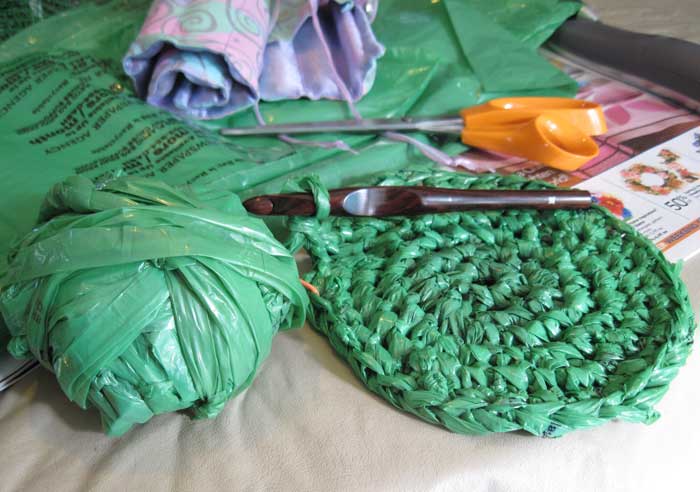
After awhile I had a decent sized ball of plarn and began crocheting a circle.

Beginning of Basket

The really fun thing about working on this project was that I could create more plarn as I needed by joining more loops onto the end of the working plarn.

Adding on more Plarn loops

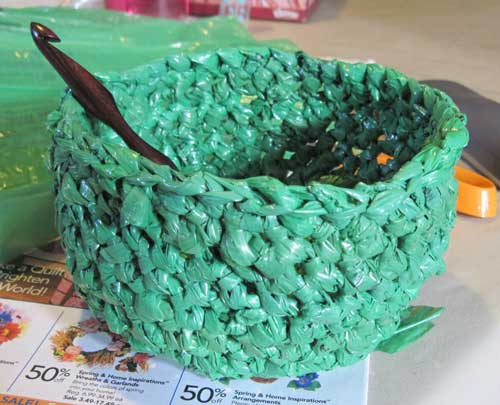
I did find working with the thickness I had a bit difficult and wouldn’t consider plarn to be very hand friendly.  A  wooden crochet hook seemed to be the best tool for the job.  My plastic and metal hooks both “stuck” too much to the plarn.

Finished Plarn part of Basket

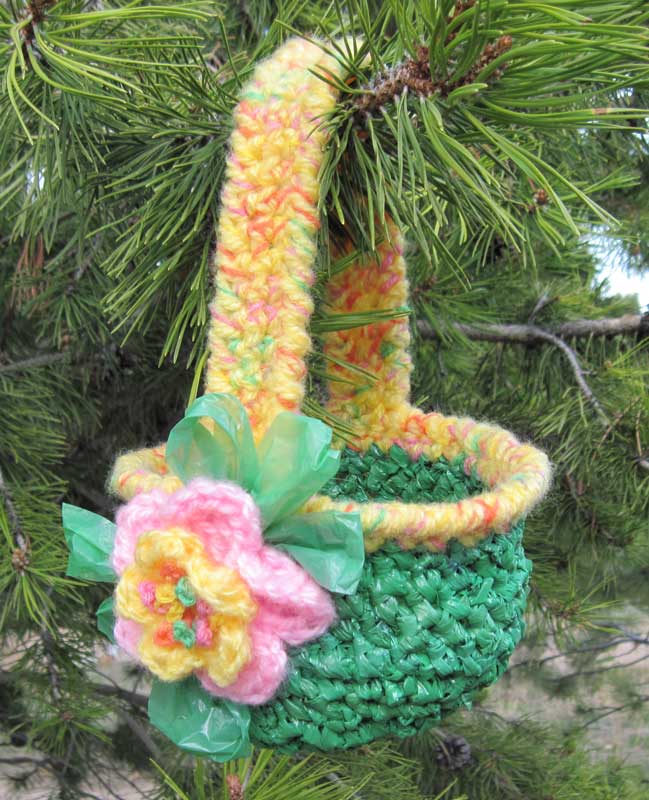
I had in mind an idea of making an easter basket using the plarn and adding some scraps of yarn from my stash.  I also added a flower.

Finished Basket

I learnt a number of things working on this project.  I didn’t like working over the knots where the loops joined. And, as the loops were short,  there was a knot to deal with frequently.  Next experiment I will try working with strips of plarn and possibly will cut them thinner too.  I’m too enthralled with the idea to give up quite yet.

Being Invisible

Do you ever get annoyed with that pesky bump that comes from joining the last round of a motif when you are crocheting? Even if you are the only one that sees it, you know it’s there.

I’ve always loved working in the round.  But I went thru all kinds of hoops trying to find a way to join the last stitch of a round to the first without it looking unsightly.  I wanted a join that would hold up to use and yet would not be too obvious.

In fact, what I was really searching for was something invisible.  I happily found some great solutions in Edie Eckman’s book “Beyond the Square; Crochet Motifs” and Suzann Thompson’s book “Crochet Bouquet.”  Like many of the tips you learn in crochet, it was so obvious once I’d learned it.

In Edie’s book she talks about Tidy Joins on page 17 and has lovely clear instructions and illustrations for a couple of different joins that are invisible.  This is also a fabulous book to learn many refining techniques for getting the most out of your crochet, as well as lots of clearly illustrated and charted designs for more motifs than you can imagine.

Later on I acquired Suzann’s book.  On page 14 she shows step-by-step the instructions for doing a Needle Join that has become my favorite join to use, particularly on hats as it is nearly impossible to spot.  This is also a book that will have you itching to make all kinds of crocheted flowers to embellish anything and everything.  My only complaint with this book is it does not have any stitch charts, all the patterns are only text.

If you are looking for an invisible join for ending your crochet work, take a look at either of these books.  Both are great additions to your crochet library.

Getting Stuffy

I love little crocheted toys,  popularly referred to as “amigurumis.”  I have 2 small children in my household and there are numerous neices, nephews and little friends that need toys too.  But, I hate, hate, hate, to crochet super tightly like lots of amigurumis require.

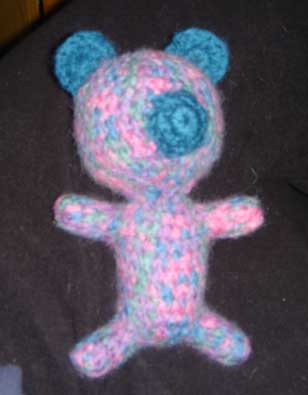
Finished Bitty Bear

My first solution to this problem was to crochet my amis in feltable yarns.  I use a bigger hook than is usually stated in the pattern, stuff the little bits and sew it all together.  Then give the toy a really hot bath in the kitchen sink.

The little bear pictured above was my first experiment with this.  I thought it would work best if I also stuffed him with wool roving.  Unfortunately, the roving felted more than the bear did!  I ended up taking some stitches thru his neck to snug things up.  His pretty pink bow hid the plastic surgery very nicely though.

Bitty Bear with some Cosmetic Surgery

The lesson I learned from this was to pre-felt the roving I was going to use for stuffing.  My next attempt was a baby turtle for my oldest.  This time I partly felted the roving and stuffed the turtle very full.  The turtle came out almost too firm, though quite cute.

Little Green Baby Turtle

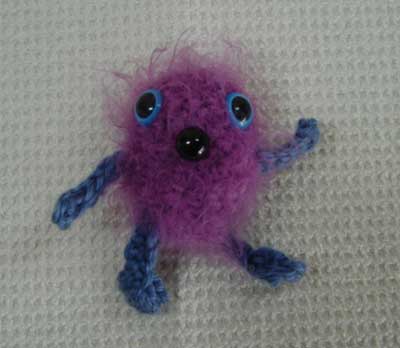
I have made a number of balls that are felted too.  Experimentation has taught me that using a fiber fill stuffing at the center with layers of roving around it works best.  My other trick for amis is to use fun fur or a fluffy yarn so I don’t need to stitch as tight, yet the fiber fill won’t work it’s way out.   Some examples are my Pocket Monsters.

Pocket Monster
Purple Pocket Monster

So if you’ve avoided trying to make amigurumis because the tight stitching hurts your hands some of these approaches might help you.  Just be sure you have enough yarn for all the “kids” in your life.  Everyone will want one. ;o)

How To Make a Travel Niddy Noddy

When I first stumbled across Ravelry, I ran into a lot of terms and tools that I had never heard of before.   I was especially intrigued by two spinner’s tools- Nostepinnes and Niddy Noddy’s.  Not only are they  great tools for winding and measuring yarn, I was pretty sure that I could easily make my own versions to use for my crafting.       

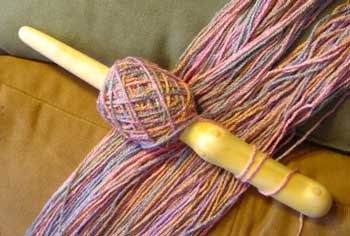
Nostepinne with partially wound Ball

 A Nostepinne is used to wind a center pull ball or cake by hand.  Using the Nostepinne is a wonderfully contemplative way to rewind small bits of yarn or to make balls from delicate yarns that can be damaged by the more mechanical winding methods.     

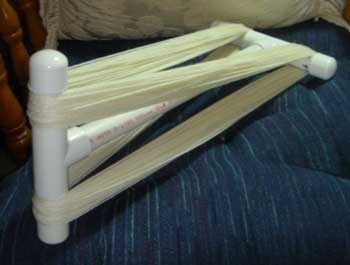
PVC Niddy Noddy with yarn wound on it.
PVC Niddy Noddy with Yarn

A Niddy Noddy is often used by spinners and hand dyers to “skein” the yarn.  Depending on the size of your Niddy Noddy you can also use it to get a  measurement of the yardage you have.  I use my one-yard Niddy Noddy to measure out small hanks of color for free form crochet projects, or for trading with other freeformers.  I have used my two-yard one for dying yarn.  The best bit is the 2 yard skeins/hanks fit nicely on my swift for winding later.  Whether with the ball winder or the nostepinne.       

When I checked with fellow crafters on Ravelry I was pointed toward  PVC piping from the local DIY store as an inexpensive way to make a niddy noddy.  So I first made one out of that.  But I found it a bit bulky and heavy.  Using it got to my wrist after a time.      

I went in search of a lighter version.  I then discovered there was a variety of PVC piping that was thinner in diameter and much lighter weight called CPVC HiTemp.   I purchased a 3 foot length and some connectors and headed home to my studio to create a Travel Niddy Noddy. 

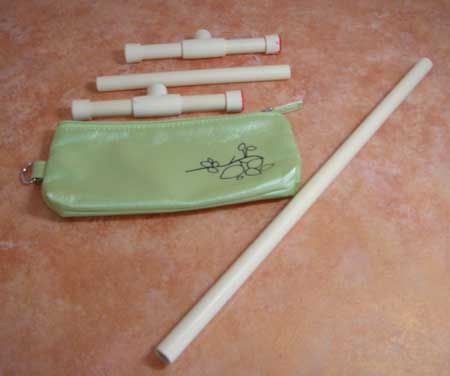
Travel Niddy Noddy in pieces with Storage Bag

It is a travel one since I can easily take it apart and bring it with me in a storage bag.  This works with the one-yard Niddy Noddy, but the center bar for the two-yard version is too long for my current storage bag.  The following are my steps for making it. 

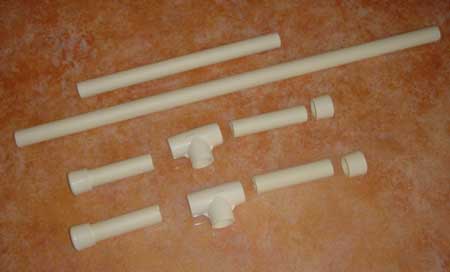
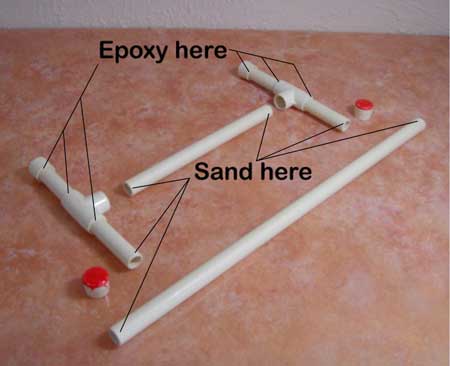
Step One: Gather all the tools and supplies you’ll need.  In my case this was a 3 foot length of CPVC Hi Temp pipe, 2 T-connectors, 4 end caps, a marking pen, wet/dry sandpaper and a hacksaw.  Not pictured but very necessary is a tape measure or ruler.      

My Supplies and Tools

Step Two:   Mark your length of pipe for cuts to make four – 2 3/4 inch bits for the “arms” of your niddy noddy. You can make the arms longer if you wish,  these are the spots where your yarn wraps round,  for thicker hanks it helps but it also makes it a little harder to remove the hanks. You also will need to cut 2 lengths for the cross bar. Mine were 8 and 17 inches.     

The cut pieces before Assembly

Step Three:   Sand all the ends of the cut pieces, especially the cross bars and the end of the 2 arms that will have a removable cap. You want the T-connector and the end caps to be snug but not so much you can’t remove them.  I then used epoxy to attach the arms to the T-connector.  I also marked the 2 end caps that would be removable.     

Assembly layout

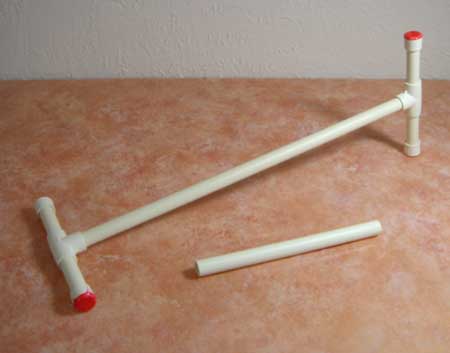
Step Four:  Now you can put the pieces together to use to skein or measure your yarn.  Twist one T-bar to make the arms at a 90 degree angle to the other T-bar.  Your niddy noddy is ready for use.  Once you’ve finished skeining or measuring your yarn removing the end cap will make it easier to remove the yarn. 

Assembled 1 yard version

Or using the longer cross bar gives you a 2 yard version of the niddy noddy.      

Assembled 2 yard Niddy Noddy

Now I don’t know how I ever lived without them. Well those and my Swift and Ball-winder. I purchased the later two, but the former two seemed relatively easy to make on my own so I asked some questions, looked at some photographs and decided to take a run at it.  I hope you enjoy your own Niddy Noddy, despite the odd name it is a very useful tool for any fiber artist.

Chainless Fears

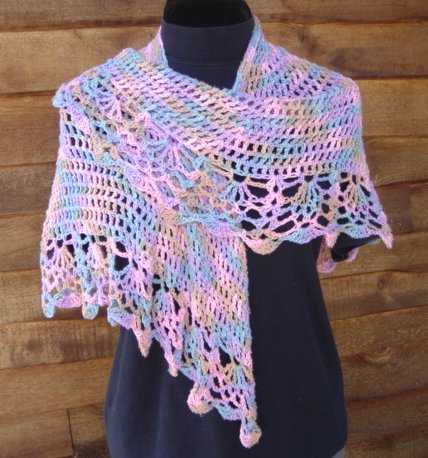
Crocheted All Shawl worked in Rayon multi-colored yarn
My First All Shawl

My favorite foundation to use in my designs is the Foundation Single Crochet (FSC).  And it’s all Doris Chan’s fault–since I first discovered this technique in her books “Amazing Crochet Lace” and “Everyday Crochet.”

I had a deuce of a time getting the hang of the FSC,  as I had never worked a foundation the way Doris described. But I persisted because I REALLY wanted to make some of Doris’s gorgeous garments.

Doris’s All-Shawl pattern was to be my “ah ha!” moment.  I figured I could manage  the eight foundation single crochet stitches necessary to make my own All-Shawl.  Although I have to admit I first tried working SC into the back bump of the chains as a substitute– it didn’t work.

The real beauty of starting your projects with the foundation single crochet is that it produces a wonderfully elastic edge.  In contrast, a chained foundation gives you a rigid and constricted edge. While that might work for some projects, an elastic foundation is critical for garments like a skirt or gloves, which need to be able to stretch over various body parts.

I’ll be the first to admit that the FSC  is not the easiest technique to learn.  But  once you figure it out it is FanTasTic!

If you learn techniques better by viewing a video this is a good one to check out.  Or this one is helpful as well. 

If written instructions are best for you, Doris’s books have wonderful illustrations and instructions in them, or the glossary pages in the back of the “Interweave Crochet” magazine has both the FSC and FDC instructions and illustrations.

If you are on Ravelry.com visit the Everyday Crochet Group where this thread has awesome advice from Doris Chan herself as well as helpful suggestions from other folks on how they have gotten the hang of the FSC.