Inline vs Tapered

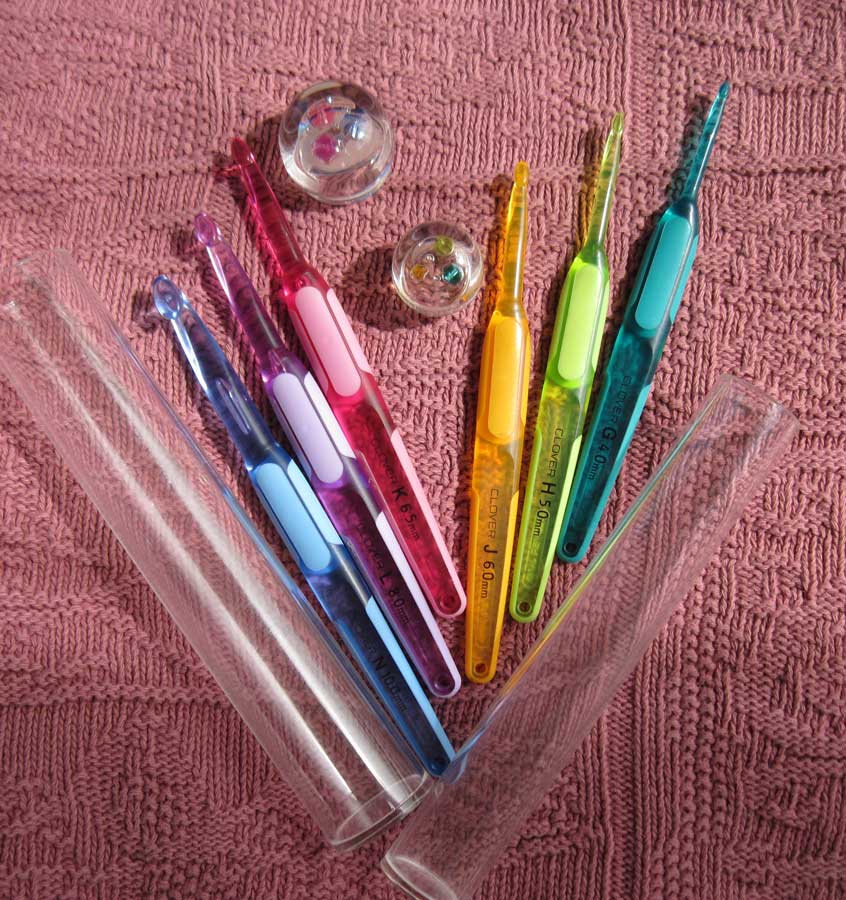
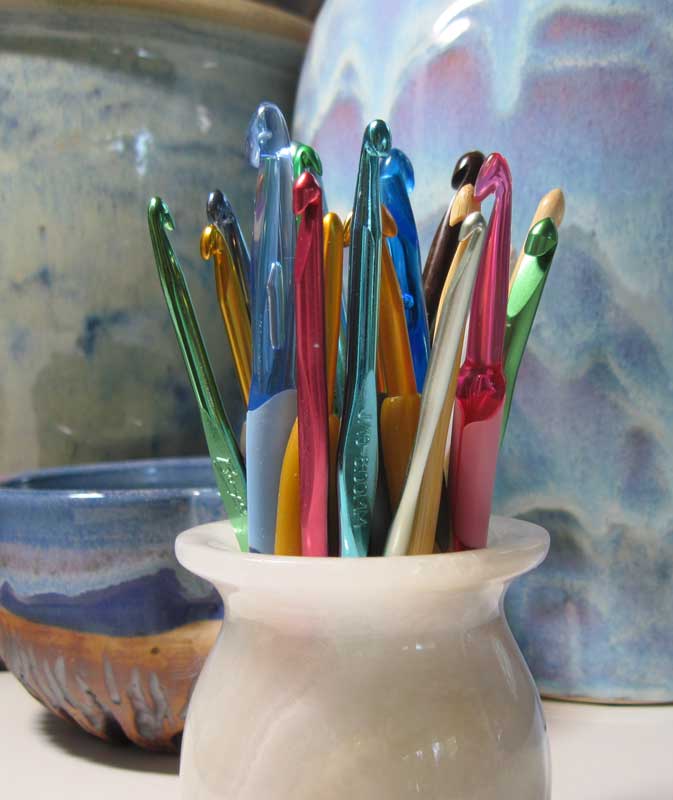
This little vase full of hooks is only a small representation of the hooks I own. There are times when my friend Janet and I laugh about which of us has the worst case of H.A.S. (hook acquisition syndrome for those of the uninitiated amongst my readers).  I show you this bouquet to demonstrate that I love all types of hooks.

If you are an American crocheter or even if you spend much time on the Crochet boards at Ravelry (or possibly any other crochet sites), you have likely heard numerous debates of the merits of Boye versus Susan Bates hooks.

Much of that discussion is about the shape of the throat. Tapered or In-line. All hooks fall into one of these categories for the most part.  Boye is a very good example of Tapered shaping and Susan Bates hooks are a very good example of In-line shaping. (There are changes in the shaping of Boye and Bates hooks depending on the year and where they were made, but that is a subject for another post at a later date).
Tapered hooks throats are generally shaped with a strong narrowing from the “shaft” of the hook  to the head.

In these images you can see a continuum of hook throat shaping. Starting on the left with the very tapered Boye hook and ending on the right with the strictly in line shape of the Susan Bates hook. The wooden hook is a Laurel Hill hook, they are a bit unusual in that the throat is mostly in-line but the overall shaping is tapered starting from the thumb rest thru the point.

When I teach beginning crochet I prefer that students use an in-line style hook.  Beginning students tend to have a very tight tension on their yarn and more commonly they have a harder time with that using a tapered hook. A tapered hook allows the yarn loop to become smaller as it is pulled up the throat of the hook, making stitches harder to work into in subsequent rows, these 2 things combined don’t trend toward a positive first crocheting experience. 

With an inline hook  most beginners can keep their loops a consistent size, making it easier to work into their stitches. Though the beginner death grip can still get tight tension even with an in-line hook.

If you are past the beginner stage of your crocheting though it’s time to branch out. Whatever style of hook you started with, try the opposite. Especially if you are having particular difficulty with a yarn. Oftentimes switching the style of hook or size of hook can help.  As many of us know, not all yarns are right for all projects. The next thing to keep in mind is that not all hooks are right for all yarns.

And the hook I find ideal for a certain yarn and project, might not be the right one for you.  We all tend to use our tools with slight differences. One of the reasons that our handwriting can look quite different.  Same is true of crochet hooks.  An example, I adore the Tulip Etimo hooks, but some crocheting friends of mine find them not their cup of tea at all.

The best way to find out which hooks will work for you is to take the time to play with some yarn and a variety of hooks.  Afterall, playing with yarn is a pleasure we can all agree on, whether we think we prefer In-line or Tapered hooks.
Seriously Pink

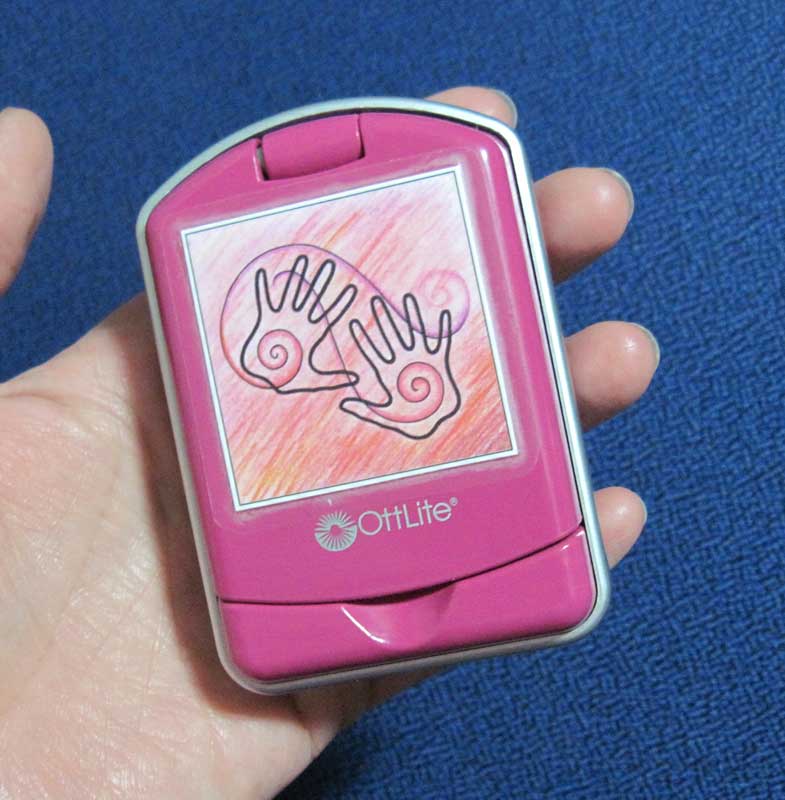
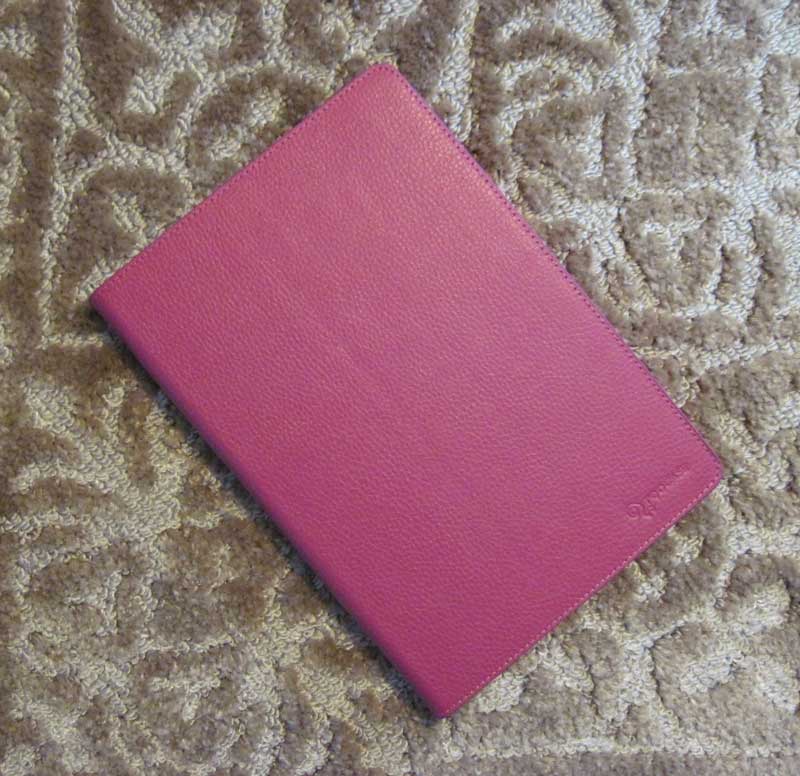
Hot pink is sort of becoming my signature color. It all started with my Two Hands logo and has built from there. Whenever I am looking for items for my crocheting or other business needs I seem to find hot pink colored items catching my eye.

Such as the extremely portable Ott-lite that I keep in my project bag.

Or the protective cover for my Android Tablet.

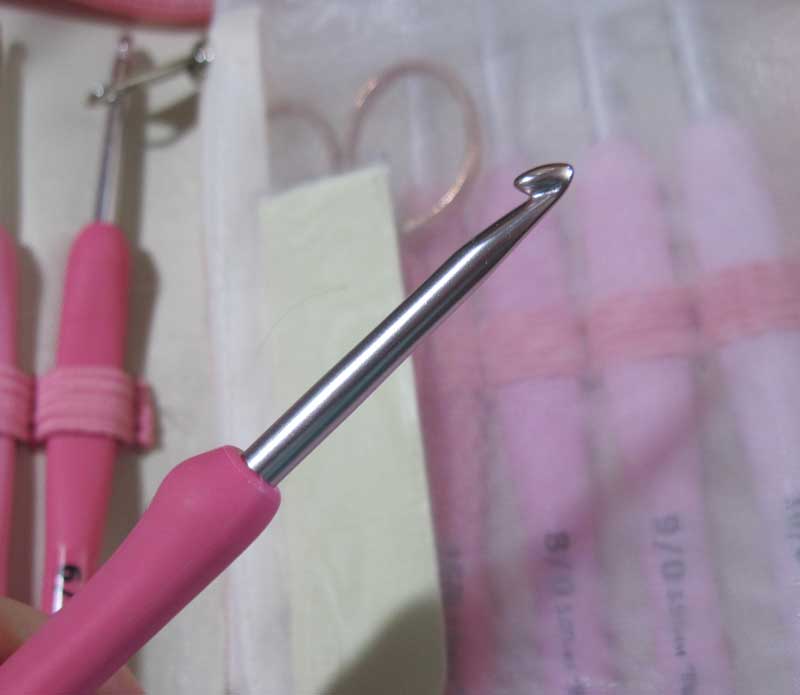
Best latest Pink acquisition is my new set of Etimo hooks from the Tulip Company. I purchased these beauties at the Market during the Manchester Chain Link. In fact almost all of my shopping took place at their booth. Though these were the only Pink purchase.

I knew I had to have them as soon as I saw them in the booth. Not only is the case nice and sturdy, but each of the hook handles is a different shade of pink. I’m not as thrilled with the pale pink ones…but they are a huge improvement over the dark gray handles of the original Etimo hooks. The hook sizes are in Japanese sizes, which makes no never mind to me as I go by the millimeter measurements anyway. 

And the metal of the hooks is a lovely pinkish silver color too.

So do you have an irresistible color, that makes you think you must have that ball of yarn or new tool? Look around your belongings and stash, you might get a smile realizing that certain colors seem to creep in when you are not thinking about it.

Isosceles Scarf

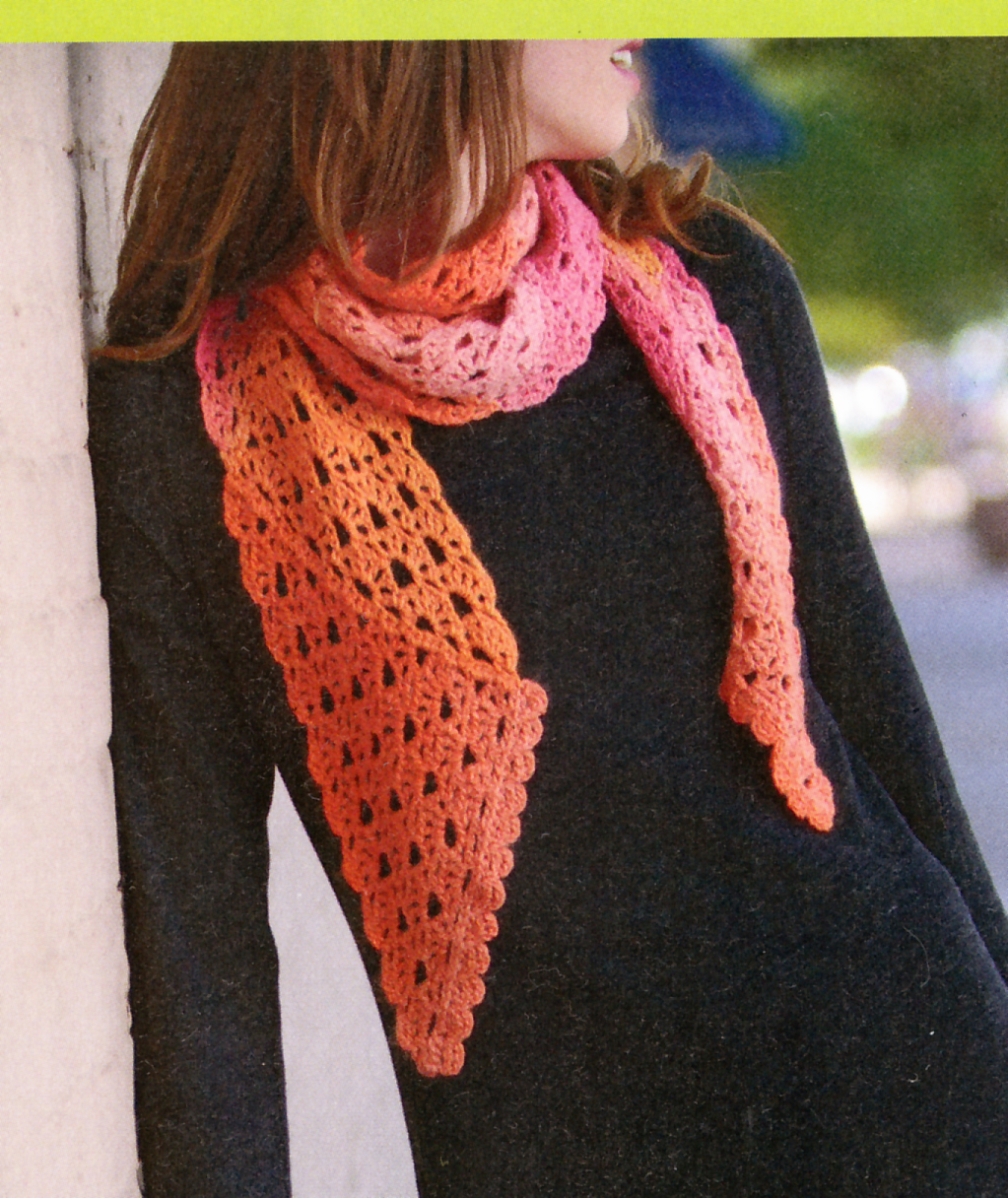
I just recently learned that this pattern is available as a digital version from Interweave. You can find it on their website in the E-patterns, along with lots of other wonderful patterns. Most exciting to me is that the pattern includes symbol charts as well as written instructions, so those of us that are more visual learners will find the instructions easy to follow.

Photo courtesy of Interweave Press

So if you missed your opportunity to purchase the “Crochet Accessories” issue that it was included in, or that issue didn’t interest you, here is your opportunity to acquire it.

This is a really fun pattern to stitch up, each triangle works up quickly and the next triangle is worked off the previous one. A bit like working in motifs, but minus the headache of sewing them all together later.  You can use a solid color yarn, but I designed this with long gradual color changing yarns in mind.

The lace pattern lends itself nicely to adding buttons, as any of the openings can become button holes. So working fewer triangles can be a great way to make a quick neck cozy for gift giving.

A different Yarnie Craft

Yesterday was was an indoor rainy day and was all about my children. Especially Thing 1 (Dr. Seuss reference for those of you thinking I’m a wicked mom to call my children Things).

My children see me playing/working with yarn All The Time. Yarn pervades the entire household.  So there really is no way to avoid it.  They both have expressed desires to learn to crochet, but it is slow going at times.  So what is a Mom to do to share the yarn crafting love with them?

Why, teach them to weave of course. Particularly Thing 1, as Thing 2 is sticking with the crochet hook for the nonce.

Actually it’s sort of funny me teaching my children to weave, since my knowledge base isn’t a whole lot larger than their own. I’m just blessed with a nimble mind and a small bit of experience from over 30 years ago.

The basics to make our loom

The wonderful thing about weaving is it is so accessible, even for the utter novice.  So I grabbed my trusty utility knife and an empty cardboard box from the recycling pile and declared it was going to provide the bits for a loom and accessories.

Without any real measuring I cut out a flat piece to use for the loom and made small slits along the top and bottom to hold the warp of the loom. Quickly warped it with some acrylic yarn. Then I dug out some oversized knitting needles to act as sheds.

Shuttles, with one needing notching

My son and I began to play with weaving a bit of yarn in, but it soon became apparent that we needed some more tools. Like sturdier shuttles for the weft yarn and a shed and sword. So more cutting on the box and I had made shuttles, shed and sword. I also grabbed a comb for him to use as the “beater”.

Then my son went to town weaving happily. He decided this is really a hobby he wants to learn more about.  After he went to bed I did a little research about basic weaving on the internet and learned how to make a simple heddle to use to speed up the weaving process.

Today he and I are going to Boulder to visit “Shuttles, Spindles and Skeins”. This is a LYS that I have visited many times to purchase yarn for crocheting and animal fiber for felt work. As their name indicates, they also have wonderful supplies for weaving. So it will be a great opportunity to look at the various looms available and learn more about weaving from folks that know a lot about the craft.

Since Thing 2 is also expressing an interest in learning more about weaving I’m thinking we will be bringing a potholder loop loom home as well. They aren’t expensive and they are a super fun quick way to learn about weaving that both boys can enjoy.

Best part of this experience is it’s been a wonderful reminder of how much fun it is to do arts and crafts with my kids.  Even if it is just paper-crafts, find some time to craft with your kids, they have a great time learning something new and you may surprise yourself with the new things you learn about them.

When Hairy met Lily

First off, credit where credit is due, the lovely Shari White came up with that title.

If you have never met Lily Chin you haven’t really lived.  She is an amazing teacher who knows crochet, knitting and design backwards as well as forwards.

Her classes are not for the faint of heart, she covers a lot of material and your brain will be firing with loads of ideas…whether you are a designer or just love to crochet. But if you want to learn the ins and outs of crochet (or knitting) take a class with her.

If she isn’t teaching a class in your area, find her books. Her “Couture Crochet Workshop” is one of my very favorites, both informative and inspiring. And her Crochet “Tips and Tricks” book is full of information that even experienced crocheters can benefit from.

The other thing Lily can be is a complete riot.  At Chain Link in Manchester this year she was toting around the most outrageous bag I had ever seen.  So I said I had to get a photo of it. In response she gave me the pose in this photo. We were all laughing so hard that it is a miracle that I got a shot that wasn’t blurry.

Lily’s bag is named Hairy, it has a middle name too…but I’m too bashful to repeat it here for all my innocent readers.  If you figure it out on your own you are clearly not as innocent as you’ve been leading me to believe.

Tomorrow I will share with you some pictures of my loot from the marketplace. I was pretty darn busy with the Design Competition stuff, so that slowed down my shopping. Of course I still managed to do some damage to my budget anyway.

What’s in a Hook?

I’m reminded of Juliet’s soliloquy about a name. So what is in a hook, they are all the same right? Maybe not.

I’ve written articles about handle shapes and how they affect your grip.  But did you know that the shape and smoothness of the “business” end of your hook can also have an impact on the health of you hands, wrists and even neck?

Matching the hook you are using to the project and type of yarn can make a big difference in your comfort level. If your hook doesn’t work well with your yarn the adjustments you have to make while crocheting can add up to long-term pain.

There are a number of hook styles and shapes available commericially.  Here in the US hook shape debate seems to be between the “Boye” tapered style and “Bates” inline style hooks.  Now, no offense to either manufacturer, but there is far more to hooks than that.

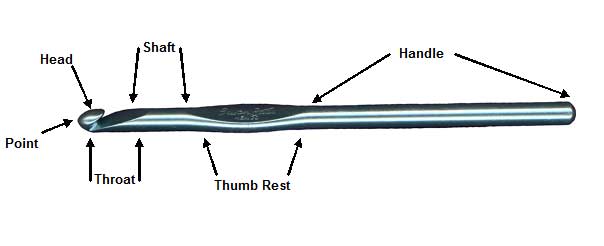
First let’s look at the anatomy of a hook. The “business” end is the Point, Head, Throat and Shaft.

The shape of the point is key when you are looking at how easily the hook slips into a stitch. This is particullarly important if you are doing stitch work that requires a dense fabric…like amigurumis.

Another important thing to consider is the sharpness of the edge of the head in front of the throat.  When there is a sharp edge or sharp point there it can get caught on splitty yarns.

In fact, having the right hook for your project and yarn can change your mind about what types of projects and yarn you like to work with.  I used to think I didn’t like working tight stitched projects like amigurumi. Then I discovered that using the Clover Soft Touch hooks made them much easier. I now design projects like these regularly.

The Clover Soft Touch hook has a fairly tapered point that is slightly rounded.  They are also very smooth with an almost “teflon” finish that slip into snug stitches without splitting your yarn.  Unfortunately, being the visual person I am, I have never been thrilled with the color of the handles. I recently saw that Clover has come out with a new line of hooks called “Amour”. Colorful Elastomer handles with an interesting shape. Hopefully I will get my hands on some soon, and can post a product review.

Clover does have their Reflections sets too, which I think are beautiful.  These are acrylic with an elastomer inset on the thumbgrip and handle. Over the years that I have had these sets the elastomer has begun to peel and occassionally the edges between elastomer and acrylic can wear on my hands as I work.  I do wish they had these hooks in a wider range of sizes.

They have a similar shaped hook point to the Soft Touches, but the material that the hook is made of  isn’t always the best match with acrylic yarns.  Definitely not a good match for a project that requires tight stitch work.

Next hook post I’ll write about In-line versus Tapered.  This is really the debate for many American crocheters between the Boye and Bates hooks.

Reality Check

Recently I had to have some photos taken of me in Yoga clothes. Looking thru those photos was definitely a reality check.

Fact is…I’ll be celebrating my 49th birthday this year.  Most of the time I can conveniently forget that. Afterall, I don’t feel like I’m in my late forties, in many ways I feel like I’m still a 20-something with my life ahead of me.  I can mentally select what I notice in the mirror, but photos seem to make everything visible, even the aspects of my physical self that I would like to ignore.

Of course photos aren’t the only way I’m getting a reality check.  This past year more of my work involves sitting for hours in front of the computer or sitting crocheting.  Either way I’m leading a much more sedentary life than I was 2 years ago, and I am noticing the difference.  I have more aches and pains, I’m gaining weight and I’m losing muscle mass.

So that makes me wonder, is this just what happens as we age? Should I just accept that the rest of my life I’ll be living with these issues? Was my Mom right, and every thing after 50 is just “patch, patch, patch”? For those who know me well, you already know my answer.

I’m fighting back.  I’ve already been making efforts to become more active in my life, interspersing physical activity through-out my day.  I now  have a tread-mill that I walk on for at least 20 minutes each morning.  With our family adding a dog to the mix I get out and play ball with her and take her for walks as well.

I have plans for more physical activity as well, especially with summer finally arriving…hiking and swimming with my kids and yard work.

But exercise, though important, it isn’t the only change I’m making. My Chiropractor told me about a book called “The Paleo Diet” by Loren Cordain, Ph.D. that I am currently reading.  It is very interesting, discussing how our physiology isn’t really in sync with the modern diet.  The argument is we are basicially Stone-age beings living in the Space Age.

The Paleo diet consists of eating like our Stone-age ancestors; lean meats, fruits and non-starchy vegetables.  I’m very impressed by the information Dr. Cordain presents in his book. I have already discovered that I do better health-wise by eliminating wheat and gluten from my diet.

I’m a little leary about the amount of lean meat the diet recommends, but I know I’ll be happy with eating all the veggies and fruit I want.  The hardest part will be eliminating the sugars and salts I love.  His recommendations for the diet do include an occassional “cheater” meal, but I don’t know how easily I can adapt.

So I  have decided to conduct an experiment on myself.  I will be incorporating the Paleo diet into my eating life-style. Hopefully even convincing my husband and children to join me.  And I’ll be blogging about my progress as I go along.

My Crochet Companion

I am insanely crocheting away on a super secret project which involves 10 designs, and 2 of them have to be shipped today. It is past midnight so counts as today already.

My companion in this madness is my wonderful new 4-legged kid, Kenna. She loves to curl up on her cushy round bed beside my work area in the living room.  I have discovered this past week that she can snore like a real champ.

She is also very good at making me take regular breaks, since she wants to go outside for exercise and such.  I may end up with a rotator cuff injury throwing the ball for her to chase.

A Very Sharp Edge

As much as I love to crochet I have another craft I love that compliments crochet nicely. I sew. 

Lately most of my sewing has been about making project bags for my crochet endeavors, or linings for crochet projects.  Sewing isn’t as portable as crochet, and that is the reason I spend less time sewing lately.  My life is full of “on-the-go” situations and crochet can accompany me everywhere.

When I do sew, the biggest part of the task isn’t really the sewing…it’s the cutting out the fabric in the shapes to be sewn.  I am fortunate that I have a big table that is tall enough that I can cut at it without hurting my back.  Best of all it has a cutting mat on it so I can use my rotary cutter.

Rotary cutters are a necessity if you are doing more than cutting a single short line. Scissors are certainly an efficient means of cutting fabric, but they begin to take a toll on your hands after a while. It is also more difficult to get a clean cut with scissors, since you need to have the blades on either side of the fabric.

With a Rotary cutter, the blade slices thru from top to bottom with minimal disturbance of your fabric. Of course the sharper the cutter the easier it is to cut your fabric.

Which leads me to my least favorite part about rotary cutters. Their blades are very sharp and it is easy to cut yourself with them without even realizing it.  I have learnt the hard way not to use my rotary cutter when I am tired or distracted.

One safety feature I like about my Fiskar Rotary cutter is that the blade is retractable. This is nice from the standpoint of avoiding cutting myself, but it also helps keep the blades sharp longer as it isn’t bumping against other implements in my work basket.

I’ve had my rotary cutter for quite a while, so if you are looking to purchase your own rotary cutter there may be some better ones available now.  Either way, a nice sharp rotary cutter and mat can help keep your hands happy during your next big fabric cutting project.  Just remember to be careful of that very sharp edge.