It’s been a crazy busy week as I finished up design projects to ship to an editor. So tonight, after getting the projects blocking, I decided I deserved a little “play” crochet time.
I’ve been wanting to experiment with the “love-knot” from Vashti’s class I took in Manchester this past summer. She had talked about how fun love knots are to work with beads for simple jewelry.
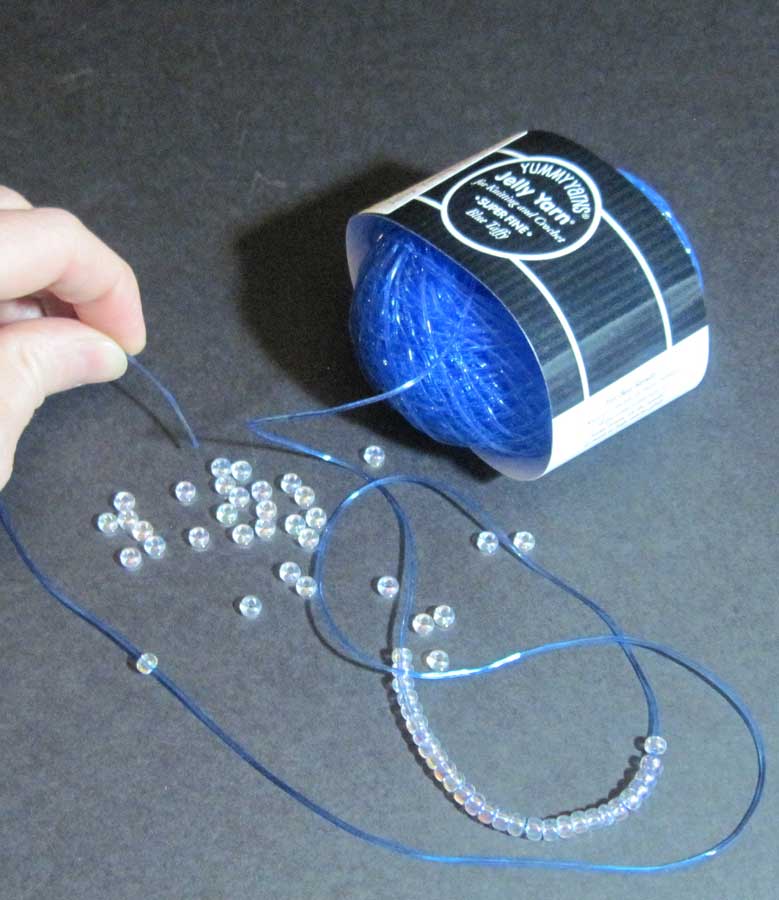
I decided for my purposes I would use some of the Jelly Yarn “thread” or “super fine” and some iredescent E-beads I had on hand. The best thing about Jelly Yarn for working with beads is you don’t need a needle to get the beads on the “yarn”.
For this experiment I wanted to make the love knots about a half inch long, the springiness of the jelly yarn would cause them to open up nicely.
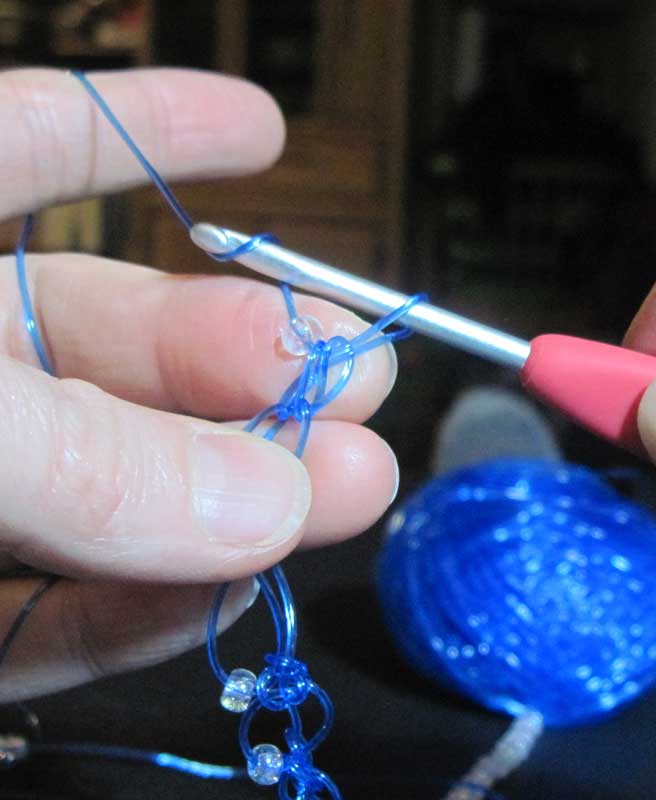
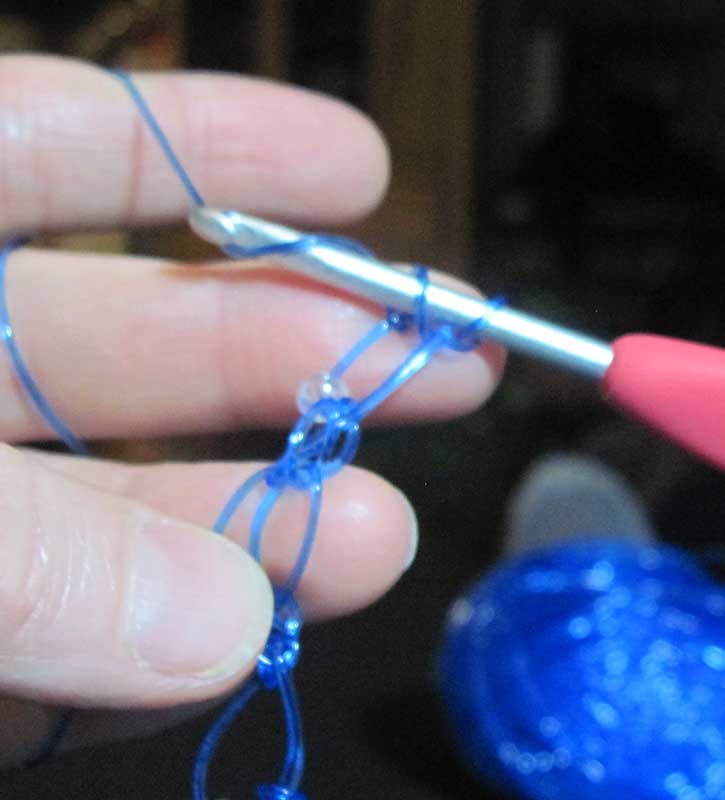
I started with a single crochet in my beginning chain, then I worked my love knots by pulling the loop on my hook up to 1/2 an inch long.
I slid one of the beads up to the base of my working yarn, then pulled thru a loop like making a chain.
Then, I worked a sc in the back bump of the chain stitch as my “knot” sc.
I repeated these steps for a while, and the photo above is what I came up with so far this evening. I’m not 100% sure if I like it enough to keep it. So I’ll look at it again tomorrow (or maybe in a few days) and decide. Time for a good night’s sleep now.
I used to hate weaving in tails when working on crochet projects. But over the years I’ve begun to regard this task as a nice break and meditative. I’m not sure what exactly changed my feelings toward this task that is dreaded by many of us yarny crafters.
I think part of my fondness came from teaching basic crochet to new hooksters. Small flower and “yo-yo” projects are great for beginners, and it’s good practice weaving in the tails.
Afterall, the work we do on the finishing touches of our crochet can have a big impact on the final appearance of a project.
Weaving in ends doesn’t have to be that tedious. In fact it is a great way to change-up the tasks you are working on (different movements of the hands break up the repetition that leads to injury).
In 2010 I took a class at the Manchester Chain Link with Karen Ratto-Whooley where she showed us some neat tricks about end weaving. This was Karen’s Venetian Lace Class (which is well worth taking) and involved creating very open lacy motifs. So the question became, how and where do you hide those darn tails.
Karen told us how her grandmother told her the “wrong side” of your work should look as nice as the “right side”. One of the tricks to making that happen is to hide your tail weaving so it blends with the stitches of your fabric. Taking your tail up and back along the tall stitches is a great way to disguise them.
Also weaving the tails so they go back over themselves helps to prevent them coming loose later.
A few months ago at the LambShoppe PJ Jam night my happiness with tail weaving was solidified. I was very tired and didn’t have the brain cells for really crocheting anything ambitious. But I did have a pile of motifs that needed their ends woven in before I could start the next stage of the project. I sat there weaving in tails and focusing on visiting with my friends. By the end of the evening I had finished all the motifs in my bag and had enjoyed the company of my dear friends.
I recently sold a design that contained 52 3-colored motifs and an additional 36 1-color motifs. Trust me, that is a lot of tails to weave. Fortunately my new found fondness for that task has served me well. I have found the Zen.
Hopefully all my dear readers will be able to approach this task with a bit less distaste in the future as well.
Yes, I know it is early to be thinking about Christmas. But if you are a crafter making your holiday gifts, it is really moving into the last stretches for getting those projects done. So maybe you need something quick to fill a few spots on your list.
A Bear for All Seasons Photo courtesy of Annie’s/Crochet World
How about these cuddly little bears? You can find the pattern for them in the December 2012 issue of Crochet World. The brown bear is 3-dimensional and the white bear is flat, the pattern has instructions for both.
I really loved designing these little guys. They are just big enough to add some fun to your tree, packages or as a simple gift. You can change the size of your bears by using smaller or larger gauge yarns (or even thread), just remember to adjust the size of your hook accordingly.
Make the flat bear to embellish store-bought mittens, gloves, hat, scarves or even a sweatshirt or sweater. Suddenly you have a special gift that took just a few hours to make.
The 3-D bear is perfect for a fun ornament for the Christmas tree. You could even use some sparkly yarns to make him a real stand-out. Or add some holly to his bow-tie. And if you want him to be a keepsake ornament, you could embroider the year on his tummy or back.
Sometimes, if you pay attention, life will give you a chance to learn and grow. Such was the lesson of my relationship with my step-mother Maurine. When my dad re-married I wasn’t too sure about the whole thing. It took us a long while to find our balance with each other. But over the years we became family, later on we even became friends.
Our friendship was founded on crochet. When I started getting into crocheting again about 14 years ago we began to share our joy in playing with hooks and yarn. Maurine was an avid crocheter. She primarily made house-hold items like afghans, pillows, dishcloths and doilies. Occasionally she would make some slippers or other small accessory type projects.
She was my “cheer-leader” as I developed my career as a crochet designer. She was supportive and encouraging about my efforts and celebrated each published and sold design for me.
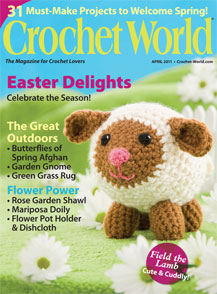
Our last face to face visit was in March 2011, when I was thrilled to be able to give her a copy of the April 2011 issue of Crochet World that had my design “Field the Lamb” on the cover. We had a great time looking thru the magazine at all the different patterns and she was so happy for my success. She had me sign her copy, which made me chuckle.
Unfortunately, I had no idea that would be our last visit. We spoke on the phone over the next months, then I was in super busy mode with spring time design work. That September I got a call from my sister that Maurine was in the hospital and the prognosis was not good. This was the week before I was to leave for the Greensboro Knit & Crochet Show (ChainLink). I called my father and asked him if I should cancel going on my trip, his response was that I should go, because Maurine would have wanted me to go.
My beloved step-mom passed away shortly after midnight on Tuesday, September 20, 2011. My sister texted me that morning as I was traveling to the airport. My heart was so heavy as the plane lifted off carrying me far away from Colorado and Kansas. I was grateful that she was no longer suffering.
Maurine was afraid to fly, so she never went to one of these shows and I know she would have loved attending one. All the yarn and folks playing with it. The gorgeous crocheted and knit garments that you see everyone wearing. For the Greensboro show I found myself seeing the show thru her eyes.
Every step and stage of my time in Greensboro went smoothly, and it seemed like Maurine was being my guardian and good fortune angel. When I met with Carol Alexander we discussed a thread design of a crocheted angel in honor of Maurine.
Well today is nearly over, so I need a quick post. Here is a funny picture my dear Jan and I staged after the Banquet Fashion Show. I was pretending to be crocheting on the skirt of my Evening Seaside Gown. Which really wasn’t far from the truth, as I finished the last bit of stitching Friday night of the show.
The gown was a success on the runway during the Fashion Show and I even managed not to trip on the hem as I walked up the stairs to the stage. There will not be a pattern for this dress, though I will be using a lot of what I learned making it in future designs.
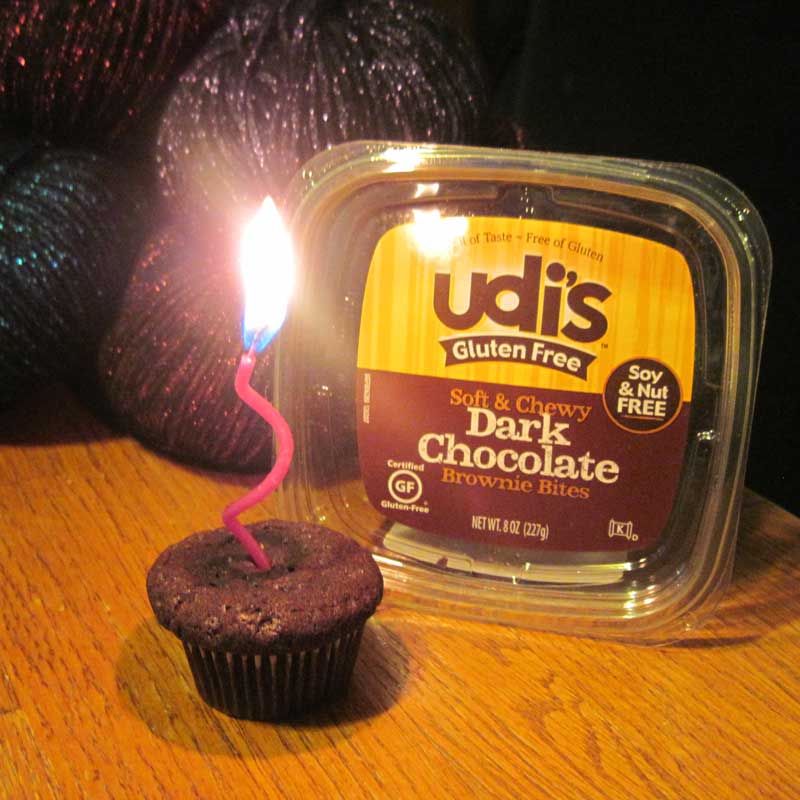
Well, today is my birthday. I’m not sure how it came around again so quickly, I would have sworn I had one of these just 6 months ago.
I’ve been very good to myself leading up to this birthday. Indulged in some yarn purchases, as well as some fun goodies for jewelry making that may or may not be used in my design work. Plus there was the whole “Trip to Reno” that was a kind of gift from my family.
Anyway, I think I have my birthday celebration covered, so I am giving a gift to one of my readers that commented on my Mountain Ruana post. And the lucky winner is: Julie! I’ll be in touch by email very soon to get your address to mail you the copy of “Warm & Cozy Crochet” that you won. Thanks for commenting on my blog.
Meanwhile, since I officially turn 49 today, I shall be contemplating the 50th year of my life. I think I need to take better care of myself. Which sort of encompasses all manner of sins: Like getting more and regular sleep, eating a healthy hearty breakfast every morning (which means this is the last morning I am having GF brownies for breakfast), and getting some form of cardio exercise everyday. I know from all my work as a health and wellness writer that it’s all a matter of “Move it or Lose it” if I don’t want the years to bring me to a grinding halt.
Of course, no matter what, I will always celebrate my birthday. As a very wise friend told me years ago upon his 50th birthday, “Getting older is far preferable over the alternative.”
I’ve been crocheting for a very long time. And I’ve used many a slip stitch. They are a vital part of seamless construction and working in the round. Two of my very favorite techniques in crochet.
But shortly after I joined Ravelry I started hearing about a technique called “Slip Stitch Crochet”. A fellow raveler and designer, David Burchall, was at the forefront of many of these conversations. He crocheted, and he wanted to crochet “masculine” fabric that he would be comfortable wearing. He liked the look of many knit fabrics but had not had good success with learning to knit. So David began to experiment with Slip Stitch crochet as a way to create the fabric he wanted.
About the time I was hoping to experiment with learning these new slip stitch techniques David went thru some big changes and disappeared from the Ravelry world for a while. So I put that pursuit on the back burner, and then life got busier for me as my “part-time” work as a designer turned into “full-time”. Once David was back and providing information on slip stitch again I was too hectic.
Then the classes for the 2012 Knit & Crochet Show came out. Vashti Braha was teaching Slip Stitch classes. I wasn’t able to take the classes in Manchester because they were offered on my busiest day with the CGOA Design Competition. But they were first on my list for the Reno Show.
I was so excited for the class to begin and Vashti did not disappoint. I’m generally pretty slow in class working on the swatchs, but I didn’t mind as Vashti touched upon each technique and provided a comprehensive 3 page handout that gave me all the information I needed to keep practicing.
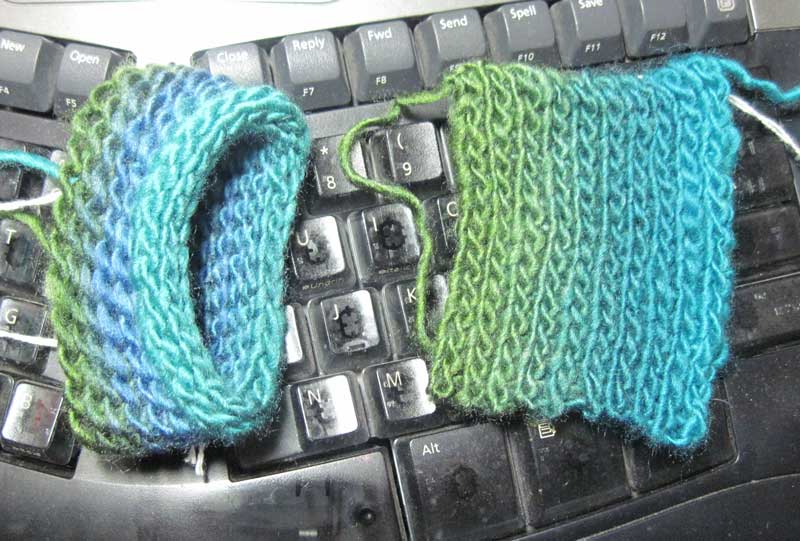
Back Loop Sl St – Uber Stretchy fabric
Even though my tension was a bit wonky with the swatch I really liked the stretch of this fabric. Had a cushy feel that was really nice, I’m thinking my husband may be getting a hat for Christmas made with this stitch technique.
Bosnian Sl St /Back loop and Front loop
I loved the curl of the fabric with the Bosnian front loop sl st, reminds me of the rolled edges for neck and cuffs on many knit sweaters. (If you are wondering what that yummy yarn is in my photos, it is “Unforgettable” from Red Heart in the Tidal colorway)
I’m really looking forward to playing with this technique more and am hoping that Vashti will be offering more slip stitch classes at next year’s shows. Meanwhile you can visit Vashti’s website and subscribe to her wonderful newsletter to learn more about this enticing technique.
When I design a project I think about the yarn a lot. All yarns are not created equal. By that I don’t mean that some are inferior to others, but some definitely work better for certain projects or effects than others.
An example:Worsted weight kitchen cotton rarely makes a nice garment, it tends to bag and sag with wear and can be very heavy. It’s ideal though for dish cloths, bath scrubbies or even a sturdy market or beach bag.
The things I look at when choosing a yarn for a design often happen long before the design is even conceived.
Yarn for Design Swatching
I frequently purchase a single skein/ball/hank of yarn to try it out. I’ll play with different stitches and stitch patterns with various hooks to see how the yarn behaves and how the fabric looks. If I like any of those swatches, or if I think I might like them, I’ll wash and block the swatch to see what happens next. How much does it grow or shrink? Does it look better or worse?
Lately this experimenting occurs as part of my search for a yarn to use in a design I want to publish or that I want to propose to a magazine or yarn company. I know what I want the yarn to do in the design, so I search for a yarn that will do that. OR I know what a yarn will do and I come up with a design that I know will showcase that yarn well.
The road from this creative process to a published design can often be rocky. Sometimes I will sell a proposed design, but the publisher wants to change the yarn I will use. That can lead to some interesting juggling if the preferred yarn responds differently to the stitch work of the proposed design than the original yarn.
Often it requires some re-calculations of the math to make the design come together. Since this all happens at the beginning of the creative road it doesn’t distort how the finished design looks to the pattern using public.
What happens though when the pattern using public decides to substitute a different yarn than the one used for the original design?
Almost everyone decides to substitute yarns at one point or another. It’s quite understandable. For some of us it may be that we have yarn in our stash that we feel would work nicely or we like the color of. For others the specified yarn may not be easy to obtain where they live, or may be outside the reach of their budget. But substituting yarn can be quite tricky.
Sometimes the resulting project is even nicer than the original sample that was pictured with the pattern. Unfortunately the opposite can happen to varying degrees. I’ve seen instances where stitchers have substituted a different yarn that changed the gauge significantly, they then adjusted the math of the pattern…but are unhappy with the finished object.
All this is understandable, and it can even be entertaining as a stitcher to play with a pattern in that way. But what yarn will you choose?
Four points to keep in mind when you want to substitute a yarn:
1) Pick something that has a similar fiber content.
If you are horribly allergic to animal fibers like wool and have fallen completely in lust with a pattern that was originally designed in a wool or wool blend yarn you may have some difficulties. You might be able to find a yarn that looks somewhat similar, but your finished object is going to block and wear quite differently from the original. If you are okay with that result, go for it.
2) Stay with the same size yarn.
Meaning if the pattern calls for DK weight yarn and you substitute a Bulky yarn you are going to have some BIG changes in your finished object (no pun intended). I’ve seen some stitchers decide to work a pattern in a heavier yarn without changing the size hook or needles they are using. Then they are unhappy because their project doesn’t have the drape or flow of the original.
If you are going bigger or smaller than the recommended yarn you need to change hook or needle size accordingly, and you need to figure out how your gauge will change to adjust the pattern.
3) Try to match the twist and elasticity of the original yarn.
This is a bit harder to do, because you need to be able to observe both the original yarn and the yarn you wish to substitute. Yarns using the same fiber content and of the same weight can still have a big difference in “give” due to the way they are created.
Take a close look and touch different yarns in your local yarn store and big box craft stores. You will see that some are much more elastic than others, even if they don’t have elastic thread added to them (there are a few sock yarns that do have elastic nylon added to create a very stretchy sock fabric).
If the original yarn in a pattern is very “cushy” or elastic and you substitute a tight non-elastic yarn the finished project will be much less stretchy and, in the case of garments, may not give you the fit you want.
One quick test for similarity in elasticity is to measure the yarn resting and stretched. Best case scenario is if you can compare a couple of yarns you are considering to the original yarn. Shopping at your LYS you may be able to use the knowledge of the shop employees to help you find a good substitute.
4) Swatch!
Yes, I know many of you hate to swatch. But when substituting yarn it really is critical. It is far better to put in 20 minutes or less swatching, than to have worked days and weeks on a project to discover the gauge or yarn performance is completely off.
Once you finish a swatch let it rest before making any measurements or evaluating the fabric. During the process of crocheting (or knitting) the warmth of your hands and the manipulation of the yarn can change the fabric.
I tend to lay my swatch out flat on my work table for at least an hour (sometimes overnight) before taking any measurements and evaluating the fabric. If the finished piece will be blocked I block my swatch, this is particularly important if the yarn is natural fibers like cotton, silk or any animal hair/fur.
Another thing to consider is growth of the project. The weight of the yarn can change the fabric you create when the piece is large. One way to evaluate that from the swatch is to hang it with weights on the bottom edge. I use clothes pins.
I hope these tips and this glimpse into my design process are helpful to you. Play with your yarn choices and patterns to find the mix that gives you what you want. “Play” is the key word there, just have fun with it. Afterall, it’s all playing with yarn.
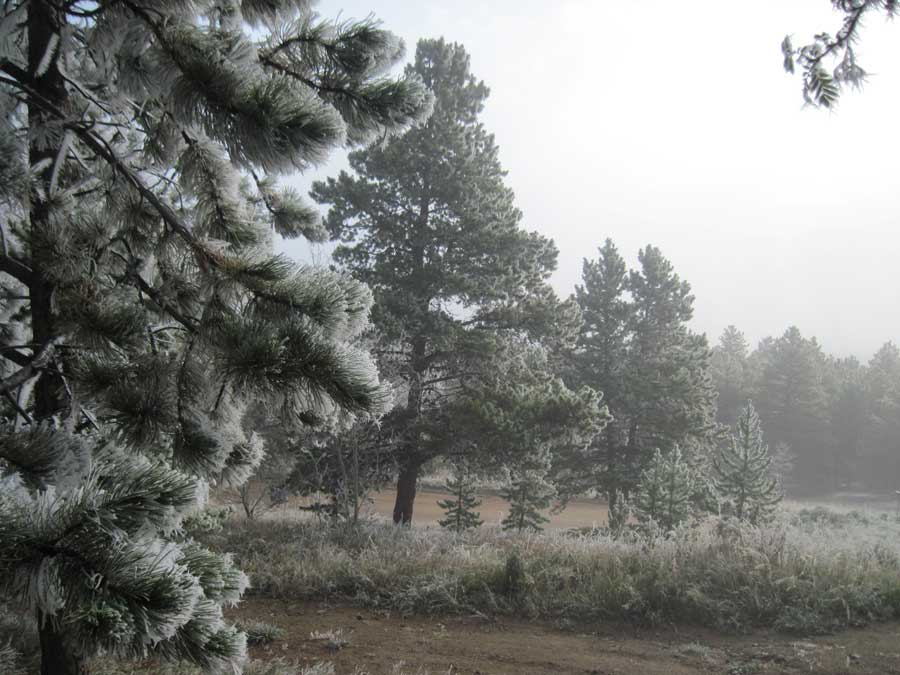
Another very cold day up here on the mountain. Third day in a row that the temperature has been below 40F. Quite a lot below that last night and this morning. At 9 a.m. , when I was taking these photos, it was 25F. Currently it is a balmy 28F. It will actually have to warm up a bit before we will get more snow.
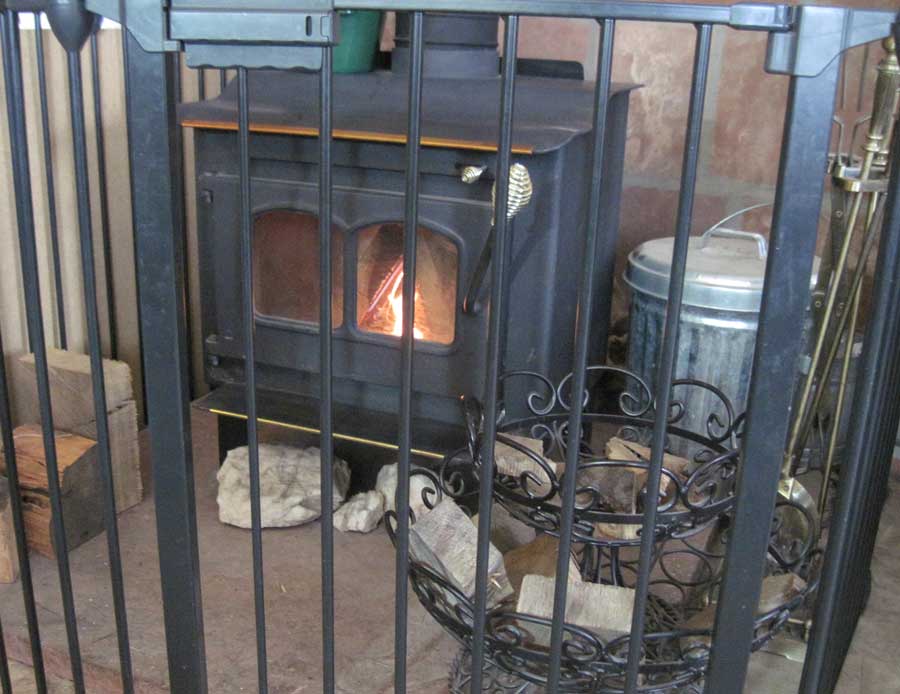
This cold weather convinced me it was time to get the wood stove going again. So here is the first warming fire of the winter season (even if the calendar says it is still Fall).
Frost feathers on Pine Branches
If this is any indication, I’d better be prepared for some seriously cold temperatures this winter. I have been working with a lovely Alpaca yarn from my stash recently. It is going to become a cozy set of Hat, Scarflette and Fingerless mitts. I like to wear the mitts over thin gloves, gives me warmth where I need it at the same time I have some dexterity with the exposed fingertips.
One of my favorite things to work on in the cold weather are afghans, especially ones with a simple stitch pattern that allow me to cozy up under the work-in-progress and happily stitch along whilst watching a show or movie.
Frost Feathers on Deck Fencing
What are your favorite cozy crochet items? Do you make hats, scarves or mittens for yourself? Or are you like me, so busy making gifts for others (or design pieces) that you never have any new crochet to wear for yourself?
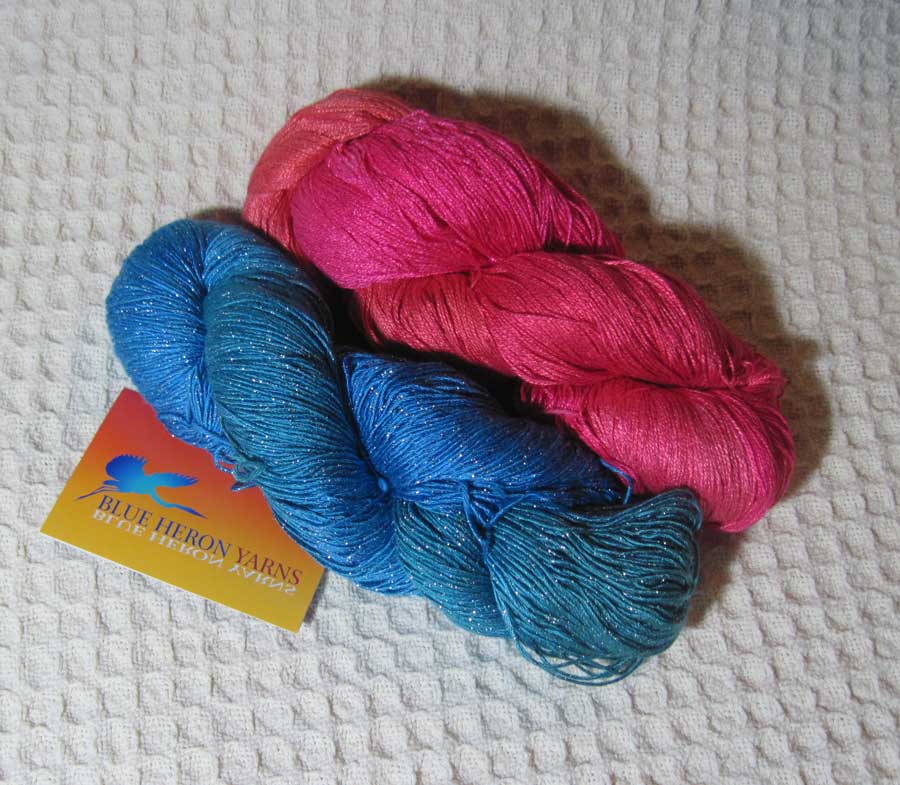
You may have heard of Blue Heron Yarns. The description you’ll get from most folks that have worked with these yarns is “yummy”. The colors they offer it in are eye pleasing. The drape and fluidity of the fabric, whether it is knit or crochet is delightful.
My 2 hanks of Blue Heron Yarn
When I knew that Blue Heron was going to be one of the vendor booths at the Reno Knit & Crochet Show I made immediate plans to swing by to check out the lovely colors and pick up a few hanks to play with. The yardage in the hanks is very generous, so I knew I would have a great time creating some wonderful crochet designs.
Demian and Miguel
It was fun and interesting visiting with the 2 gentlemen at the booth. I’m sure these fellas were wondering what they had got themselves into. Neither of them crochets, though Miguel said he was learning. Demian’s Mother started Blue Heron Yarns and he gets to go to all the various shows and sell their yarns. If you can’t make it to a show where they are selling their yarns, you can purchase them thru their website: YarnJunky.BlueHeronYarns (a great name for a yarn website).
I did get a bit of a giggle from Demian when he was surprised that I would be looking to crochet with their bamboo lace weight yarn (that’s the gorgeous pink and coral colored one in the first photo). Of course I’m always amused when folks think that certain yarns can’t be crocheted with. It’s wild how crochet’s hey-day of Irish lace work has been replaced in most people’s minds by the 1960-1970’s Granny Squares. Don’t get me wrong, I adore granny squares. It’s just that crochet is so much more.
Clearly I’ll have to create something gorgeous out of this yarn soon and get the pictures out there. Even if I worked simple granny squares in these yarns though, they would look amazing.











 Mamas2Hands