The Cure for SSS

Second Sock Syndrome (SSS) is often spoken about by those that like to knit or crochet socks. One sock gets finished and the second half of the pair waits in the project bag for ages sometimes to never be seen again. Today I’m going to share my cure for SSS and how to finish 2 at a time in crochet, whether it is socks, mitts, slippers or sleeves.

Making 2 identical objects is always a challenge for me.  Being I seem to have been born with the designer gene I tend to “fiddle” with patterns.  Unfortunately, if you don’t write down the fiddling bits when doing the first object, you are a bit sunk when making the second one.  Sometimes my pairs are more like fraternal twins than identical and a few times it was questionable as to if they were even from the same family.

Photo from Red Heart Website

Along comes the idea of making 2-at-a-time.  Quite popular with my sock knitting friends it seemed a good idea for me when crocheting fingerless mitts.  Especially as I was doing the original designing bit. You can find the free pattern for the above design at the RedHeart.com website here.


Photo courtesy of Leisure Arts Publishing

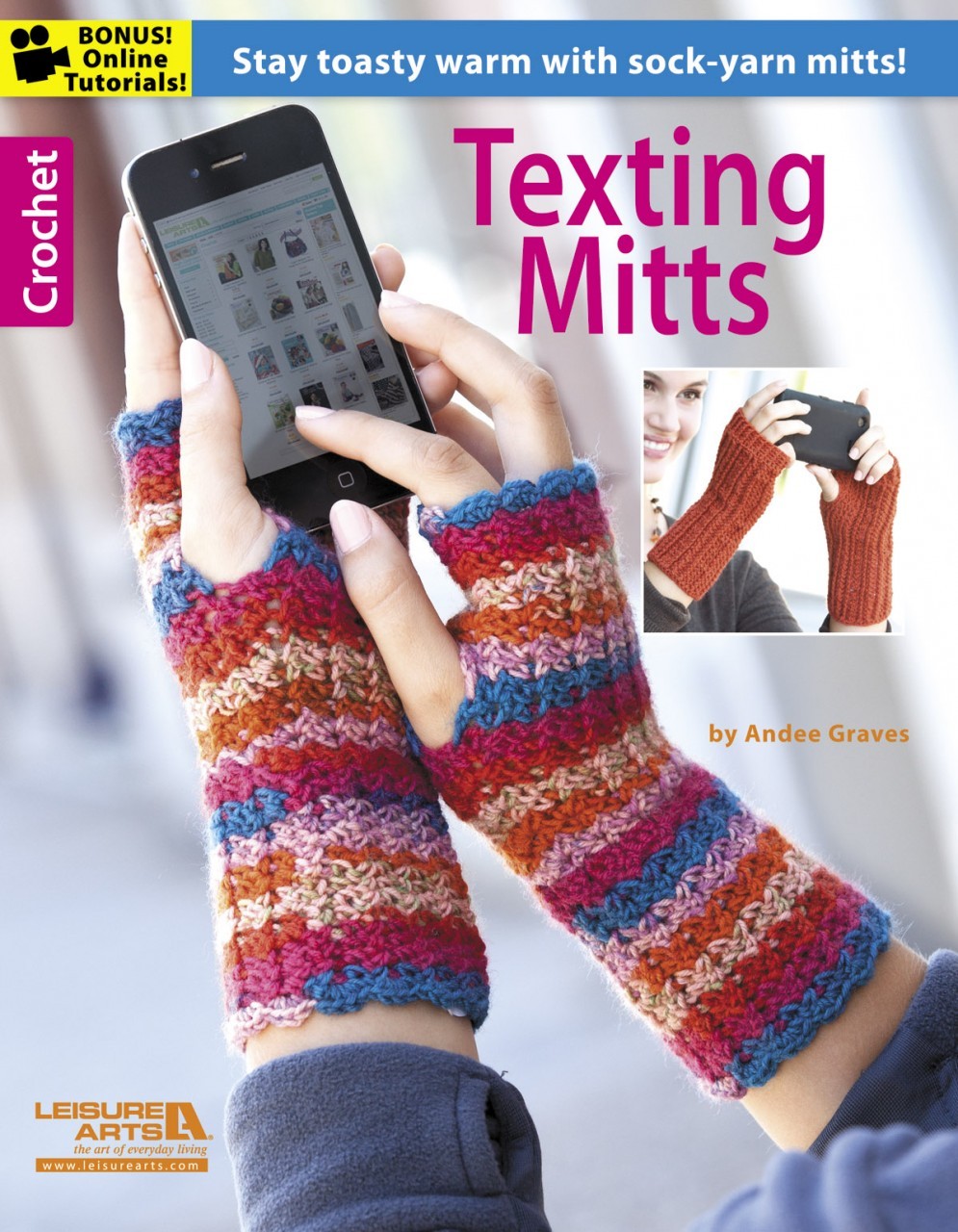
I worked all the samples for my mitts in my “Texting Mitts” book using this method (You can purchase an electronic version or paperback version of my book on the Leisure Arts website here). The great thing is you get to the end of the pattern and you have 2 mitts all done!

What you will need:

2 balls of yarn

At least 2 locking stitch markers, more if your pattern calls for them.

Pattern for pairs: Either mittens, gloves, slippers or socks (or the sleeve section of a sweater pattern).

I recommend 2 balls of yarn.  Some folks use the 2 opposite ends of the same ball.  I find that to be a bit tricky and tangly.  If I already have 2 balls of the color I want to use, I just go with them.  If not, I weigh the yarn and do a quick calculation of yards/per grams(or ounces) then use my 2 yard niddy noddy to measure out half of the yarn.

Measuring Yarn on my Niddy Noddy

Pop that onto my swift and wind it up into another ball (I generally wind the other half remaining in the original ball too as it gives me a tidier ball to work with and is less likely to tangle…I hate tangles).

The 2 balls of Yarn to Work From

Now you need the pattern.  Any crochet pair pattern could be worked similarly.  No matter what pattern you are using I highly recommend that you work the foundation/start in the same sitting if at all possible.

I am sharing this from a sad experience.  I was making myself a set of mitts and thought I would work the palm bit then return to the foundation and work the palm bit of the 2nd mitt.  Unfortunately, I was a few rows into the palm of the 2nd mitt and discovered my gauge was too different in my foundation round.

2-at-a-Time-A

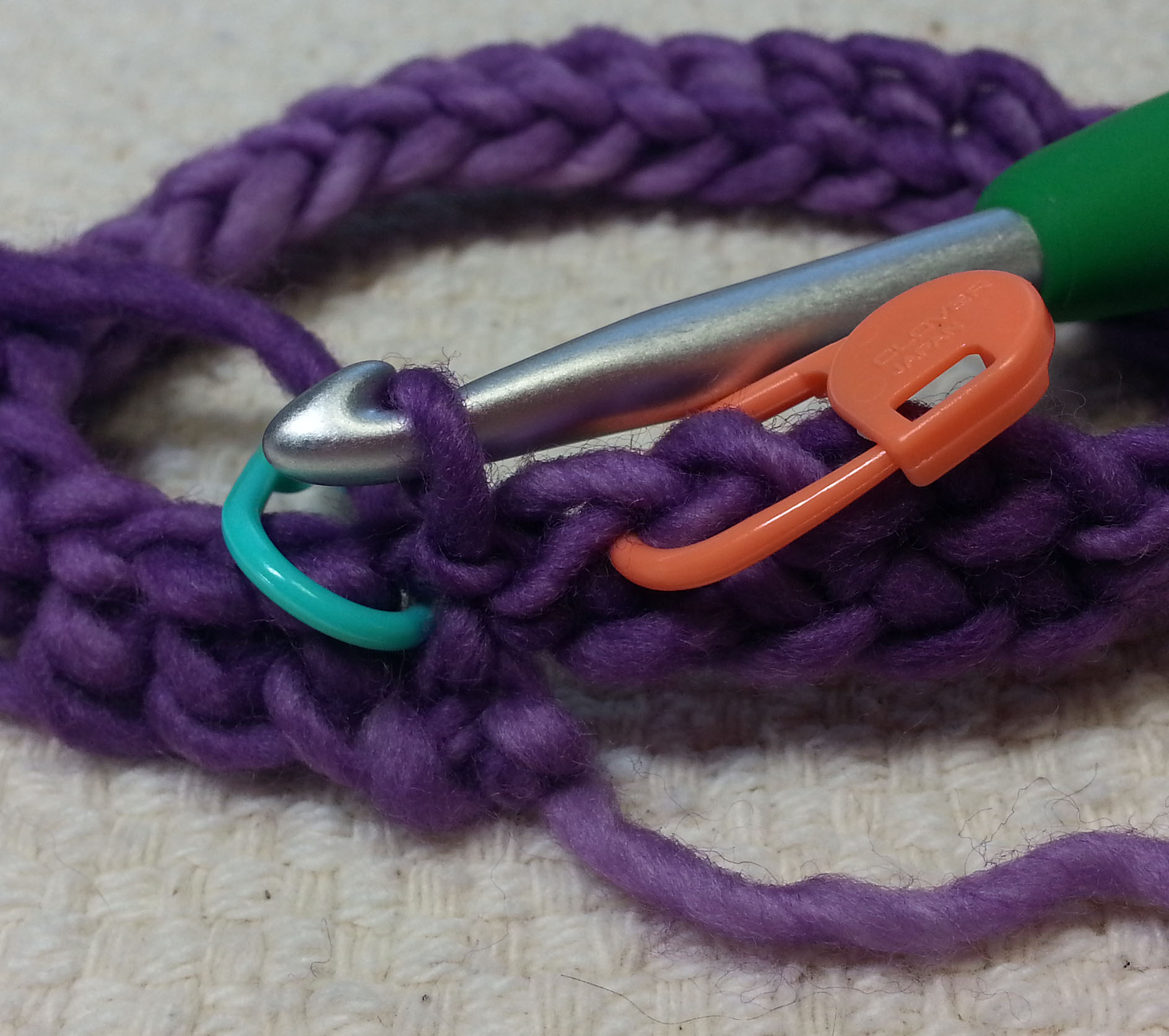
The real trick to working 2 at a time in crochet is the locking stitch markers.  One of the wonderful things about crochet is that you have only one “live” loop at a time. The locking stitch marker placed in that loop means you can run off with the hook to work on the 2nd object or even a completely different project and your stitches will not unravel.

2-at-a-time-b

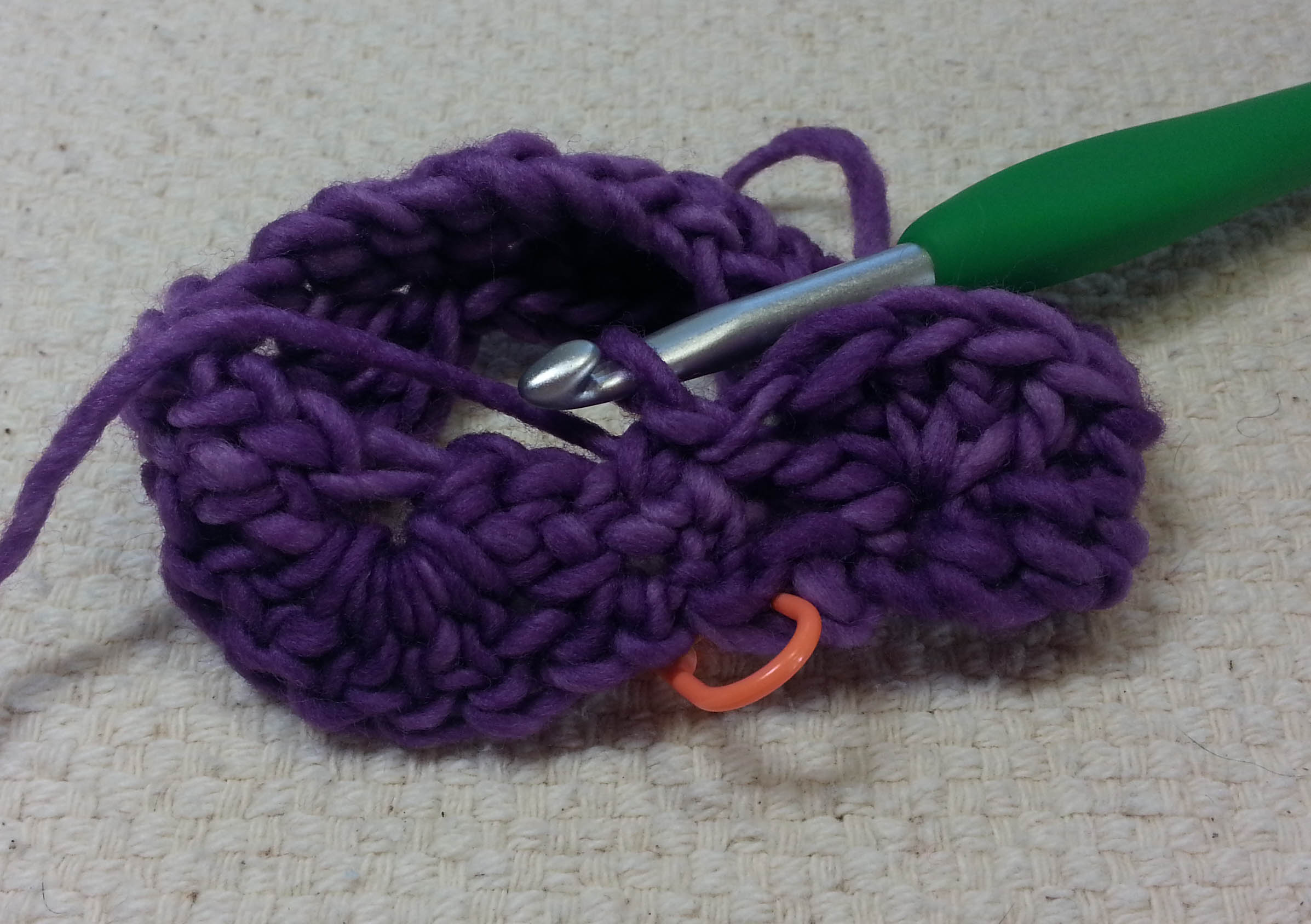
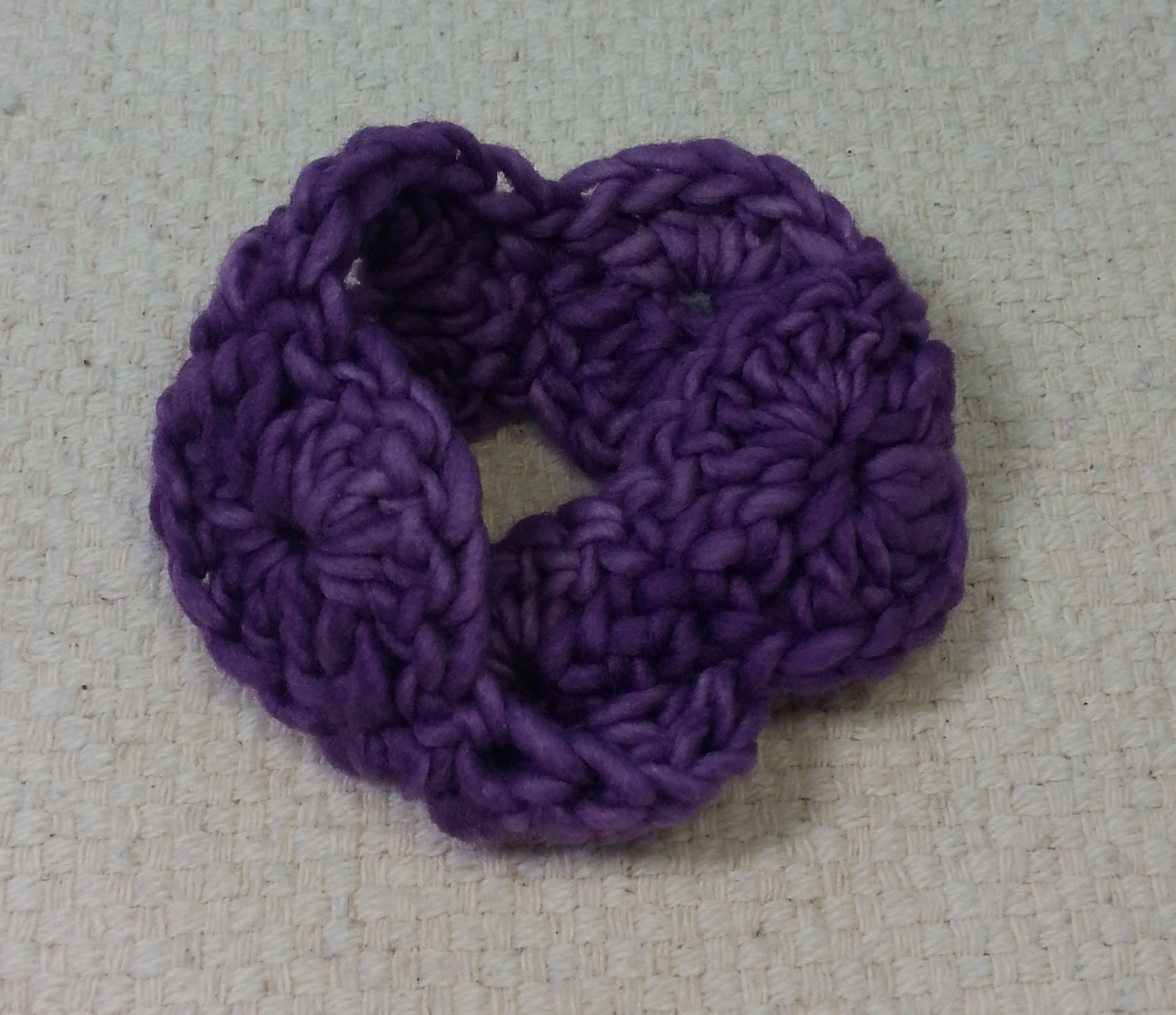
As you work back and forth between your 2 items you place the stitch marker in the working loop of the “resting” item. I use 2 different colors to keep track of which 1 of the 2 I’m working on. These were the start of some fingerless mitts I made using one of my patterns from my “Texting Mitts” book a few years back.

I crocheted the foundations for each mitt, placing the locking stitch marker in my working loop as I finished the foundation. Then I worked 2 rounds of the first mitt, placed the stitch marker in the working loop, removed the stitch marker from the working loop in my 2nd mitt, inserted my hook and crocheted 2 rounds of the 2nd mitt.

There are other methods for securing your working loop, but I like the stitch markers because you don’t need to make the working loop super large to keep it from getting pulled out. That allows me to be fairly speedy in my crochet work and that helps me with deadlines.

When I am designing my mitt or other pair patterns, I crochet 1 round at a time noting any design changes and switching back and forth between the 2 objects. Sometimes I will pin the 2 objects together to make it easier to switch back and forth. Just pin them so that you don’t obstruct the area you need to crochet into.

scritches

Now dear readers, it’s your turn to tackle some pairs. Hopefully you will end up with 2 of a kind.


Sophisticated Simplicity

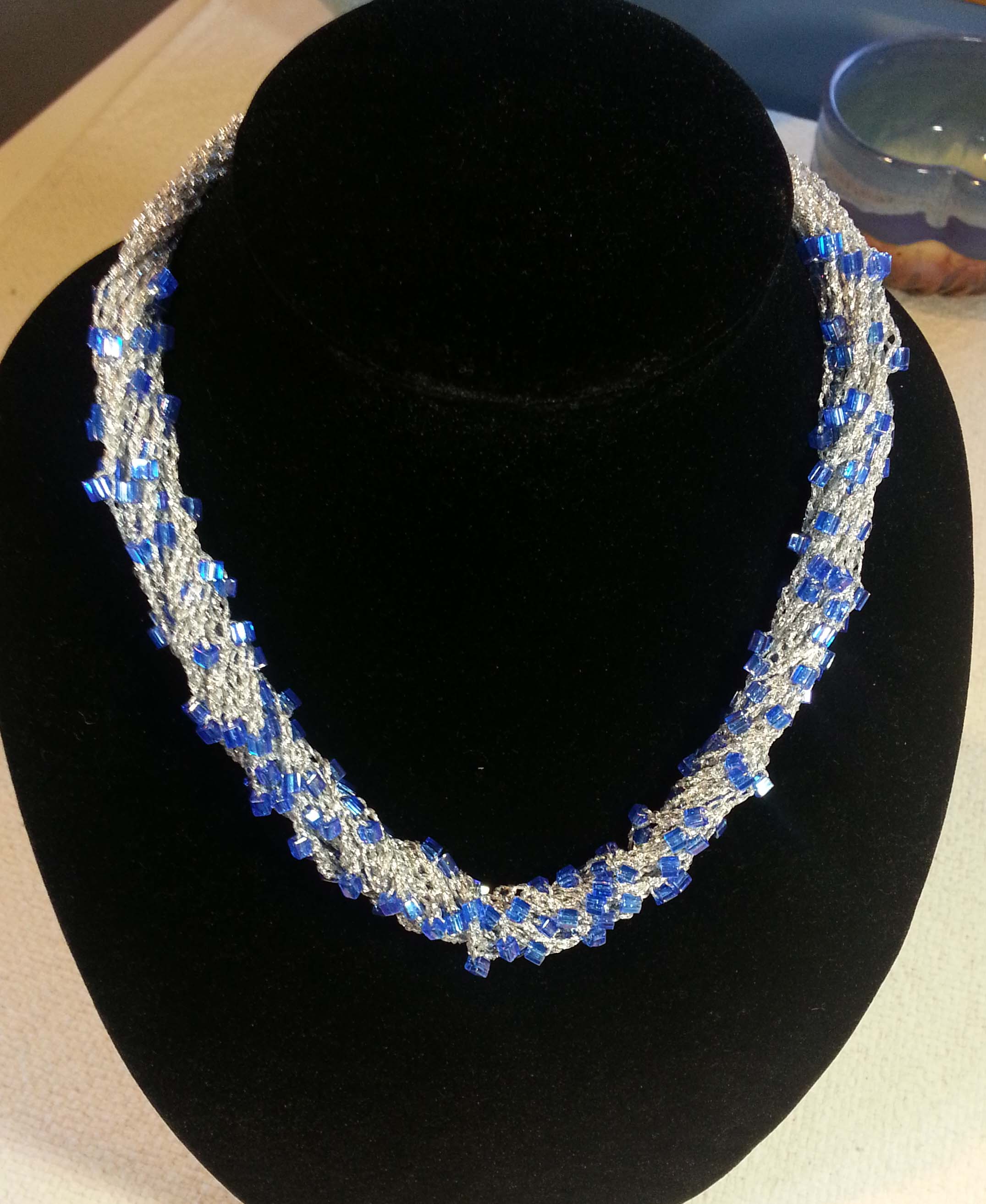
Sophisticated Simplicity Necklace - Andee Graves/M2H Designs

I am really happy to share my latest beaded chain pattern with all my readers. This was an idea that has been bumping around in my brain for a while. It’s a very simple project to crochet, but does take a bit of coordination.

You’ll need to be comfortable with working chain stitches [ch], beaded chain stitches [bdch] and single crochet stitches [sc]. I have a tutorial on crocheting beaded chain stitches here on my blog (scroll down to the bottom half of the post) for those of you needing a refresher on that stitch.

Sophisticated Simplicity Necklace - Andee Graves/M2H Designs 2

Sophisticated Simplicity Necklace

Designed by Andee Graves

Skill level: Easy

Materials

Thread/Yarn:  Sample was made with Kreinik’s Ombre Twist thread, took approximately 45 yards (3 yds per strand), you can get approximately 6 necklaces out of one cone depending on how many strands you decide to have in your necklace.

Hook: Size B/2.25mm

265 glass  beads: Sample was made with Twisted Sistah’s 4mm Cube Transparent Sapphire with AB finish.

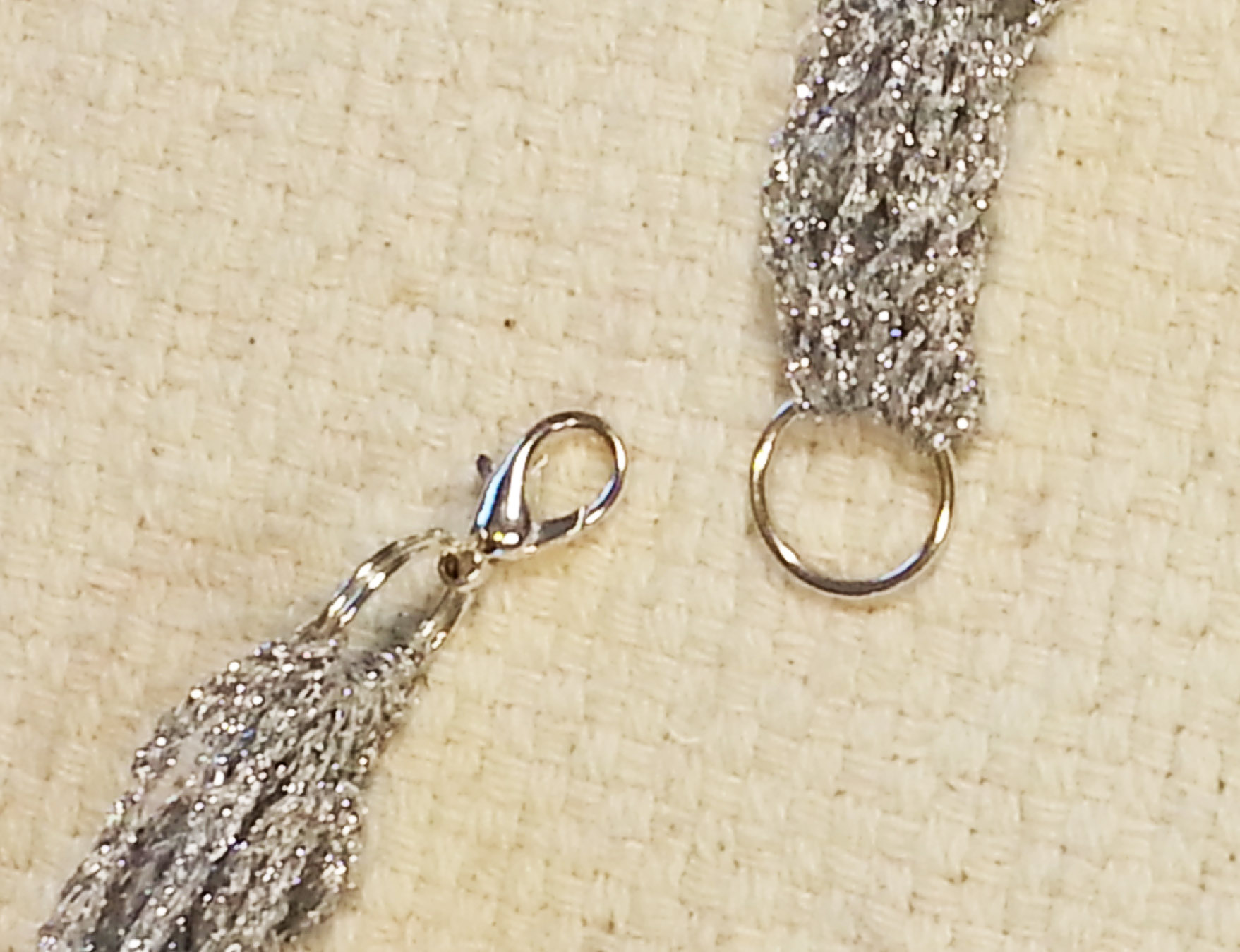
2 metal split rings (I used rings that were 1/2″ in diameter) and a large lobster clasp necklace fastener.

Gauge:

15 chain stitches = 2″

Instructions:

Before you begin crocheting, string all the beads you want to use onto the thread (I always add in a few extra when stringing my beads just to be on the safe side). Also work the ring of the lobster clasp onto one of your split rings.

Leaving about 6 inches of thread for your beginning tail make a slip knot and place loop on your hook. Slip st into one ring, chain 1 and single crochet into the ring to secure the end of your first strand.

You will work the necklace by working chained strands in 3 different styles:

Bead interval for Style 1 & 2
Bead interval for Styles 1 & 2

Style 1: Ch 24, (bdch, ch 7) 12 times, bdch, ch 24, sc to opposite ring. [132 ch, 13 bdch, 1 sc]

Style 2: Ch 21, (bdch, ch 7) 13 times, bdch, ch 21, sc to opposite ring. [133 ch, 14 bdch, 1 sc]

Bead interval for Style 3

Style 3: Ch 19, (bdch, ch 3) 25 times, bdch, ch 19, sc to opposite ring. [113 ch, 26 bdch, 1 sc]

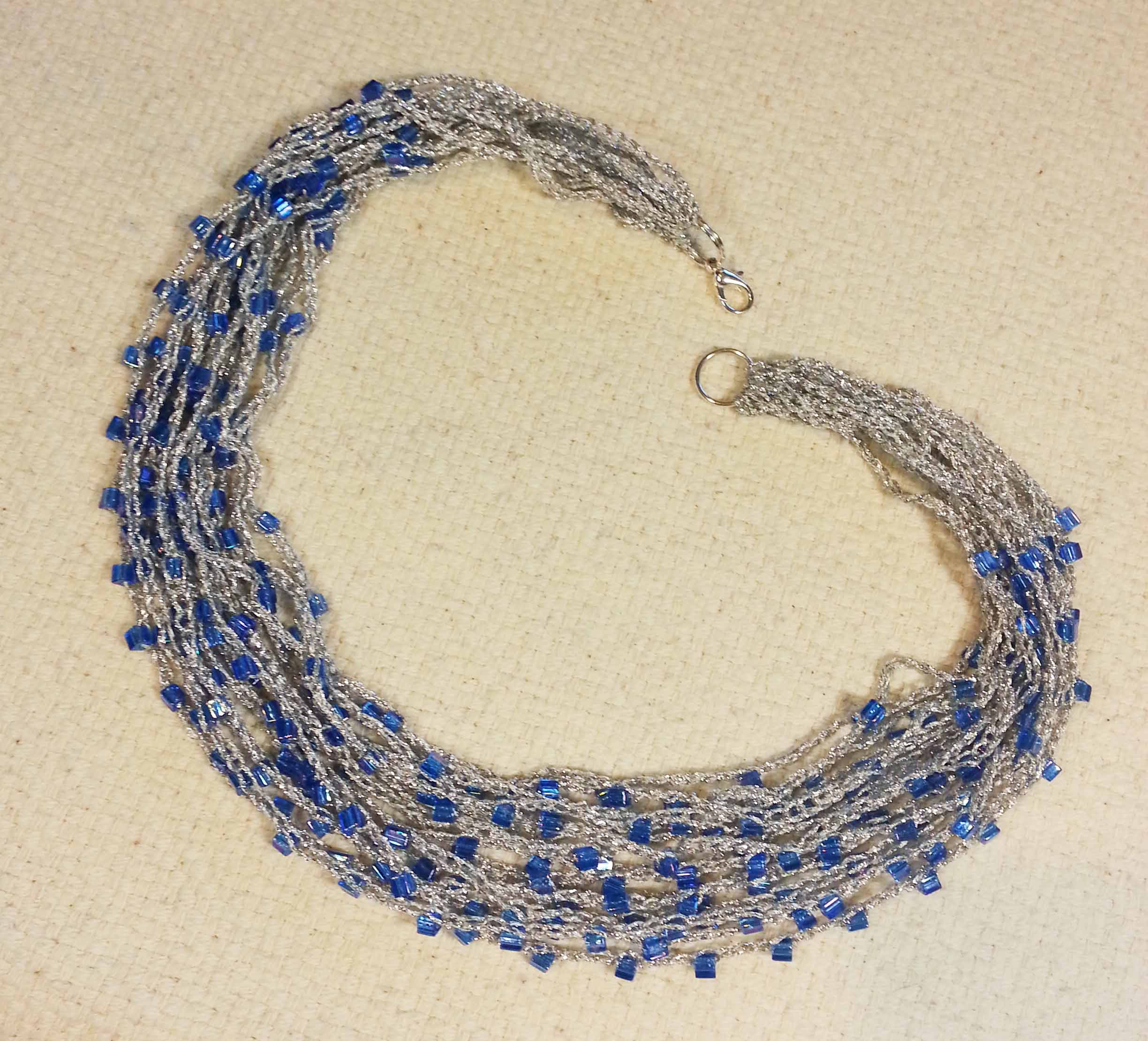
Completed Necklace
Completed Necklace

I alternated working the various styles of strands until I had completed 15 strands (5 strands of each style). You could do more or less, you’ll just want to adjust the number of beads you string before starting your project.

Once you have crocheted all your chain strands and have made the final sc in the ring, fasten off with a six-inch long tail. Weave the ending and beginning tails in and trim off excess thread. If you need to you can secure the tails further with a drop of cyanoacrylate glue (sometimes known as “Super Glue”).

Tips and Tricks for Success

When I was working on my sample in the photos I kept getting carried away with crocheting the beaded chain intervals. About half way thru I discovered a little trick that really sped things up and saved me some frogging and frustration.

Tip for keeping track of beads.

Start the next strand by crocheting the chain stitches before the first beaded chain. Bring the number of beads for the strand you are working close to your hook, and push the remaining beads further down your thread so you have plenty of thread to work with while crocheting the strand. Make a slip knot in the thread right before your extra beads and put a locking stitch marker in the loop.

Now work your strand of chains and beaded chains, when you run out of beads you know it is time to finish that strand and connect it to the opposite ring with a single crochet. If you use up the thread you had pulled up, just move the extra beads further down the thread, undo your slip knot and create another slip knot down the thread. Replace your stitch marker and finish your strand.

Rings and Clasp

Note about the rings you use for the ends: I choose split rings because there is not an opening that the thread can slip thru causing your strands to drop off. If you prefer to use regular jump rings make sure that the opening in the ring is tightly closed.

I would also recommend placing a drop of thin cyanoacrylate glue over the join and let it dry completely before proceeding with your project. You want the thin runny type of glue that can penetrate the tight space between the 2 ends of your jump ring, not the thicker “gel” formulas that are also available.  Obviously you want to have your lobster claw fastener placed on the jump ring before you seal it with the glue.

Now it’s your turn dear readers. Find some beads that appeal to you and crochet a Sophisticated Simplicity Necklace that will turn heads. No one needs to know how easy it was to make.

Time flies

My little man on his first Birthday.
My little J’s first Birthday.

Today is my oldest’s 13th birthday. Really not sure how that went by so fast. I took a walk down memory lane looking at photos of both my kiddos as babies.

Babies are so much fun, especially when they belong to friends and extended family.  I really like crocheting wearable gifts for them because they are quick to make. It’s that nearly instant gratification aspect.

If you don’t have a baby to crochet for check with your local hospital to see if they have a program for accepting donated hats for little noggins.

Finished Little Noggin Cap - M2H Designs
Finished Little Noggin Cap – M2H Designs

I was asked by my friends at the Longmont Yarn Shoppe to crochet a baby hat for a sample recently and this is the little hat I made. I used my Little Bitty Noggin Cap pattern from my November 2010 blog post. I actually had enough yarn left over that I could have made some booties to go along with it. It took less than 1/2 a 50g ball of yarn.

Yarn for Hat

The yarn I used was Plymouth Yarns “Dreambaby DK; Paintpot”. I started with a G (4mm) hook, but felt the fabric was coming out too stiff, so I pulled it all out and switched to my 7 (4.5mm) hook. The fabric still came out solid, but had a bit more stretch to it and a softer feel.

Finished Hat - Crown View

I made this hat a little bigger than the hat in my “Little Noggins” blog post. But essentially I used the same instructions. I made the flat circle for the crown larger by repeating the increase instructions for 8 rounds (instead of 6), I worked 10 more rounds without increases and then 2 rounds of ribbing.  I wanted this hat to be ideal for a brand new baby, which is typically 14 – 15 inch head circumference.

The half double crochet stitch has nice stretch to it and babies tend to have silky hair, so I made this hat to be a little snug by aiming for a circumference in the 13.5 inch range.

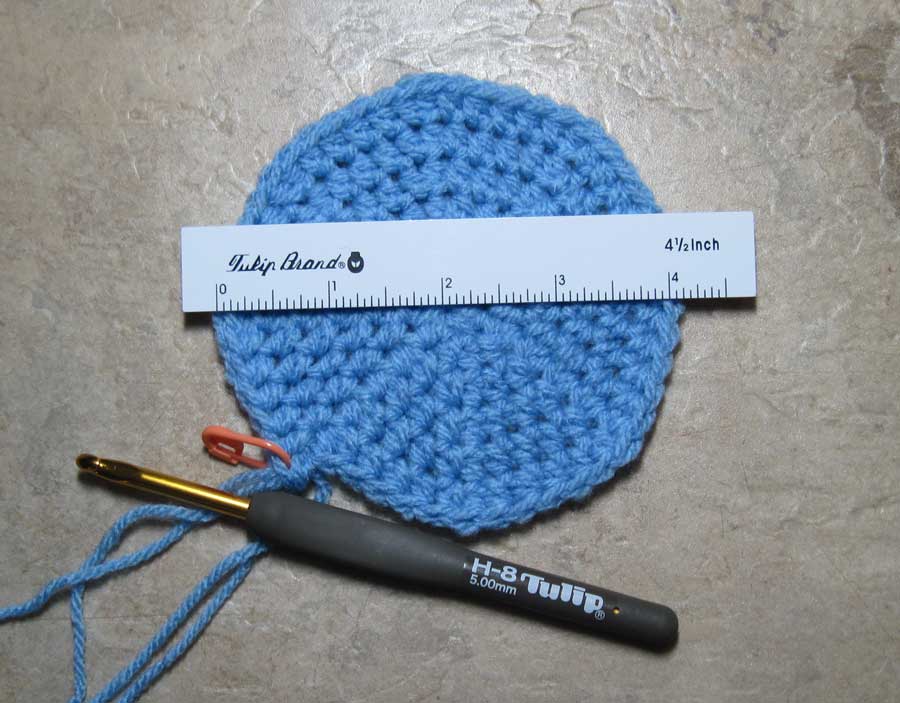
Measuring across the diameter of your crown. This was the original Little Noggin Cap.

If you would rather have a hat that is bigger, work your increase rounds until your crown diameter is just over 5 inches. That will give a hat that is a tad large for most newborns, but they grow very fast and will likely fit it in just a few short weeks.

I also changed how I work the ribbing at the brim for my hats. In the original pattern I had you step down the continuous spiral and then work the brim in joined rounds. I’ve since discovered that I can go right into the back post/front post ribbing without stepping down and it isn’t really all that obvious. Then I work the step down at the end of the ribbing rounds. Much easier that way.

I hope you have fun making some hats for the little noggins in your life.

I’m off to San Diego for the TNNA Winter Show. Hope to have some fun new yarns and products to show you all when I get back. My next post may not happen until Wednesday morning. So thanks for your patience.

Crochet Surgery or Not

One of the things I have celebrated on my blog are the number of good friends I’ve made over the years of being online. Most of these friends are fellow crochet enthusiasts. One of my online friends is “Maven”, we met thru a group on Ravelry back in 2008 and have continued to stay in touch thru Ravelry, Facebook and Twitter over the intervening years.

We have even met in real life. It was a couple years ago, when I took my trip to NJ and NYC to visit Jan. It was far too short  a visit, but really fun to finally have a face to go with the name.

Maven likes to collect yarn when she travels and she purchased some yarn in Tallinin, Estonia on her trip there in May 2012. In May 2014  she decided to crochet a shawl with it while traveling in London and Paris.  She picked the “Festival Shawl” pattern designed by Lyn Robinson. This is a pretty point-up triangle shawl.

Unfortunately it was not coming out the way she wanted, but it turned out the yarn was really difficult to frog. It is a rather toothy wool that likes to grab onto itself. She decided to put it in time-out for awhile in June 2014.

Maven had posted photos of her project and we had talked about how to fix it. I had suggested doing some surgery on the original UFO, then finishing the shawl with how-ever much yarn she had left.  Or she could try using hair conditioner on the project and seeing if she could gently un-ravel the project that way.

She wasn’t sure she was up to either of those fixes and jokingly suggested that she should send it to me to mess with. Of course, I thought that was a great idea, Blog Post!

1 - Box of Goodies and WIP

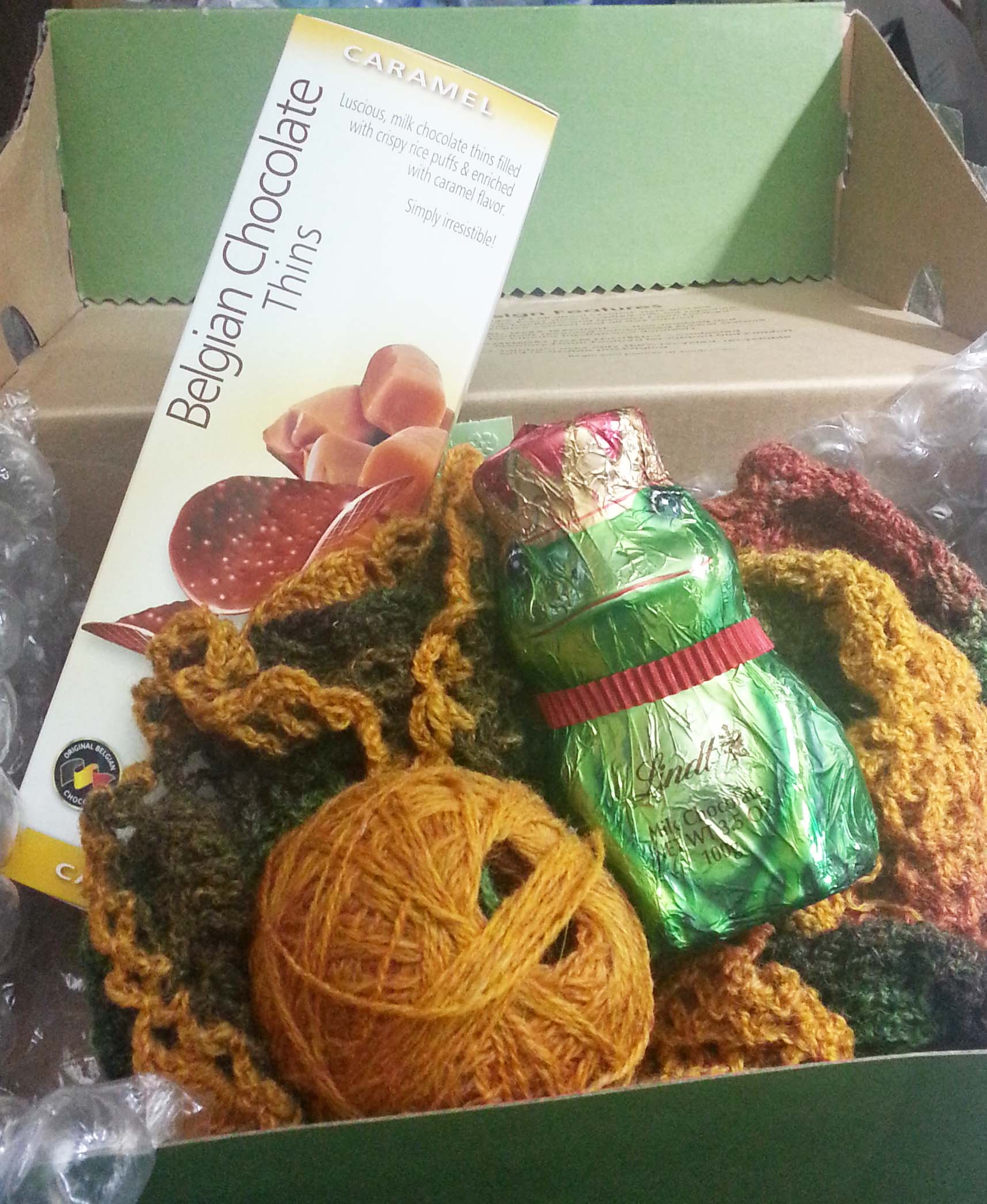
This joke kept getting tossed back and forth between us, finally she decided to take me up on the offer for real. Tuesday of this week I got the box in the mail. There was the expected project, but Maven also included some interesting chocolate goodies. She knows what a chocolate fiend I am. I am not planning on sharing any of these.

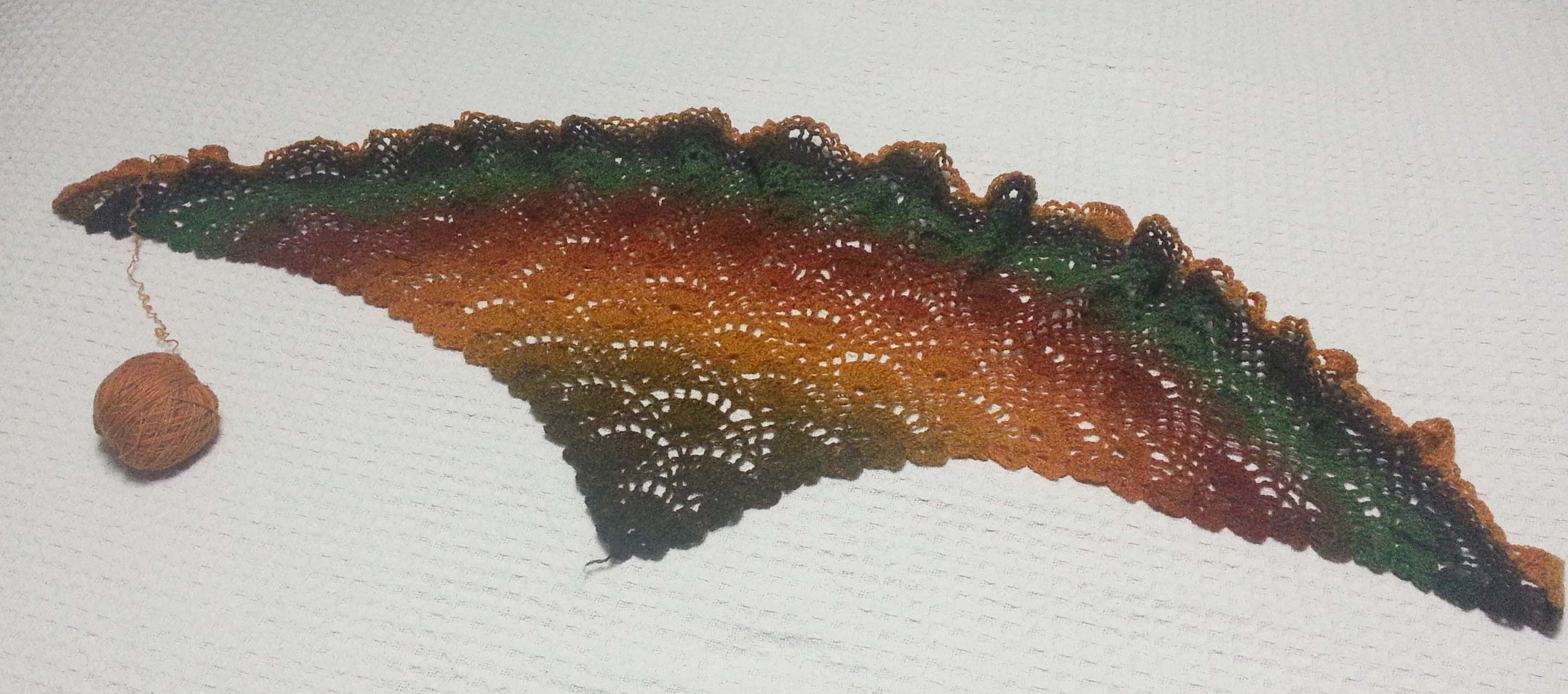
Triangle Shawl

Initial look at the project made me think that crochet surgery could work quite well. But I wanted to get a really good look at the project in the light of day before making my final assessment.

2 - Looking at options 1

I could see changing the direction of wear and loping off the original bottom point might work. That would mean the shawl would be more of a crescent shape than a triangle. But would Maven like it, and want to wear it?

3 - Materials for Surgery

4 - Looking at route for Safety line

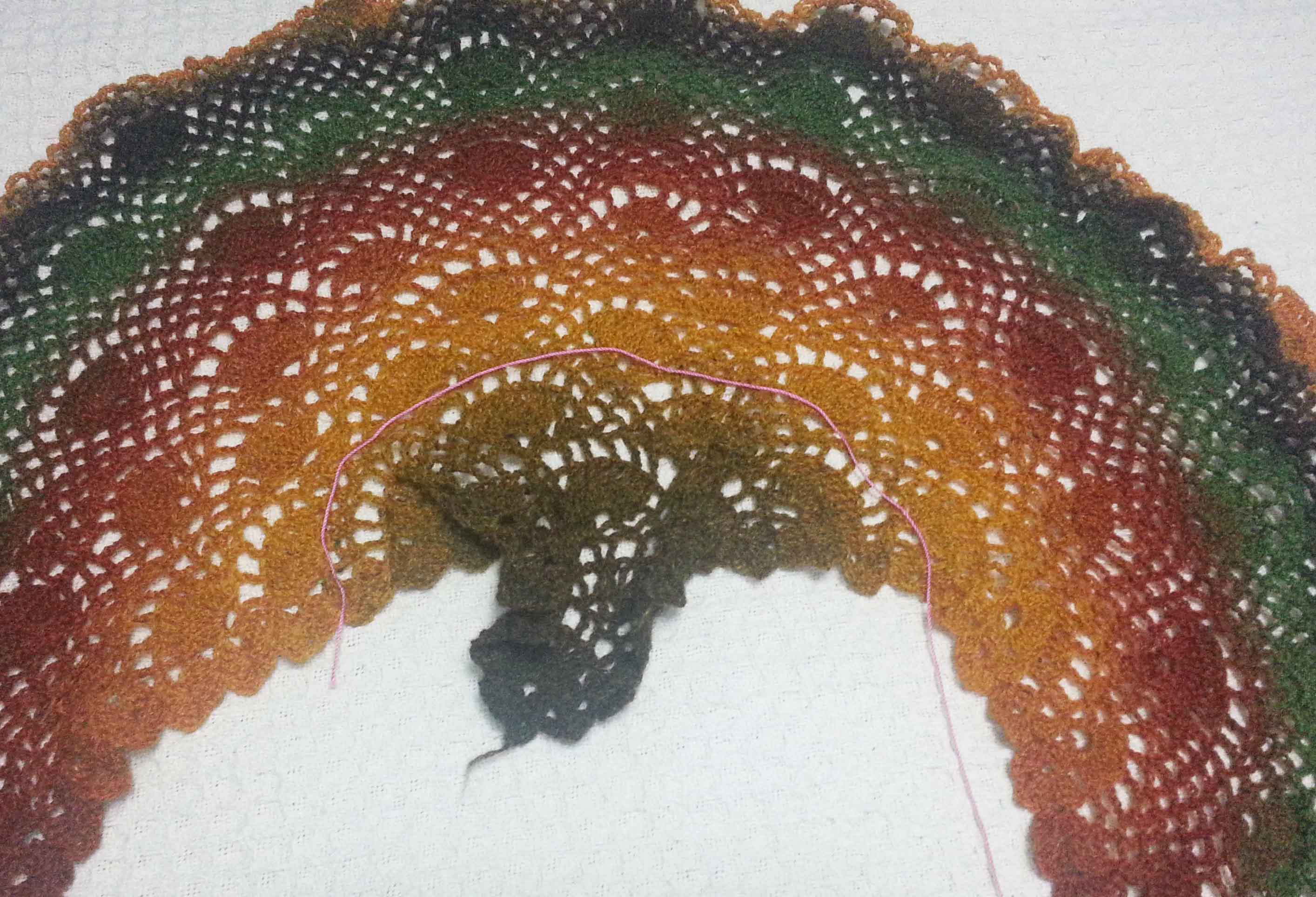
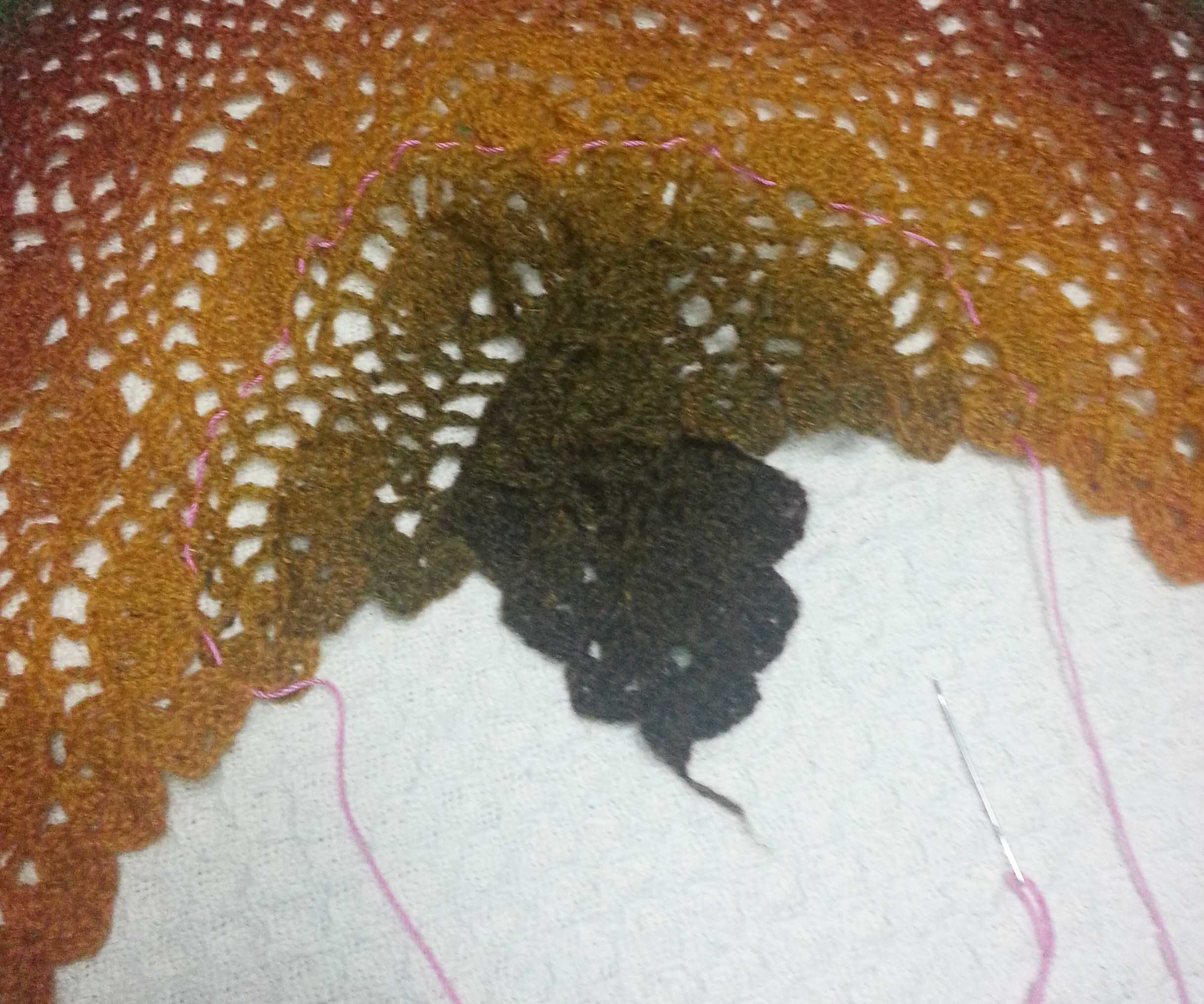
I even went so far as to begin the set-up for crochet surgery. In this case I used some size 3 crochet cotton thread and a blunt yarn needle.

5 - Running safety line thru sts

I carefully wove the thread into the base of each stitch of my chosen row. The idea being once I had secured that row I could then cut the yarn on the previous row and un-ravel it or otherwise remove it.

If you decide to do surgery on your crochet this is the basic approach. If I had continued along this line with this project I would have left a lengthy tail at both ends of my secured row when removing the previous row.

Then I would have used some of the yarn in the remaining ball of yarn to crochet a chain that captured the base of each of my secured stitches and created bridges between them where needed. After that it is just a matter of treating that chain like a normal crochet foundation and crocheting any additional stitches off of it for the neckline of the shawl.

6 - Safety line in place

Once I had the thread in place though I kept looking at the project and was concerned that the finished object would not work for Maven. I wanted her to be happy with whatever I came up with and it really didn’t look like this would fit the bill.

7 - Partial Row

What about frogging it?  The last row on the project was un-finished, so I looked at it to see how difficult it would be to un-ravel. It came apart easier than I had expected. I realized that frogging the project and returning the yarn to Maven was a real possibility.

I hadn’t even tried the conditioner or de-tangling spray yet. So I began to very carefully pull the stitches apart and wind up the yarn as I went.

8 - Broken Yarn and crochet hook

Yarn wrap for broken ends

Early on there was a break in the yarn, so I folded the ends together and used a long slip knot to secure them. That way when Maven goes to work with the yarn again the color gradients won’t be interrupted.

One of the tricks when un-raveling a fussy yarn like this: take it slowly, one stitch at a time. I occasionally used a small crochet hook to hold the top of a stitch open as I gently persuaded the yarn to release. Other times I pinched the base of that top loop between my thumb nail and fore finger.

9 - Almost done Frogging

Whenever I ran into a spot that wouldn’t come free I would gently tease the fibers loose. Yes, this takes a bit more time. So only work on frogging a project like this in bits and pieces so that you don’t get impatient.

Now, some of you may be wondering why I could frog this and Maven can’t. I think 2 factors were in play here. Lack of humidity and very cold temperatures. I live on a cold dry mountain, Maven lives at sea-level on the East Coast. It was really cold the day the package arrived, 27F in fact.

If you are trying to un-ravel a project and are having difficulties with the fiber grabbing onto itself, try popping it in your freezer for a bit. A de-humidifier can be helpful too.

10 - Final Ball of Yarn

Now I have turned this project into a big ball of yarn. It’s ready to go back to Maven for her to crochet it into something new.

Playing with Corner to Corner

Last Wednesday was the “Causal Crochet” meet-up at the Longmont Yarn Shoppe. The 3rd Wednesday of every month crocheters can get together from 10:30 a.m. to 12:30 p.m. to crochet and learn new crochet tips and tricks.

C2C projects M2H Designs

At last week’s meeting we started our CAL. We are making a corner to corner scarf to practice the corner-to-corner (C2C) technique.  If you have never tried making corner-to-corner project this is a good starting project that works up fairly quickly. All the crochet skills you need are Chain, Slip Stitch, and Double Crochet.

Corner to corner projects are about the direction the stitches are worked. Projects begin with a single square, following rows of squares are worked on the diagonal with increases until the desired width is reached. Then rows of squares are worked along the diagonal with an increase at one end and decrease at the opposite end until the desired length is reached. Once the desired length is obtained, decreases are worked to square off the final corner.

The C2C Basics Scarf uses 3 different squares made with a ch-3 and 3 dc. Increase, Regular and Decrease Squares.

The first square of the C2C project is basically an Increase square.

Beginning Chain 6
Beginning Chain 6

You start by chaining 6, you will want to keep all your chain stitches relaxed as you will be working back into the actual chains.

First Square completed

The first square is counted as your Row 1 for this pattern.

Beginning Row 2
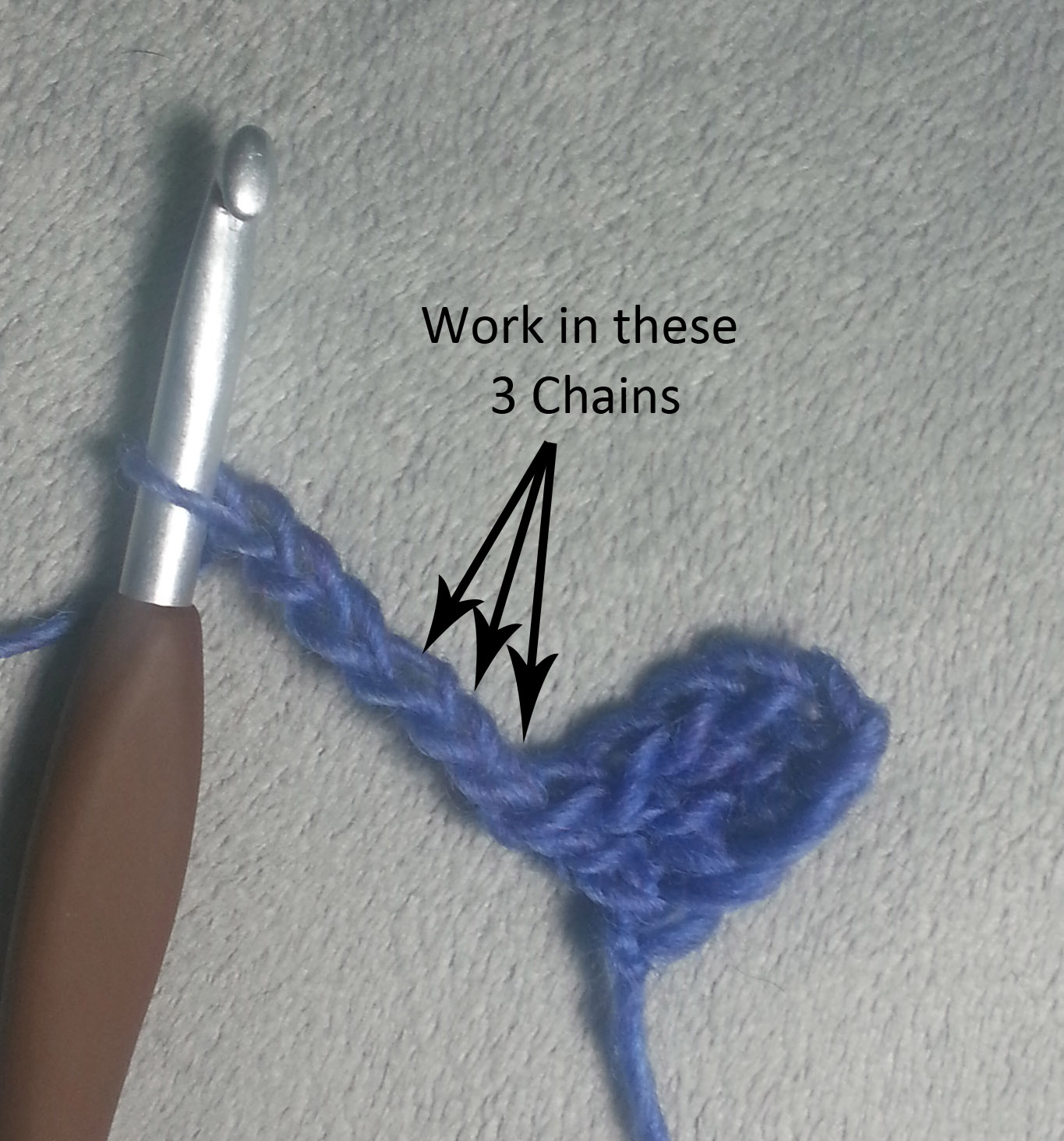
Beginning Row 2, Ch 6 work in 4th, 5th, & 6th chain stitches from hook.

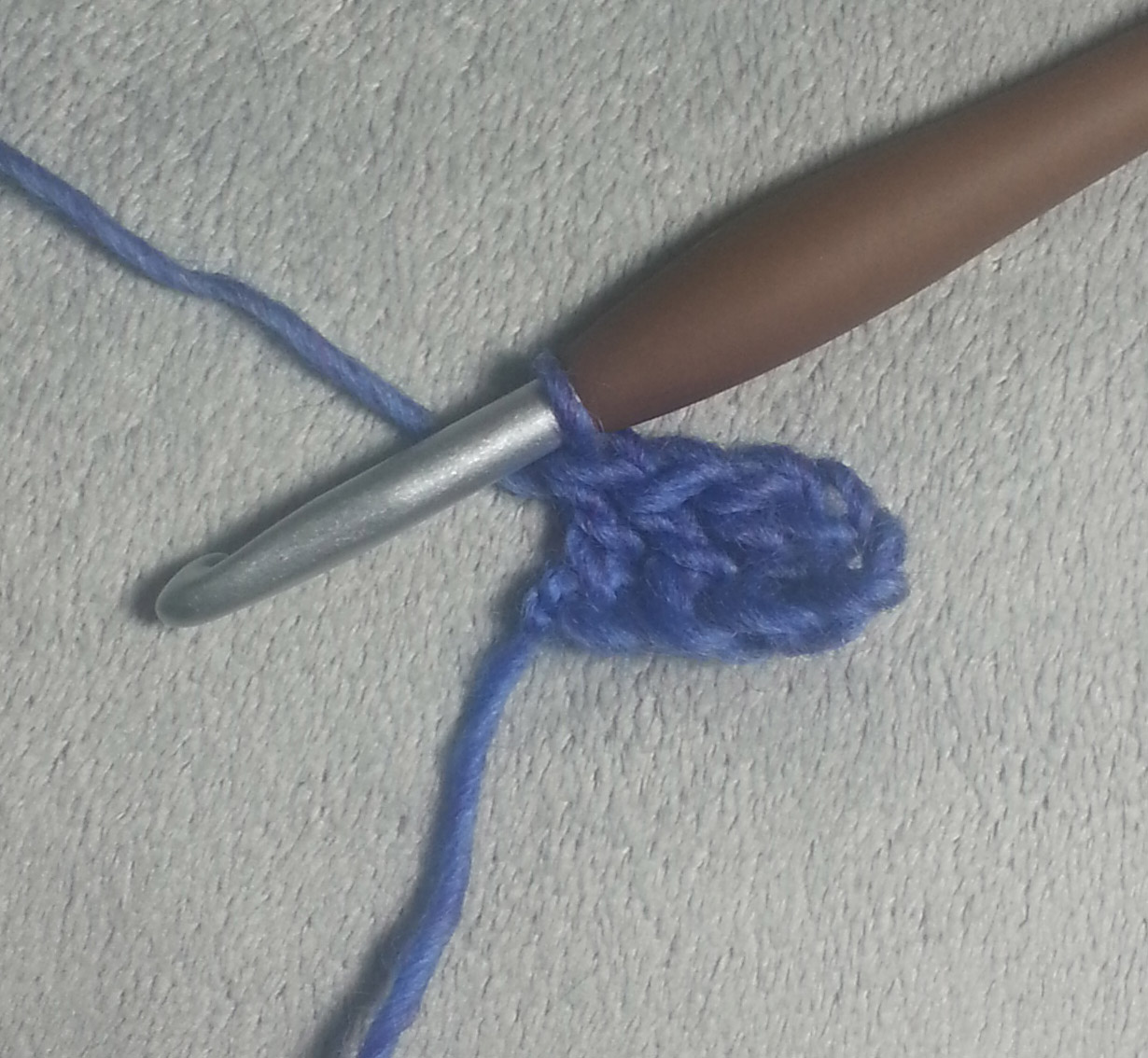
To begin Row 2 you start with an Increase Square again.

Finished 1st block of Row 2, flip up Row 1 block
Finished 1st square of Row 2, flip up Row 1 square

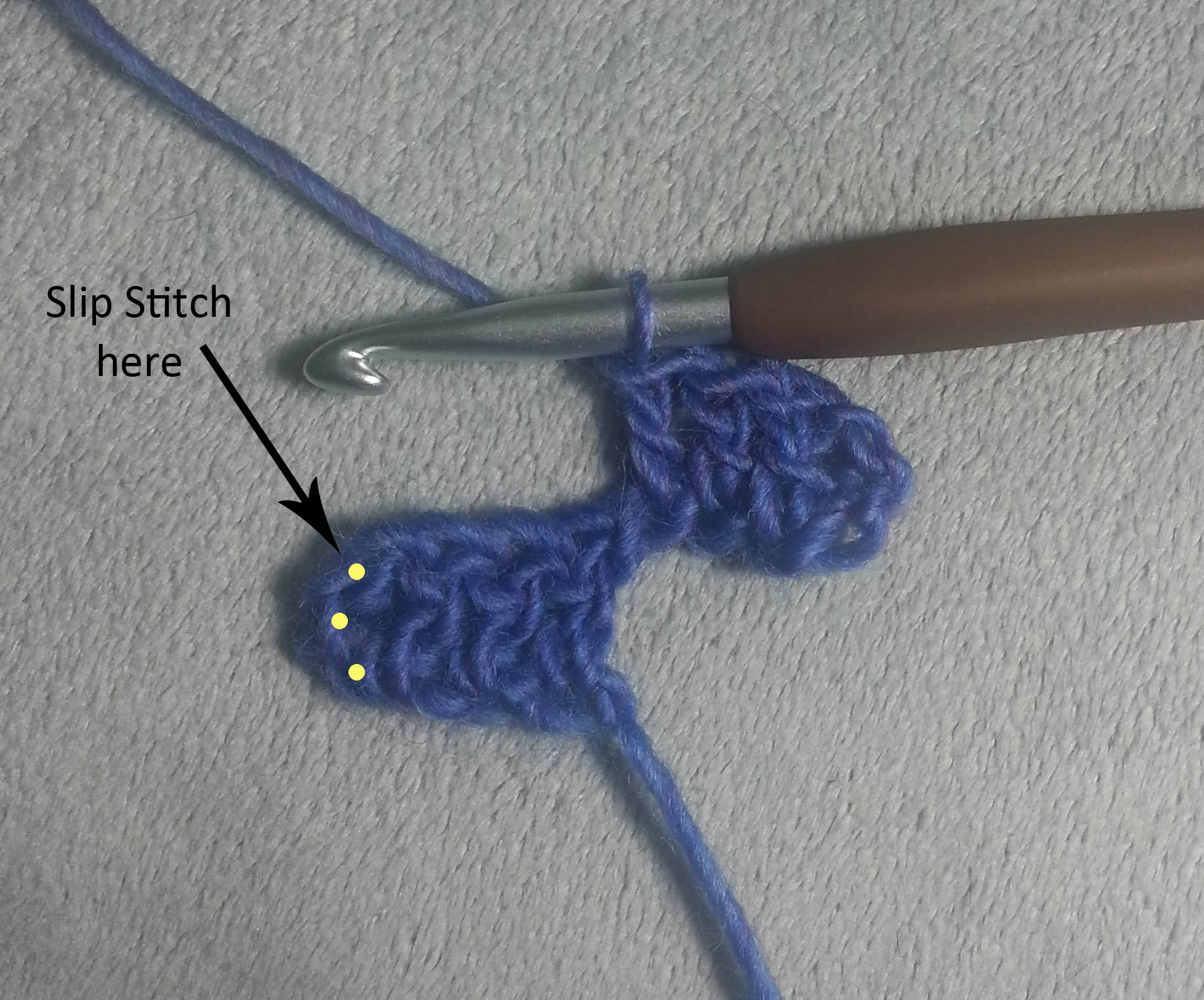
Once you have made that square, you flip up the first square to work in it’s begining chain 3. Marked in the photo above with yellow dots.

Row 2, Regular Square completed.

The second square for Row 2 is a Regular Square. This involves working a slip stitch, ch 3, dc all in the first chain stitch (first yellow dot on the right), then working a dc in each of the next 2 chains of that same square.

I prefer to crochet all my C2C squares by working into the chains. You can also work the Regular and Decrease squares by working into the space below the Ch-3, but this does give you a very different look to the overall fabric and the edges.

Once you have worked the number of increase rows you want for the size of your project, you will need to start decreasing along one side to keep your rows the same length (working “even”). Sometimes you will create your increase by working on top of the last square in the row and your decrease by not working on top of the last square in the row.

10 - Dec Sq part 1

When you need an actual Decrease square will be when your last square in the previous row ends next to the completed fabric. You will use a ch-3 to get your hook back to the right spot. The solitary yellow dot in the photo above is where you work the connecting slip stitch at the end of the previous row.

Sl st & Ch 3 in first ch of next ch-3.

Your ch-3 will be connected to the first chain of the next ch-3 (marked with 3 yellow dots) with a slip stitch followed by a chain 3.

12 - Dec Sq part 3

You then work the same as you would for a Regular Square. Continue working regular squares in the chain-3s marked with yellow dots.

Your next “even” row will begin like Row 2, with an Increase square, but will end with a square worked into the ch-3 of the next to last square of the previous row.

Beginning Decreases for 2nd Corner

Once you’ve crocheted the “even” rows to the length you want your project you need to make your second corner by decreasing at both ends of  each row. The red square in the above photo is where the last square is worked for that row.

14- Corner Dec R2

Next to last row of corner decrease.

15 - Corner Dec Final Sq

Final square for corner decrease, the last sl st is worked into the chain indicated with a blue dot in the above photo.

Now you are ready to make your own C2C project. Be sure to read thru the pattern thoroughly before starting, and refer to the tutorial above if you get stuck.

C2C Basics Scarf

Designed by Andee Graves

Skill level:       Easy

Finished Size:

Approximately 6”wide x 48” long

Materials:

Yarn

Ella Rae Seasons (76% Acrylic, 14% Wool, 10% Polymide; 3.52 oz/100g, 219 yds/200m) 1 ball

Hook

J-10 / 6mm

Notions

Yarn/tapestry needle

Stitch markers

Gauge

5 squares = 4 inches

Abbreviations/Special Stitches

Increase Square: Ch 6, dc in 4th ch from hook, dc in next 2 chs

Decrease Square: Ch 3, (sl st, ch 3, dc) in top of ch-3 of next square, dc in next 2 chs of same ch-3.

Regular Square: (Sl st, ch 3, dc) in top of ch-3 of next square, dc in next 2 chs of same ch-3.

Pattern Notes:

When working into chain stitches go under 2 strands of yarn.

Your beginning tail will help you identify the bottom right hand (or left hand) corner of your scarf when you begin working even rows. It is also helpful to mark the bottom (first) end of your scarf with a stitch marker.

Instructions

INCREASING FOR FIRST CORNER

Row 1/First Square: Ch 6, dc in 4th ch from hook, dc in next 2 chs. [1 ch-3, 3 dc]

Row 2: Ch 6, dc in 4th ch from hook, dc in next 2 chs, flip work up to (sl st, ch 3, dc) in top of ch-3 of 1st square, dc in next 2 chs of same ch-3. [2 ch-3, 6 dc {2 squares}]

Row 3: Ch 6, dc in 4th ch from hook, dc in next 2 chs, flip work up to* (sl st, ch 3, dc) in top of ch-3 of next square, dc in next 2 chs of same ch-3*; Repeat from * to * once. [3 ch-3, 9 dc {3 squares}]

Row 4: Ch 6, dc in 4th ch from hook, dc in next 2 chs, flip work up to* (sl st, ch 3, dc) in top of ch-3 of next square, dc in next 2 chs of same ch-3*; Repeat from * to * until work in ch-3 sp of last square in previous row. [4 ch-3, 12 dc {4 squares}]

Rows 5-7: Repeat Row 4. Count at end of Row 7  [7 ch-3 sp, 21 dc {7 squares}]

WORKING EVEN ROWS

Row 8: Ch 3, flip work up, *(sl st, ch 3, dc) in top of ch-3 of first square, dc in next 2 chs of same ch-3*; Repeat from * to * until work in ch-3 of last square in previous row.

Row 9: Ch 6, dc in 4th ch from hook, dc in next 2 chs, turn work to* (sl st, ch 3, dc) in top of ch-3 of next square, dc in next 2 chs of same ch-3*; Repeat from * to * until work in ch-3 of next to last square in previous row, sl st in top of ch-3 of last square in previous row. [7 ch-3 sp, 21 dc {7 squares}]

Rows 10 – 60: Alternate repeating Row 8 and Row 9.

DECREASING FOR SECOND CORNER

Row 61: Ch 3, turn, (sl st, ch 3, dc) in top of ch-3 of first square, dc in next 2 chs of same ch-3*; Repeat from * to * until work in ch-3 of next to last square in previous row, sl st in top of ch-3 of last square in previous row. [7 ch-3 sp, 18 dc {6 squares}]

Rows 62 – 66: Repeat Row 61.

Finishing

Fasten off, Weave in tails and block if desired.

Spirals and Squares

Fire Pit

************

October 29, 2015: Hello dear readers and new visitors just a little update to this post.

My Whirlwind Afghan Square is block #22 in the 2015 Moogly Afghan CAL.

If you hadn’t heard about the Moogly Afghan CAL it’s not too late to join the fun. You can hop on over to Mooglyblog.com to get all the details and see Tamara’s interpretation of my Whirlwind.

Thank you so much to Elke Wellens for providing a Dutch Translation of this pattern on her blog you can find her blog here.

Het Nederlandse patroon, vertaald door HET HAAKBEEST, kun je hier vinden. 

Check back on the blog next Tuesday, November 3, 2015. I’ll have the link to my YouTube video that will demonstrate how to crochet the first 12 rounds of this square.

************

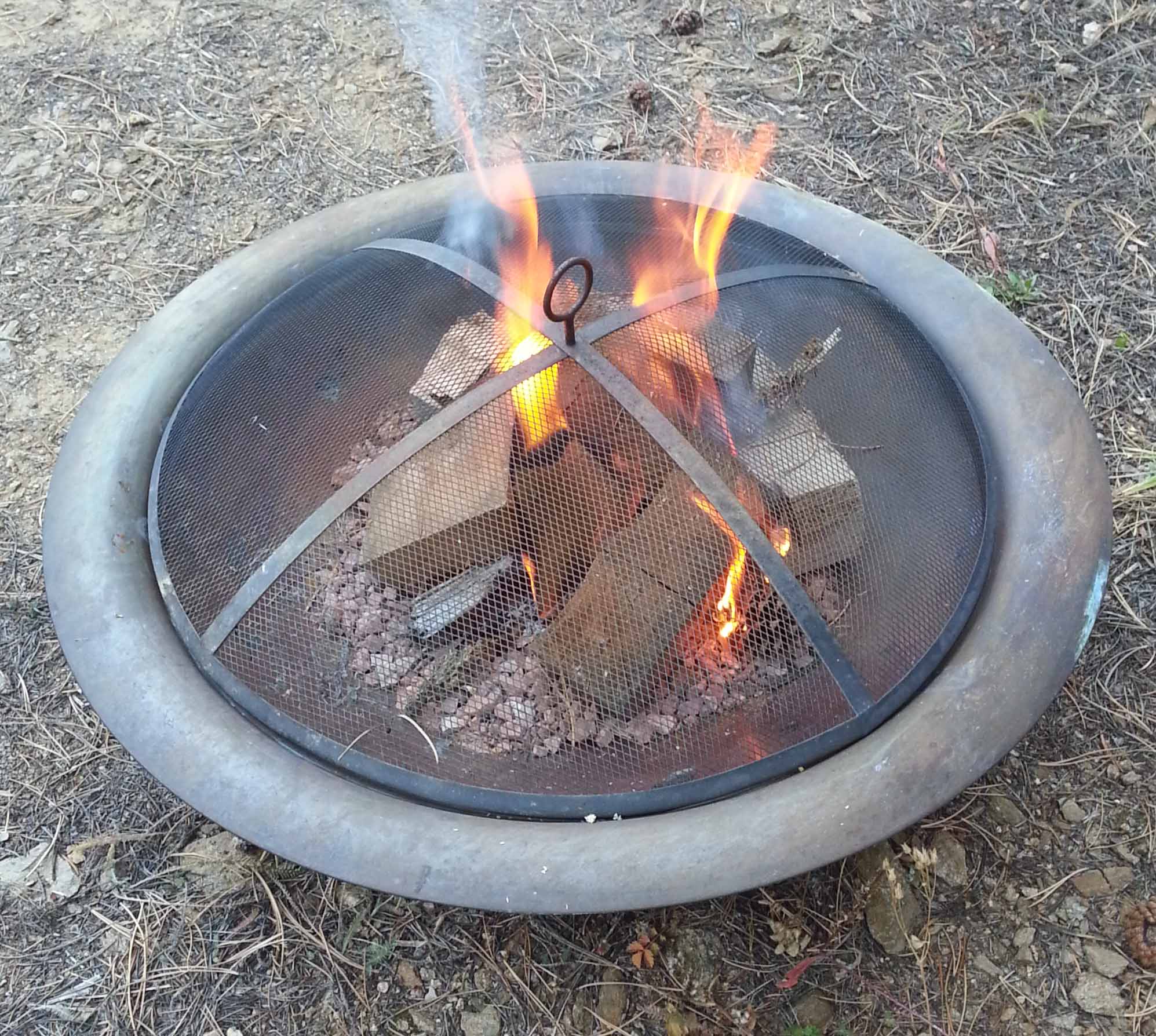
Yesterday was my 52nd birthday and I celebrated by spending most of my day goofing off, especially in the evening with my boys.  We built a fire in our outdoor fire pit and roasted hotdogs and marshmallows like we were camping out. Then I opened my cards and presents by firelight.

Today I’m continuing the celebration by sharing a new design here on the blog for all my lovely readers. This one is a little more complex than I usually share. In fact, one might call it a skill building pattern.

After all, we are celebrating my birthday so this pattern is going to be about many of the things I love in crochet. It uses a center-out construction, one of my favorite styles of design as the outside edges are all the tops of your stitches. It is also constructed round-to-square, which I find visually interesting. And of course, Spirals.

2 hands logo small

I love Spirals. You might be able to tell that just looking at my logo. I find them fun and intriguing. When I was in massage school I was very happy when I learnt that spirals are an common symbol for healing. Which is why I choose to use them in my logo.

Back in 2008, when I first became interested in free form crochet, I started exploring creating spirals in my crochet. Suddenly I was seeing spirals in so many of the crochet designs being published at that time.

Some of the instructions I found for working spirals were a bit wishy washy, which is more than fine for freeform work, but not so great for writing a pattern that others would want to replicate and get the same result. Thus my mathematical brain decided to enter the party.

Spirals are related to circles and circular geometries are always fun for me. Fortunately for those of you that might be a little math-adverse, you don’t have to understand all the numbers behind this design in order to crochet it.

One of the things I wanted to do was come up with a way to make working spirals easy for anyone to do. Especially when you are working with multi-arm spirals. For this pattern I started with a 4 armed spiral in the center this creates that round-to-square progression that I also like. I used the half-double crochet (hdc) stitch for my spirals because it takes 8 hdc to create a flat full circle which helps me take the circular spiral to a 4 cornered square.

When working spirals you need to work in continuous rounds.  This is generally the method of construction used for amigurumi and hats because it allows for a seamless appearance. That does mean that it can be easy to lose track of which round you are working on and if you have reached the end of your round. The solution for this is to use stitch markers.

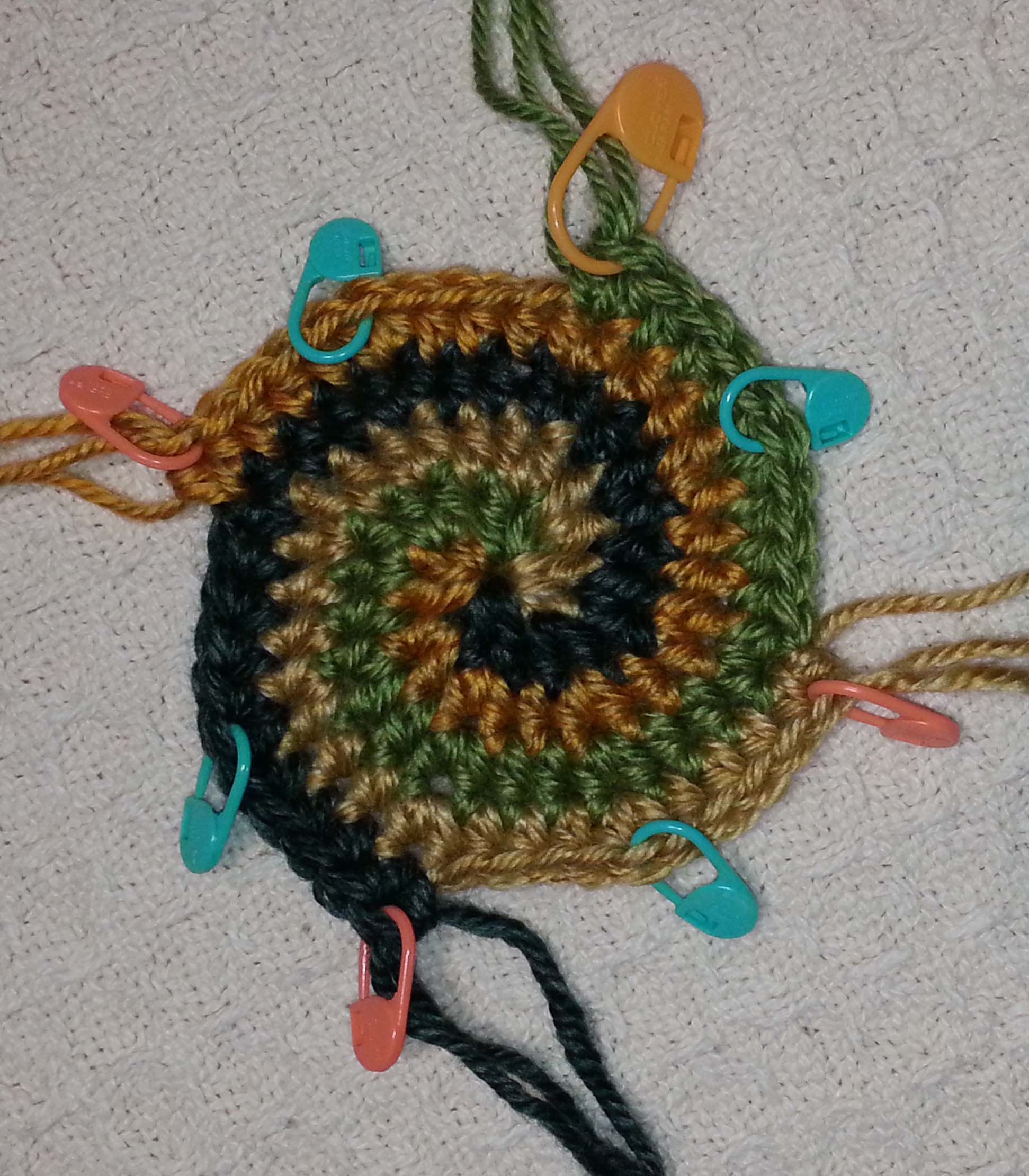
8 Stitch markers

For the construction of the first 8 rounds of this design I used 8 stitch markers. Having the 3 colors is really helpful. I love my Clover Locking Stitch Markers, but if you don’t happen to have any like that on hand you can use paper clips or coil less safety pins. Some folks like to use a spare bit of yarn for a stitch marker, but I find those tend to get pulled out of my work too easily.

First 5 rounds w Markers

This photo shows the first 5 rounds of my square completed and the placement of the stitch markers. The large yellow marker is marking the last stitch of the full round, as well as the last stitch of that section of color and the increase point. The other orange markers are marking the last stitch of that section of color and the increase point. The green markers are marking the first increase point in the various color sections. Whatever type of stitch markers you use you need ones that allow you to distinguish between the end of round/increase (1), end of color section/increase (3) and the first increase in each color section(4).

Whirlwind Square - M2H Designs

Whirlwind Afghan Square

Designed by Andee Graves

Skill level:     Intermediate

Finished Size:

12” square

Materials:

Yarn

Worsted wt (Sample uses Lion Brand Yarns “Heartland” 100% Acrylic (5 oz/142g, 251 yd/230 m)

I picked the colors of October up here on my mountain, but you can choose any 5 colors that you like together. Alternating light and dark will make the spiral in the center stand out more.

Color A: #169 Shenandoah (sample used approximately 8 yards)

Color B: #180 Kings Canyon (sample used approximately 12 yards)

Color C: #158 Yellowstone (sample used approximately 10 yards)

Color D: #173 Everglades (sample used approximately 10 yards)

Color E: #124 Big Bend (sample used approximately 9 yards)

Hook

I / 5.5mm

Notions

Yarn/tapestry needle

8 Stitch markers in 3 colors (1 in first color, 3 in next color, 4 in last color)

Gauge

First 5 rounds of pattern = 4” in diameter

Abbreviations/Special Stitches

PM – Place stitch marker

Standing Single Crochet – make slip knot in yarn and place loop snugly on shaft of hook, insert hook into indicated st, yo, pull up a loop, yo, pull thru both loops on hook.

Standing Double Crochet – make slip knot in yarn and place loop snugly on shaft of hook, yo and insert hook into indicated st, yo, pull up a loop, (yo, pull thru 2 loops on hook) twice.

Pattern Notes:

Start square with an adjustable slip knot. Beginning tail tightens the loop on the hook. If you don’t know how to do an adjustable slip knot you can see a tutorial on my blog here, or watch this video on my YouTube channel.

First 9 rounds use 4 colors. Each color is 1/4 of the total stitches in the round, you will need to insert your hook back into the dropped loop as you come to the new color, snug that loop up to the shaft of your hook and begin working the stitches as instructed in the new color. Follow instructions for using stitch markers so you don’t lose your place.

Color 1 of stitch markers is used to mark last stitch of entire round as well as last stitch/increase point of that color section.

Color 2 of stitch markers is used to mark the other 3 last stitch/increase point of color sections.

Color 3 of stitch markers is used to mark the first increase point in each color section.

When working the first 9 rounds move stitch markers up to 2nd stitch worked in each increase point.

When ending Round 9, the 2nd sl st is a tight one for final “step-down” of spirals, you will not be working into this stitch in Round 10.

For concentric rounds where changing colors attach yarn with a standing stitch.

If you have an easier time understanding a video then reading a pattern, visit my YouTube Channel to watch:

Whirlwind How-to Part 1 and Whirlwind How-to Part 2

Instructions

Rnd 1: Starting with color A make an adjustable slip knot, ch 2, (sc, hdc) in 2nd ch from hook, pull up a long loop and remove hook, with color B *insert hook in center/first ch of round, pull up a loop on hook, ch 1, (sc, hdc) in same center/ch, pull up a long loop and remove hook,* ; Repeat from * to * with Color C and D. PM in each hdc w/end of color/round markers (placing single color marker in hdc of Color D), PM in each sc with first increase markers. [4 sc, 4 hdc]

Rnd 2: *2 hdc in next 2 sts, move st marker to 2nd st worked in each st, pull up long loop and remove hook**, insert hook in next color*; Repeat from * to * 2 times; Repeat from * to ** once. [16 hdc]

Rnd 3: *(Hdc in next st, 2 hdc in marked st, move st marker to 2nd st worked) 2 times, pull up long loop and remove hook, insert hook in next color*; Repeat from * to * 2 times; Repeat from * to ** once. [24 hdc]

Rnds 4 – 8: *(1 hdc in each unmarked st, 2 hdc in marked st, move st marker to 2nd st worked in marked st) 2 times, pull up long loop and remove hook,** insert hook in next color*; Repeat from * to * 2 times; Repeat from * to ** once. Stitch count for end of Rnd 8 [64 hdc]

Rnd 9: *hdc in next 7 sts, 2 hdc in next marked st, move st marker to 2nd st worked in marked st, hdc next 6 sts, sc next st, sl st next st, ** insert hook in next color*; Repeat from * to * 2 times; Repeat from * to ** once. Make 1 additional sl st in next st for each color, fasten off yarn, remove end of round markers. [8 sl st, 4 sc, 60 hdc]

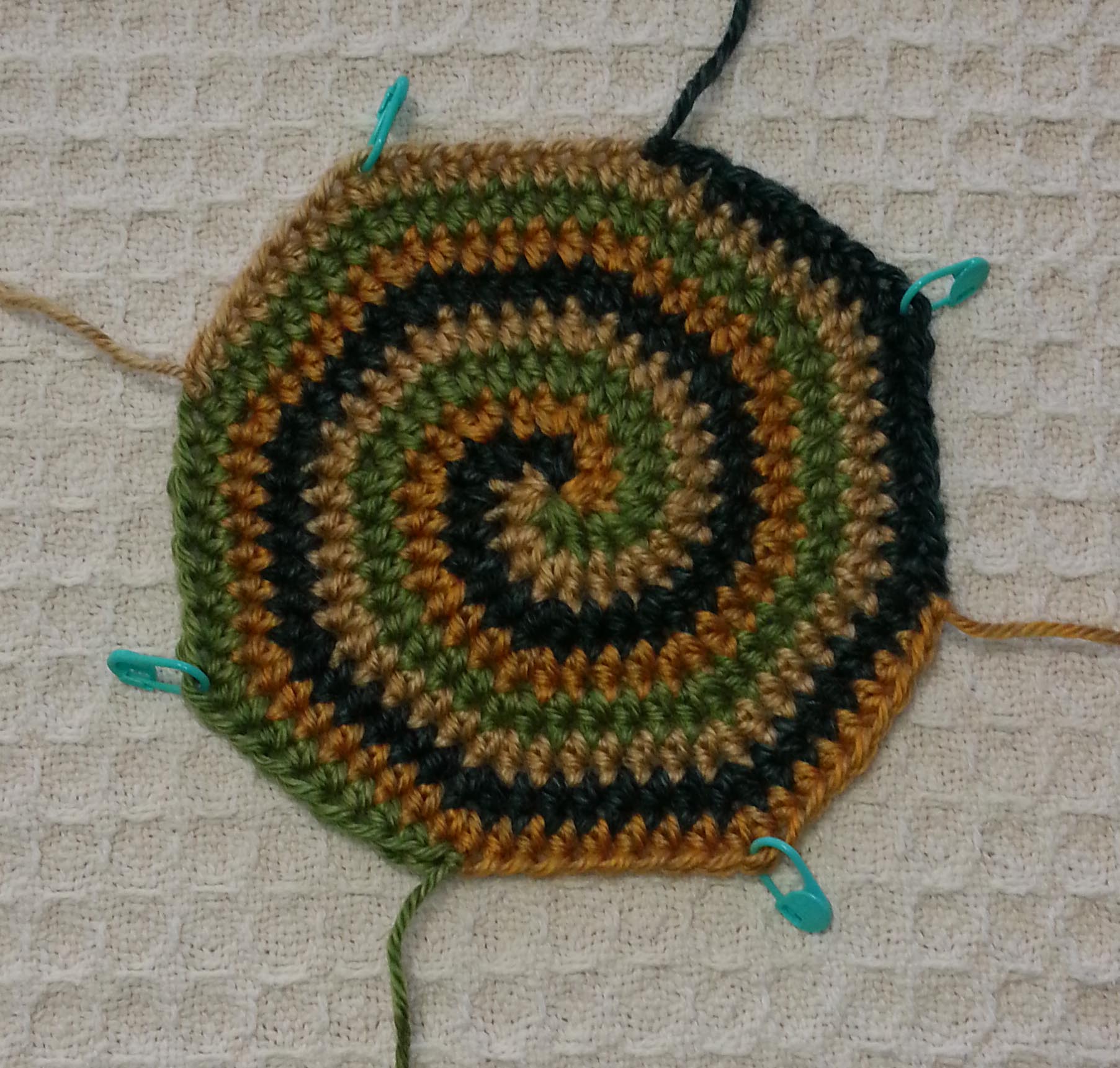
End of Rnd 9

Rnd 10: Attach color E with a standing sc along any side in same st as the second slip st of any color section from Rnd 9, sc next st, *Hdc next 3 sts, dc next 2 sts, 2 dc next st, (Tr, ch 1, Tr) in marked st, 2 dc next st, dc next 2 sts, hdc next 3 sts**, sc next 4 sts*; Repeat from * to * 2 times; Repeat from * to ** once, sc next 2 sts, sl st to first sc of round. Fasten off current color. Move increase st markers to ch-1 sp. [16 sc, 24 hdc, 32 dc, 8 tr, 4 ch-1 sps]

Rnd 11: Attach new color along any side in 11th st from marked ch-1 sp in direction of work, with a standing sc, sc next 2 sts,*hdc next 3 sts, dc next 3 sts, 2 dc next st, (Tr, ch 2, Tr) in marked ch-1 sp, 2 dc next st, dc next 3 sts, hdc next 3 sts**, sc next 6 sts*; Repeat from * to * 2 times; Repeat from * to ** once, sc next 3 sts, sl st to first sc of round. Fasten off current color. Move up increase st markers to ch-2 sps at corners. [24 sc, 24 hdc, 40 dc, 8 tr, 4 ch-2 sps]

Rnd 12: Attach new color along any side in 11th st from marked ch-2 sp in direction of work, with a standing dc, *dc in each st until reach next marked ch-2 sp, (2 dc, ch 2, 2 dc) in marked ch-2 sp*; Repeat from * to * 3 times, dc in each st until reach beginning of Round, sl st to first dc. Fasten off current color. Move increase st markers to ch-2 sps at corners. [112 dc, 4 ch-2 sps]

Rnds 13 – 16: Repeat instructions from Rnd 12. Fasten off. Stitch count at end of Rnd 16 [176 dc, 4 ch-2 sps]

Finishing

Weave in tails and block.

A big Thank You to the folks at Lion Brand Yarn for supplying the yarn for this design. I really love the colors that their Heartland yarn comes in. Hop on over to their website to check it our for yourself.

The lovely Adjustable Slip Knot

Hot Spot Square copyright 2015 M2HDesigns/Andee Graves
Hot Spot Square
copyright 2015 M2HDesigns/Andee Graves

If you have worked one of my hat or motif patterns you may have seen me reference the Adjustable Slip Knot at the beginning of my pattern instructions. I’ve blogged about it before, but I wanted to review it with you today.

I first encountered this technique in a class with Dee Stanziano, but it took me awhile to really understand how I was doing it. Most of my successes came around by happy accident.

The Adjustable slip knot method allows room to work the first round of stitches and yet end up with a snug center. The most important thing to remember: when you’ve made this slip knot correctly the beginning tail tightens the loop around your hook.

Typically when we make a slip knot to start a crochet project we create the working loop (the loop on our hook when we start) from the working yarn (the yarn coming from the ball of yarn). This creates a very stable first chain loop.

An adjustable slip knot creates the working loop from the beginning tail of your yarn. This allows the size of your first chain loop to be adjusted even after working into it with subsequent stitches.

Beg Tail over working yarn web

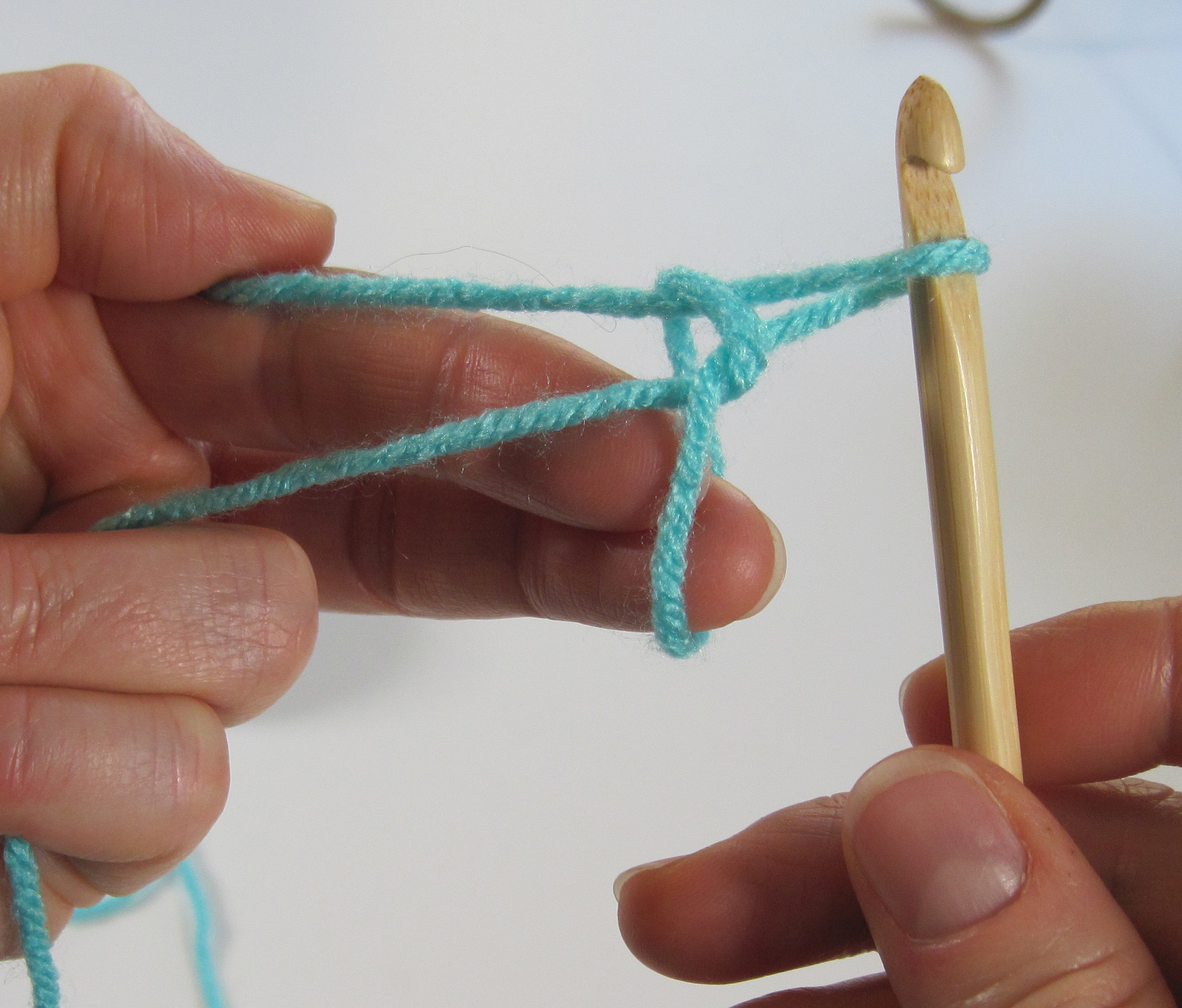
1. Hold the working yarn across your palm, wrap beginning tail around 2 fingers making an X over the top of the working yarn.

Insert hook under working yarn web

2. Insert hook under both strands of yarn and hook the beginning tail,

Pull up loop under wrkg yarn web

pull up a loop under the working yarn strand.

Sliding knot loop off fingers web

3. Holding the yarn strands, slide the loop off your fingers.

Loop on hook web

4. Holding the beginning tail end and working yarn continue to pull up a loop and gently snug the yarn to create the slip knot.

Round 1 expanded sl knot with labels

Begin working your first stitches according to the pattern. Tip: when working into the first chain loop, work under one of the “legs” of the V to get the best result.  Leave a long enough tail for your first round to expand the slip knot.

Tightening-Tail

Once you’ve finished working into the first chain, gently pull on the beginning tail to tighten the center of your round.

I’ve used this start in a number of the patterns I have here on the blog.

Annetta Square

Hot Spot (Annetta Square #2)

Sparkly Jar Cover (doesn’t specify using the Adjustable Slip Knot, but it’s a lot easier with it)

The Humble Granny Square

Simple Sweetheart (again doesn’t specify it in the directions, but it is how I worked that first round)

Little Snowflake Ornament (this pattern is a stitch diagram only, but that big circle in the middle is your first chain, and it’s much easier to work into if it’s an Adjustable Slip Knot)

Summer Shower Scrubbie

Spiral in a Heart (doesn’t specify in the directions, but again it is how I worked that first round)

Little Bitty Noggin Cap (same as some of the others, the Adjustable Slip Knot isn’t specified, but it is how I worked it)

Pretty Petunia (as above, not specified, but much easier to work the first round using an Adjustable Slip Knot)

So try out the Adjustable Slip Knot for yourself and see how you like it. You may find it becomes your favorite start for a project.

Update: I now have a video on my YouTube channel that shows how to make this slip knot for those of you that find that an easier way to learn. Adjustable Slip Knot Video.

Swatching and more Swatching, and Why that is good.


I’ve got a BIG project I just agreed to. I can’t tell you a lot about it yet. But I spent most of my weekend crocheting up swatches to figure out the amounts of yarn I would need to finish the samples for the project.

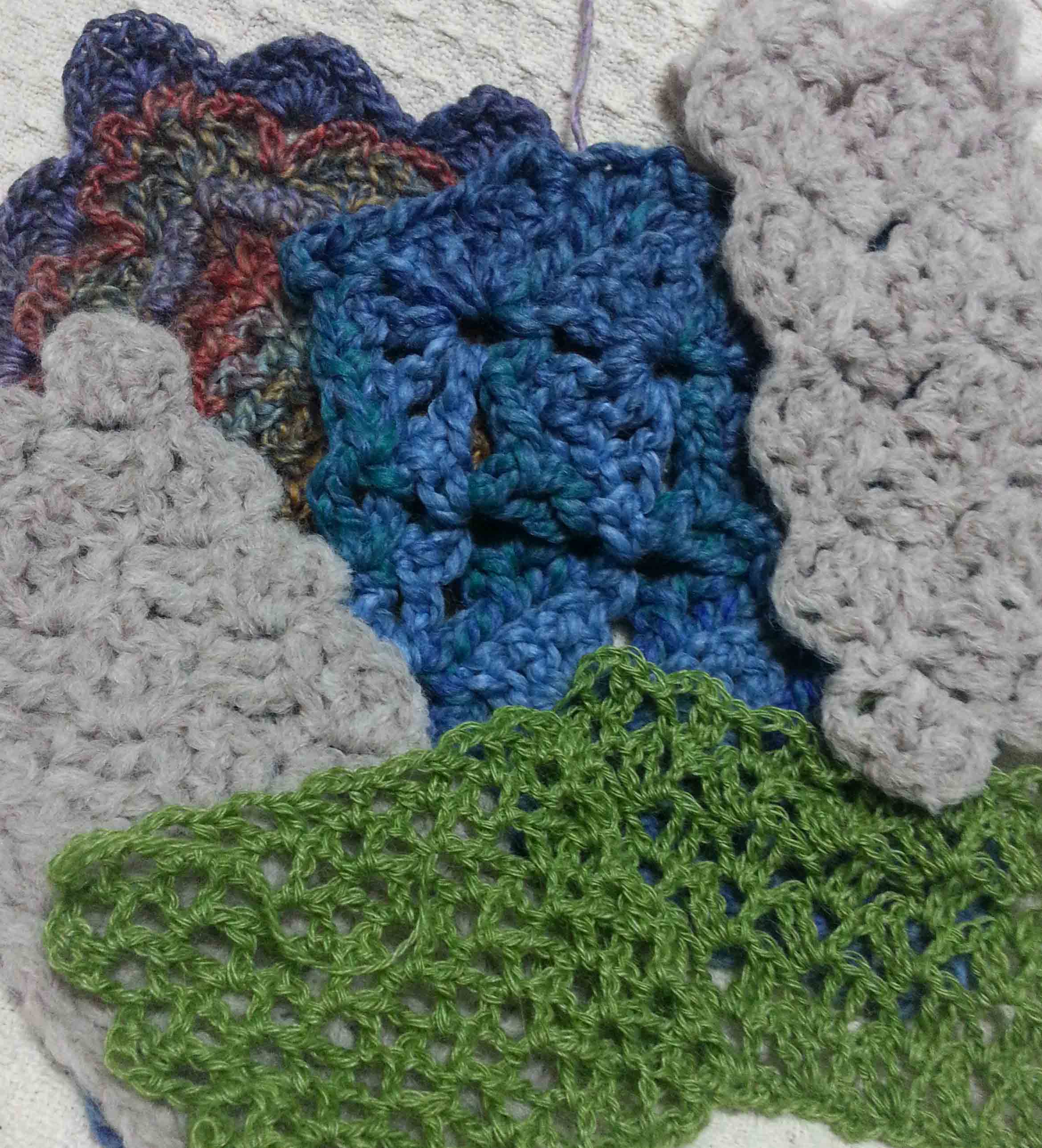
Pile of Swatches

The pile above is what I ended up with. Some of these yarns are just too lovely for words and I am really looking forward to crocheting the final pieces.

Next step, as I wait for yarn to arrive, is to write the first draft of the patterns for these designs. Because I am a geek I tend to swatch, do a bunch of math, write the pattern, then work the sample from that pattern.  It is the method I’ve found works the best for me. Then I can make corrections or additions to the pattern as I encounter trouble spots while stitching.

Photo Courtesy of Annies
Photo Courtesy of Annies Publishing

An example of this process was my Winged Columns Wrap in the Crochet! Magazine presents: Fall 2014 Special: Crochet Gifts in 1-2-3.

Stole Wrap Sketch 4web

Originally I submitted the idea for a smaller accessory, but had included a sketch and description of it as a rectangular wrap. The editor decided she wanted it as a wrap. She and I discussed the size of wrap she wanted. We decided on approximately 18″x 60″.

I then swatched with the yarn she had chosen, Premier’s Alpaca Dance. My swatch was 6″ x 6″. I then weighed my swatch in grams. That allows me to calculate how many yards of yarn are in the swatch. According to the ball band information there are 371 yards in a 100g ball of yarn. So 3.71 yards/gram.

The target size of my finished stole was 18 x 60 = 1080 square inches. My swatch was 36 square inches and took 23.4 yards to make. 1080 divided by 36 = 30. 30 x 23.4 = 702 yards. Which means I needed 2 balls of yarn to make the sample.

Now, how does this all help you?

Have you ever wondered if you have enough yarn to complete a project? Swatching in the stitch and yarn you will be using, then weighing it can get you there. Once you know the weight of your swatch and what size your final project is supposed to be, you can tell if you will need to go purchase more yarn.

Of course, once you are purchasing yarn you might find some other yarn that needs to join your household too. Yarn shopping does tend to add to our stash. But using the above formula, you’ll always know if you’ll need more yarn for the current project (or the next one).

Getting the Twist Right

Anna Moebius Cowl - Andee Graves M2H Designs

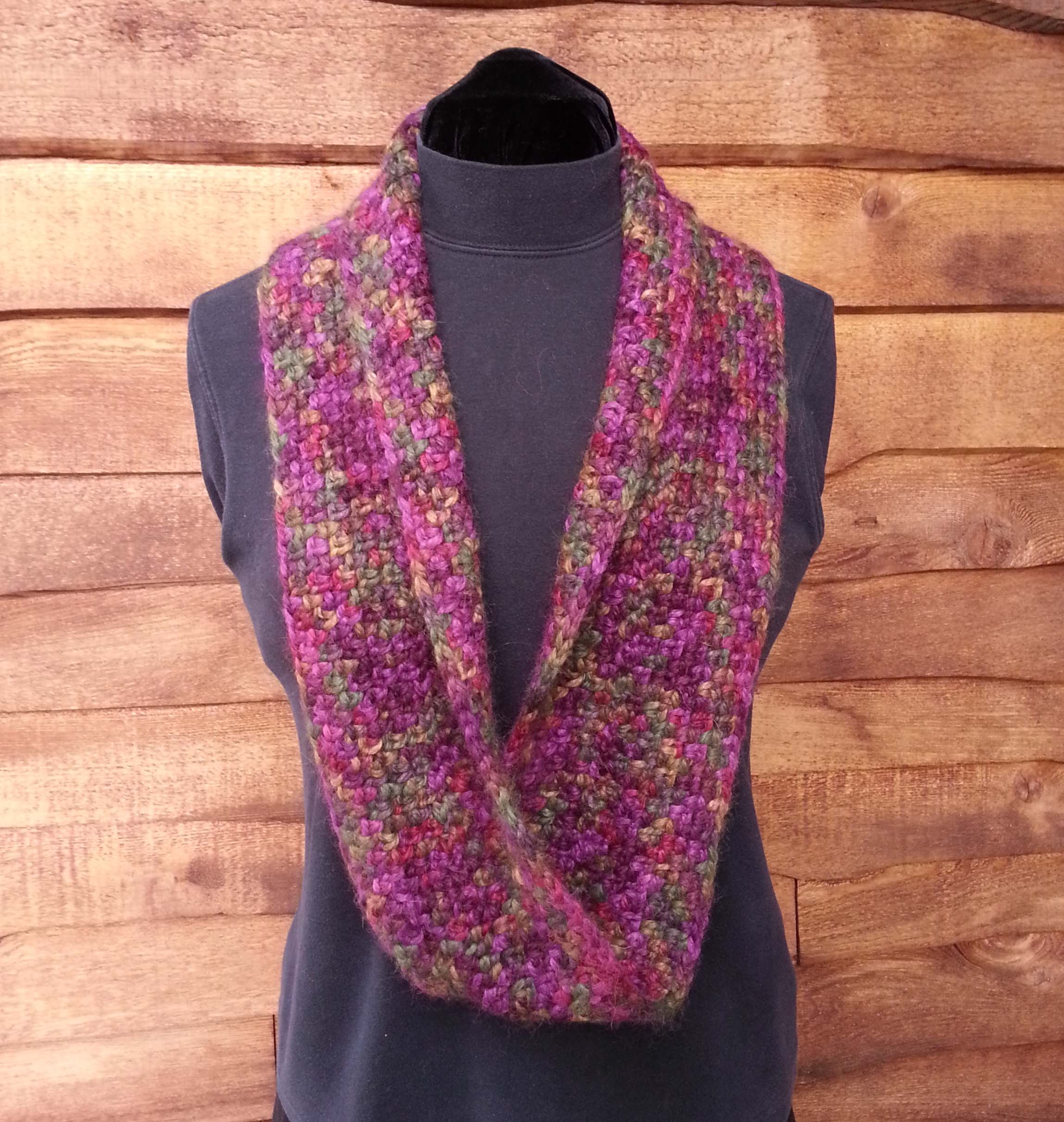
Hopefully most of you reading this post got to participate in the “Hop” I was part of last Tuesday, and now you are the proud owner of my pattern for the “Anna Moebius Cowl”.  The moebius is one of my favorite shapes to use in designs as you can see below, all 3 of these designs (as well as the Anna Moebius Cowl) start the same.


Infinite Grande Cowl - M2H Designs
Infinite Grande Cowl – M2H Designs


Twisted Garden Cowl - M2H Designs
Twisted Garden Cowl – M2H Designs


Twisted Vs Cowl - M2H Designs
Twisted Vs Cowl – M2H Designs

Today I’ve created a little photo tutorial with tips on creating your foundation to begin any of these cowls. I use this same foundation in almost all of my moebius designs, so once you get the hang of it you’ll be set to try my other patterns.

FSC toplast btm1st 4web

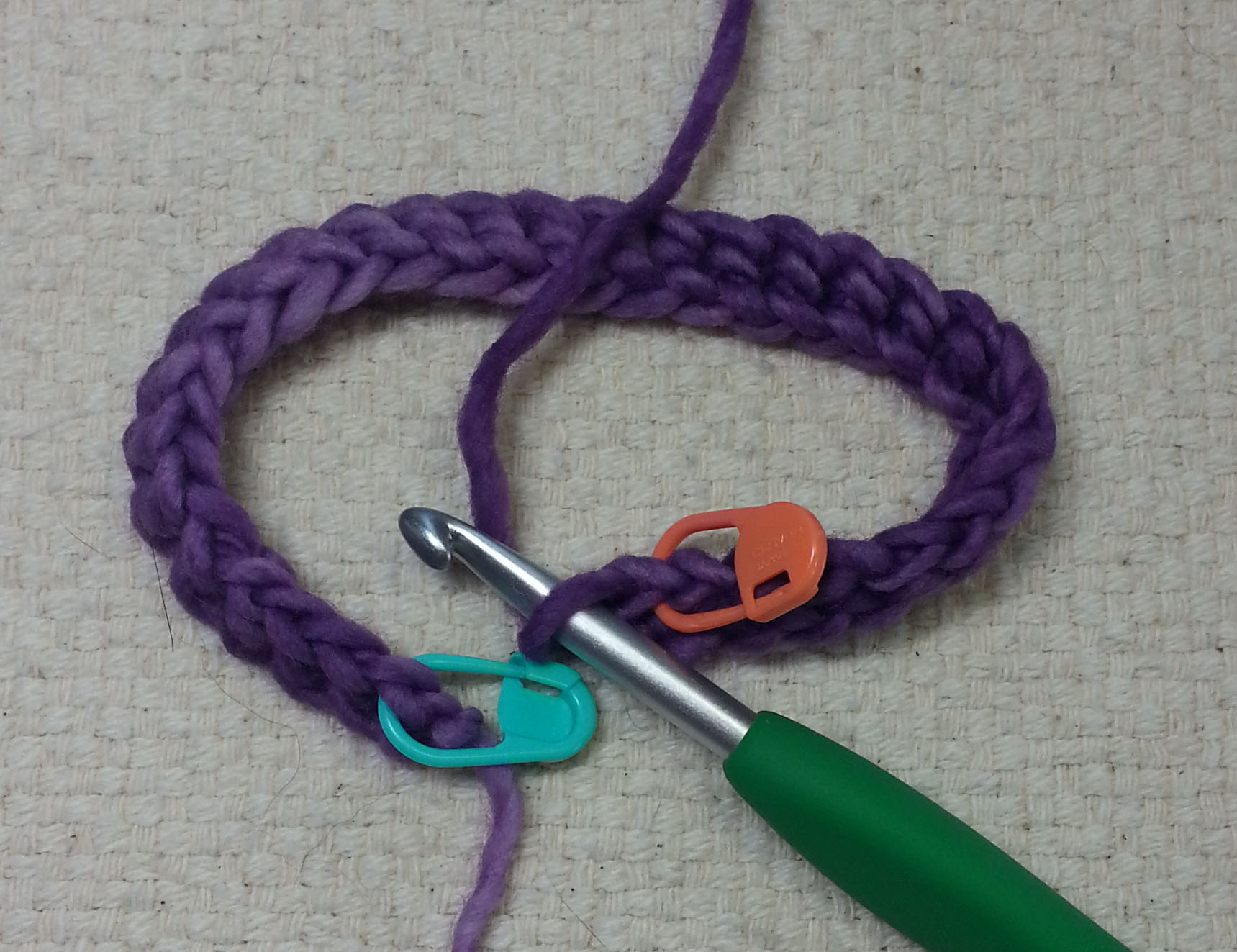
When you finish the length of foundation single crochet that the pattern specifies lay it out flat. The stitches have a top and bottom. The green stitch marker is in the bottom of the first stitch and the orange marker shows the top of the last stitch.

Fold ends together 4web

Fold the foundation to bring the 2 ends together.

Circle to match top to btm 4web

To get the moebius twist you only want to add 180 degrees of twist. Which means you join the top of the stitch where your hook is, to the bottom of the first stitch you made.

Slip St Closure 4web

I use a very tight slip stitch.

Beg Crchtg Rnd1 4web

I usually let the beginning tail hang and then later use it to tidy up the join between the ends of the foundation. Meanwhile I just start crocheting my moebius.

Rchd Opp side 4web

When you get to the join you will be on the opposite side of the foundation from your beginning.

Rchd Opp side2 4web

You are working into the bottoms of your foundation stitches and then into the tops of those same stitches as you crochet your first round. You will have doubled the number of stitches in your first round from the number you made for your foundation.

Little Mini Moebius
Little Mini Moebius

Paper Moebius Strip

If you want to learn more about moebius strips and my geeky fascination with them take a look at my post: The Twists and Turns of a Moebius.

Blocking with a Twist

Beauty shot wide 4web

My latest moebius pattern is available thru my Ravelry Shop “Infinite Grande Cowl”. This a super simple long cowl designed in a luscious baby alpaca chunky yarn, Plymouth Yarn’s Baby Alpaca Grande. The hardest aspect of this pattern is the Foundation Single Crochet length and being sure you get your moebius twist correct. The rest of the pattern is single crochet, chains and slip stitches. Pattern instructions are in text using U.S. crochet terminology and stitch diagrams.

You can find the pattern on Ravelry,  Click here to buy it now.

Looking at the patterns I have available you can see that my favorite foundation to use for a cowl or “infinity” scarf is a moebius. But a moebius does present you with some interesting challenges when it comes to blocking your finished project.

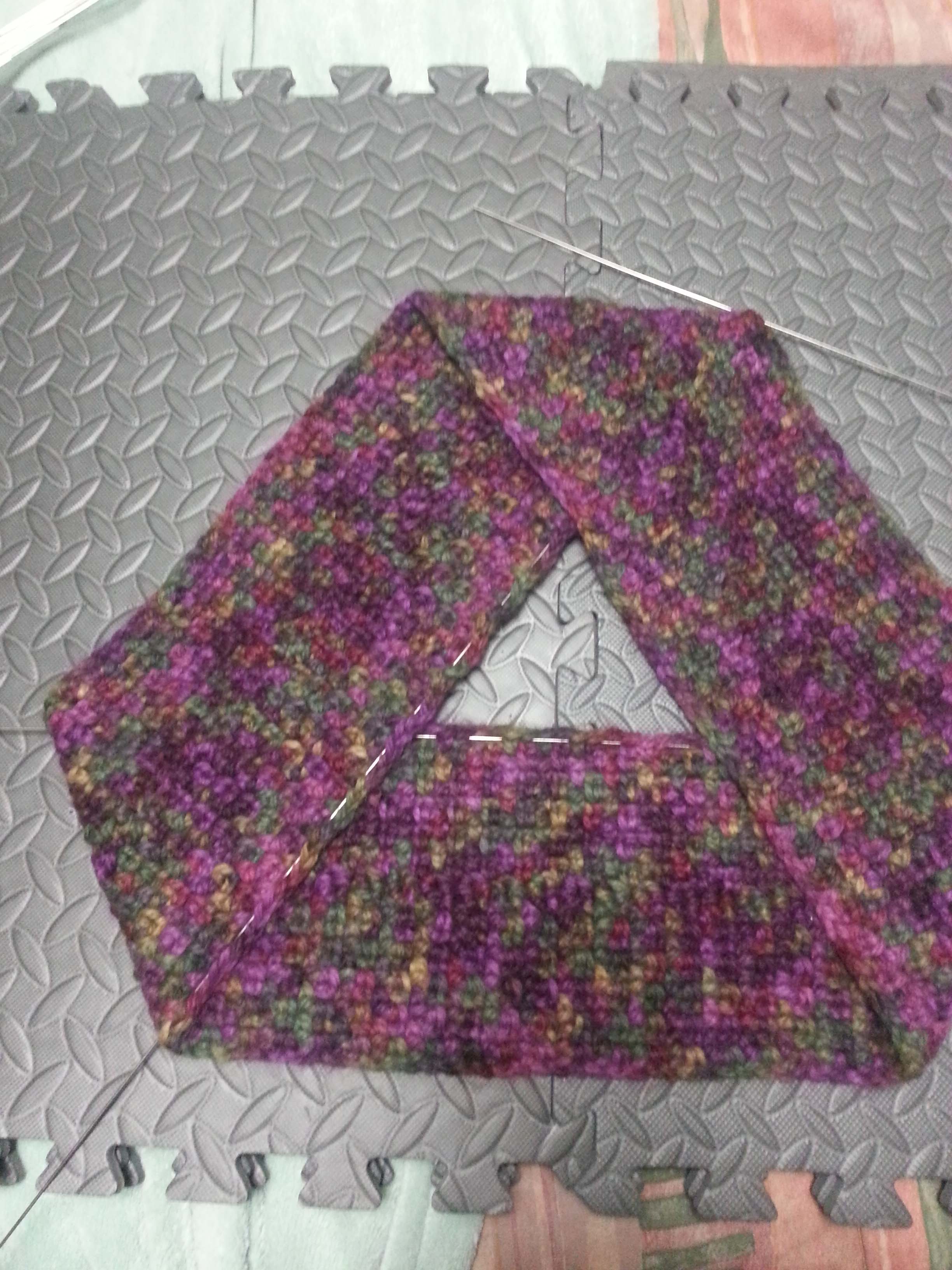
Laying out Moebius

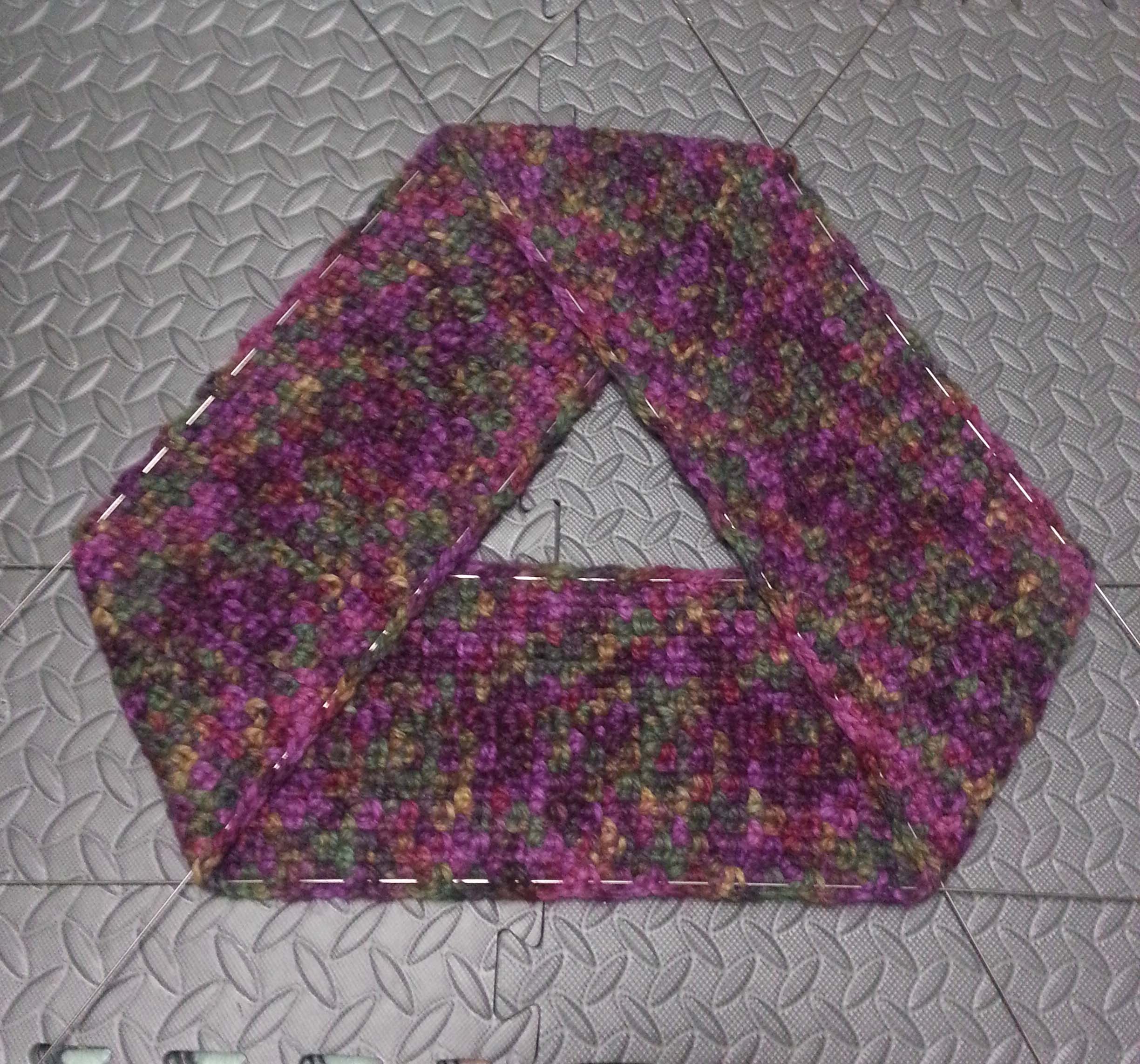
Because of the twist in the fabric a moebius doesn’t lay flat like most other projects. The best way to “flatten” a moebius is to lay it out in a triangular shape like above.

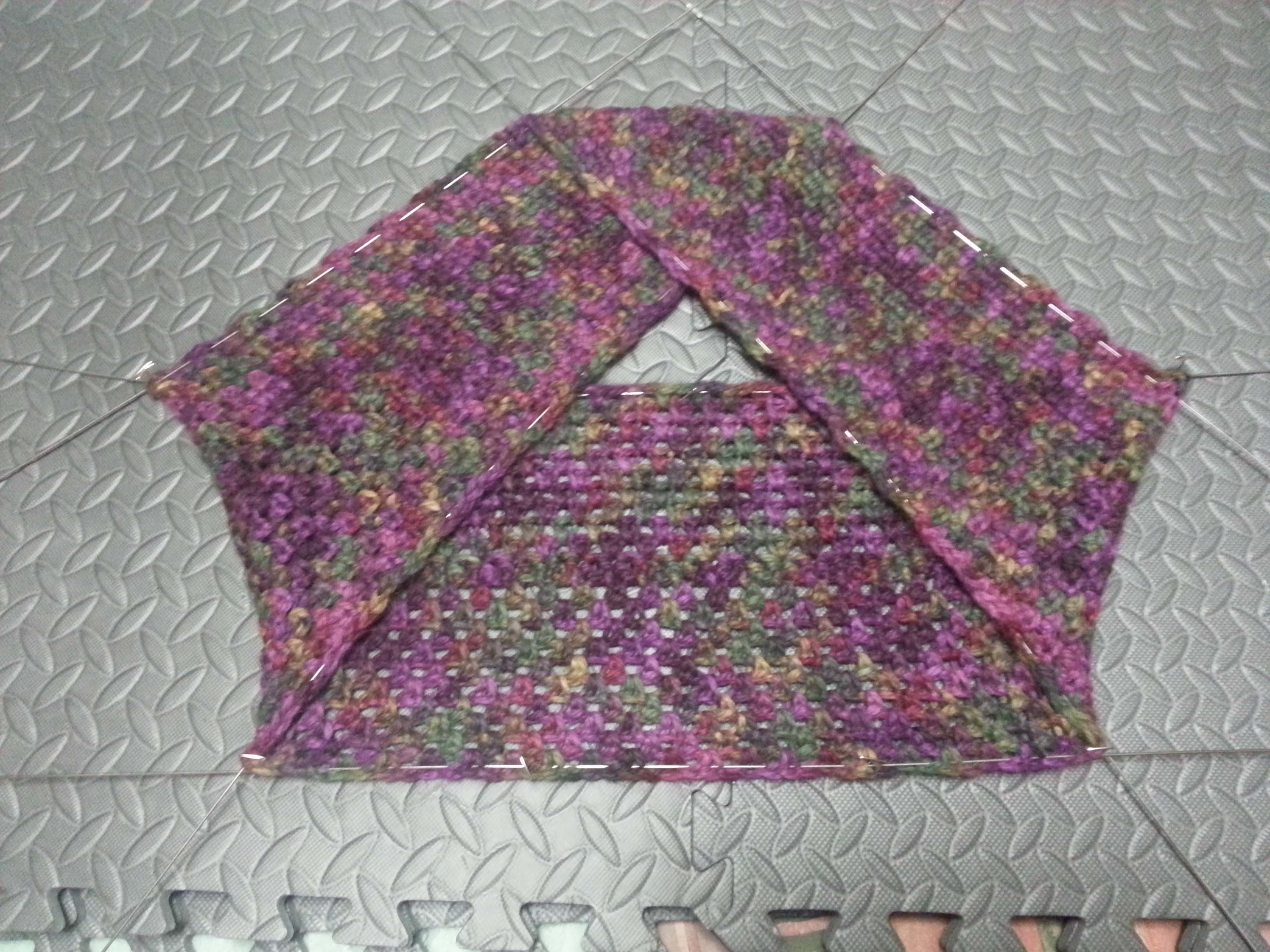
Fold and weave in first wire

I like to block using my blocking wires. So my next step in blocking a moebius is to fold the “top” of the triangle down to expose the top edge of the bottom strip in the triangle. I then wove in one of my long blocking wires along that edge.

Mark corner and weave 2nd wire

I then return the top of the triangle to the mat and flatten it out. The first wire sticks out of the corners on the bottom strip. I marked the top corner then weave my next wire along the inside edge of the next level of my moebius strip.

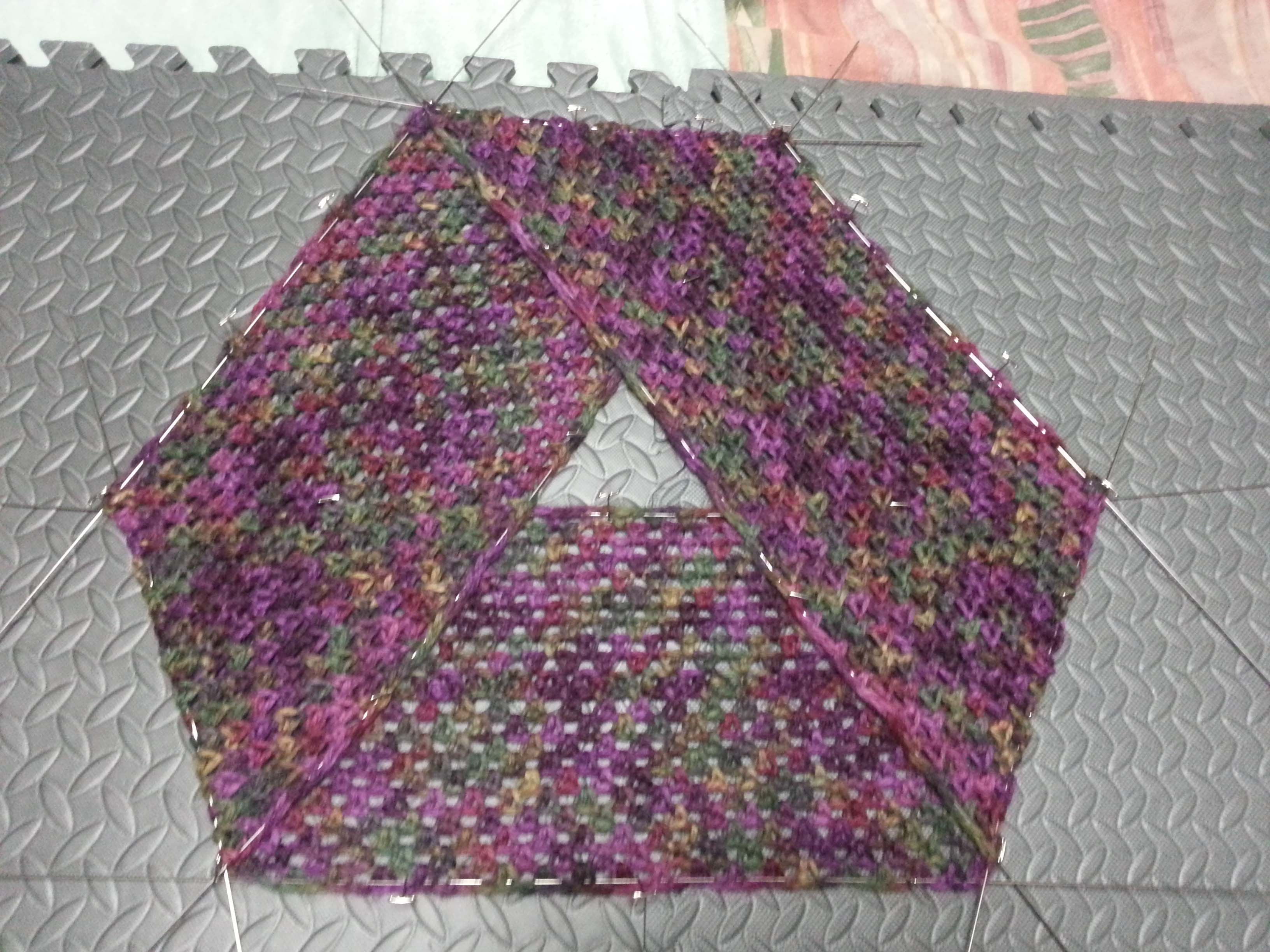
3 wires woven along inside edges

Last inside edge gets it’s wire next.

Wires woven along edge

Now I weave wires thru the outside edges. We are ready to begin stretching out the project for blocking.

Beginning to pin out

I tend to be pretty aggressive when I block and open the stitches as much as possible. I pin the bottom outside edge in place, then shift the inside wire upward to stretch open the fabric. I use nickel-plated T-pins to hold the wires in place. Nickel is important to use in blocking as it doesn’t rust and won’t mark your fabric when it is wet.

All stretched out

I work my way around the moebius pinning and stretching until I am happy with how much I’ve opened the stitches. Part way thru the stretching I realized I needed to place wires thru the “folds” at each corner of my triangle to keep the stretch from deforming the fabric. I just slipped the wires under the top layer of the strip at the corners.

Blocking paraphelia

Once everything is pinned out how I wanted I heated up my hand-held steamer and steamed the open fabric. I let it sit for about an hour to dry completely and then my cowl was ready to be photographed. Being this cowl is alpaca the stitch work didn’t open up tremendously, but the overall fabric was smoother and draped nicer afterward.

Now you know one of the ways to block a moebius. I hope you enjoy crocheting some in your projects. They are one of my favorite shapes to crochet.