Inline vs Tapered

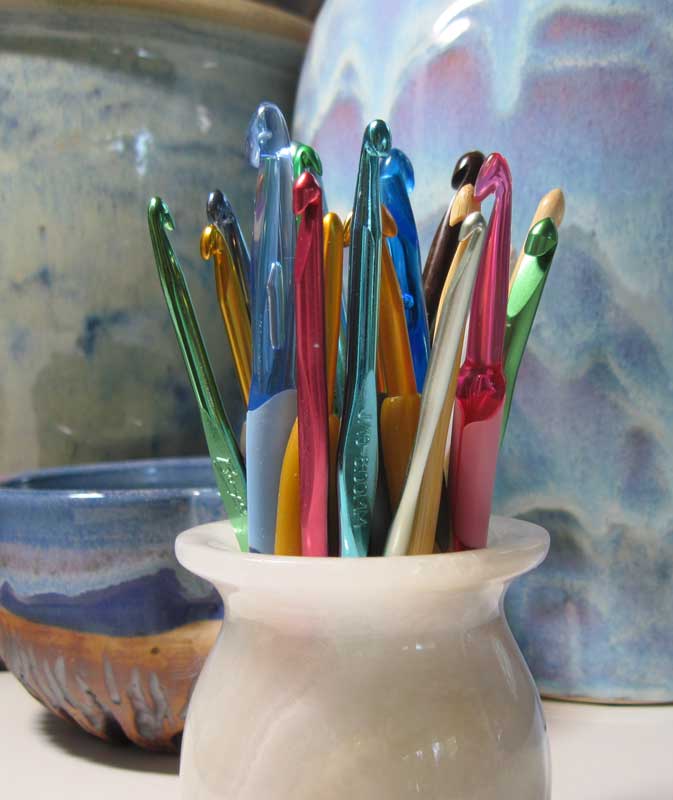
This little vase full of hooks is only a small representation of the hooks I own. There are times when my friend Janet and I laugh about which of us has the worst case of H.A.S. (hook acquisition syndrome for those of the uninitiated amongst my readers).  I show you this bouquet to demonstrate that I love all types of hooks.

If you are an American crocheter or even if you spend much time on the Crochet boards at Ravelry (or possibly any other crochet sites), you have likely heard numerous debates of the merits of Boye versus Susan Bates hooks.

Much of that discussion is about the shape of the throat. Tapered or In-line. All hooks fall into one of these categories for the most part.  Boye is a very good example of Tapered shaping and Susan Bates hooks are a very good example of In-line shaping. (There are changes in the shaping of Boye and Bates hooks depending on the year and where they were made, but that is a subject for another post at a later date).
Tapered hooks throats are generally shaped with a strong narrowing from the “shaft” of the hook  to the head.

In these images you can see a continuum of hook throat shaping. Starting on the left with the very tapered Boye hook and ending on the right with the strictly in line shape of the Susan Bates hook. The wooden hook is a Laurel Hill hook, they are a bit unusual in that the throat is mostly in-line but the overall shaping is tapered starting from the thumb rest thru the point.

When I teach beginning crochet I prefer that students use an in-line style hook.  Beginning students tend to have a very tight tension on their yarn and more commonly they have a harder time with that using a tapered hook. A tapered hook allows the yarn loop to become smaller as it is pulled up the throat of the hook, making stitches harder to work into in subsequent rows, these 2 things combined don’t trend toward a positive first crocheting experience. 

With an inline hook  most beginners can keep their loops a consistent size, making it easier to work into their stitches. Though the beginner death grip can still get tight tension even with an in-line hook.

If you are past the beginner stage of your crocheting though it’s time to branch out. Whatever style of hook you started with, try the opposite. Especially if you are having particular difficulty with a yarn. Oftentimes switching the style of hook or size of hook can help.  As many of us know, not all yarns are right for all projects. The next thing to keep in mind is that not all hooks are right for all yarns.

And the hook I find ideal for a certain yarn and project, might not be the right one for you.  We all tend to use our tools with slight differences. One of the reasons that our handwriting can look quite different.  Same is true of crochet hooks.  An example, I adore the Tulip Etimo hooks, but some crocheting friends of mine find them not their cup of tea at all.

The best way to find out which hooks will work for you is to take the time to play with some yarn and a variety of hooks.  Afterall, playing with yarn is a pleasure we can all agree on, whether we think we prefer In-line or Tapered hooks.
Seriously Pink

Hot pink is sort of becoming my signature color. It all started with my Two Hands logo and has built from there. Whenever I am looking for items for my crocheting or other business needs I seem to find hot pink colored items catching my eye.

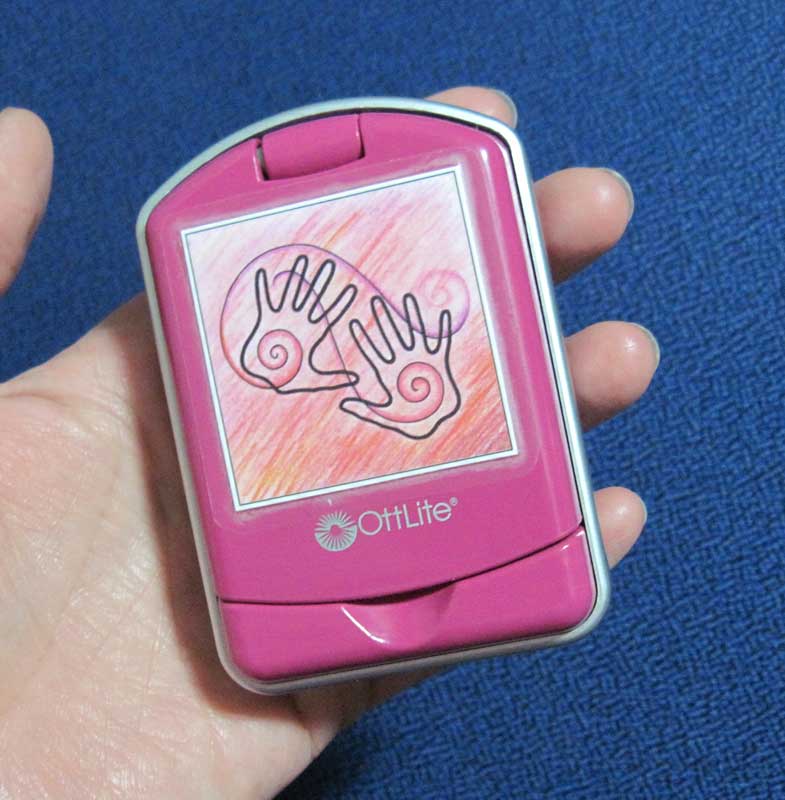
Such as the extremely portable Ott-lite that I keep in my project bag.

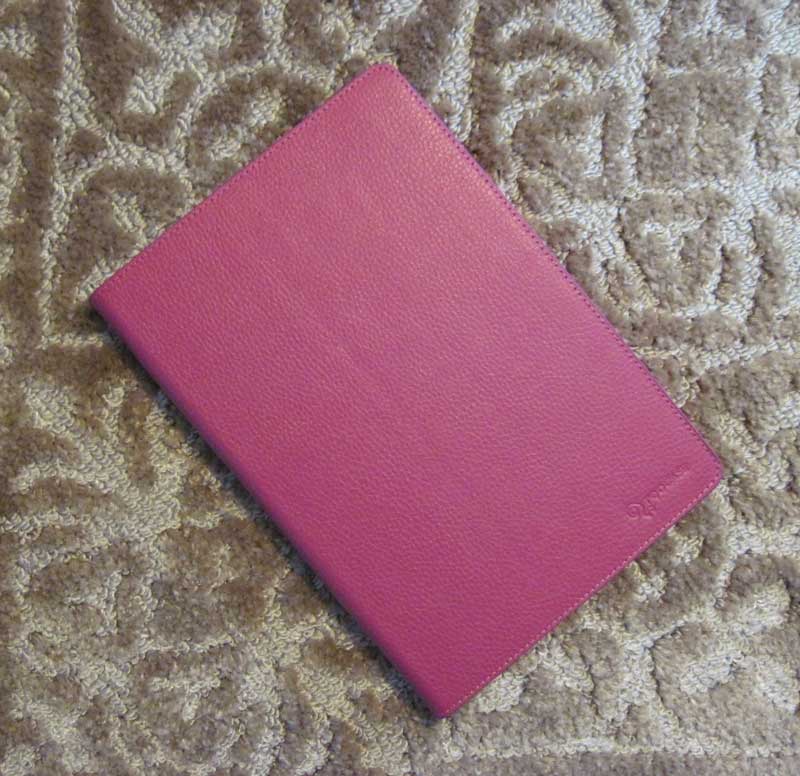
Or the protective cover for my Android Tablet.

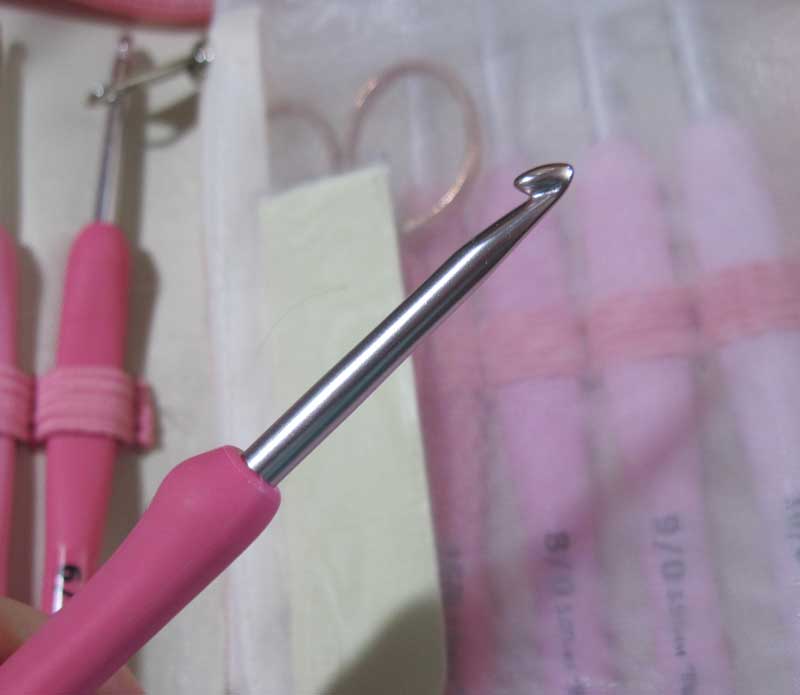
Best latest Pink acquisition is my new set of Etimo hooks from the Tulip Company. I purchased these beauties at the Market during the Manchester Chain Link. In fact almost all of my shopping took place at their booth. Though these were the only Pink purchase.

I knew I had to have them as soon as I saw them in the booth. Not only is the case nice and sturdy, but each of the hook handles is a different shade of pink. I’m not as thrilled with the pale pink ones…but they are a huge improvement over the dark gray handles of the original Etimo hooks. The hook sizes are in Japanese sizes, which makes no never mind to me as I go by the millimeter measurements anyway. 

And the metal of the hooks is a lovely pinkish silver color too.

So do you have an irresistible color, that makes you think you must have that ball of yarn or new tool? Look around your belongings and stash, you might get a smile realizing that certain colors seem to creep in when you are not thinking about it.

What’s in a Hook?

I’m reminded of Juliet’s soliloquy about a name. So what is in a hook, they are all the same right? Maybe not.

I’ve written articles about handle shapes and how they affect your grip.  But did you know that the shape and smoothness of the “business” end of your hook can also have an impact on the health of you hands, wrists and even neck?

Matching the hook you are using to the project and type of yarn can make a big difference in your comfort level. If your hook doesn’t work well with your yarn the adjustments you have to make while crocheting can add up to long-term pain.

There are a number of hook styles and shapes available commericially.  Here in the US hook shape debate seems to be between the “Boye” tapered style and “Bates” inline style hooks.  Now, no offense to either manufacturer, but there is far more to hooks than that.

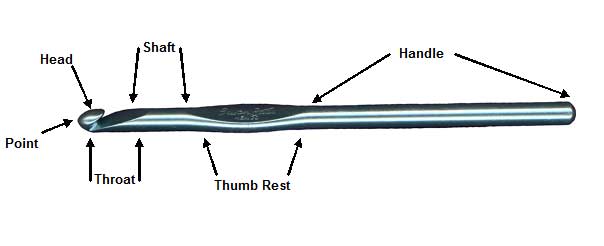
First let’s look at the anatomy of a hook. The “business” end is the Point, Head, Throat and Shaft.

The shape of the point is key when you are looking at how easily the hook slips into a stitch. This is particullarly important if you are doing stitch work that requires a dense fabric…like amigurumis.

Another important thing to consider is the sharpness of the edge of the head in front of the throat.  When there is a sharp edge or sharp point there it can get caught on splitty yarns.

In fact, having the right hook for your project and yarn can change your mind about what types of projects and yarn you like to work with.  I used to think I didn’t like working tight stitched projects like amigurumi. Then I discovered that using the Clover Soft Touch hooks made them much easier. I now design projects like these regularly.

The Clover Soft Touch hook has a fairly tapered point that is slightly rounded.  They are also very smooth with an almost “teflon” finish that slip into snug stitches without splitting your yarn.  Unfortunately, being the visual person I am, I have never been thrilled with the color of the handles. I recently saw that Clover has come out with a new line of hooks called “Amour”. Colorful Elastomer handles with an interesting shape. Hopefully I will get my hands on some soon, and can post a product review.

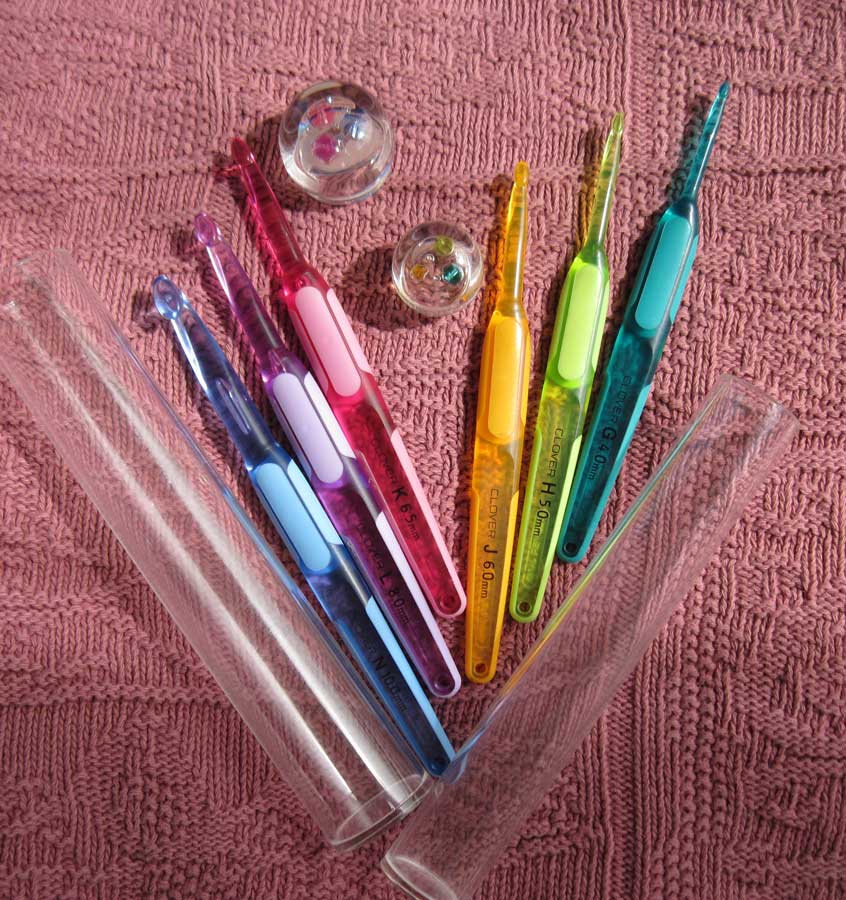
Clover does have their Reflections sets too, which I think are beautiful.  These are acrylic with an elastomer inset on the thumbgrip and handle. Over the years that I have had these sets the elastomer has begun to peel and occassionally the edges between elastomer and acrylic can wear on my hands as I work.  I do wish they had these hooks in a wider range of sizes.

They have a similar shaped hook point to the Soft Touches, but the material that the hook is made of  isn’t always the best match with acrylic yarns.  Definitely not a good match for a project that requires tight stitch work.

Next hook post I’ll write about In-line versus Tapered.  This is really the debate for many American crocheters between the Boye and Bates hooks.

My Crochet Companion

I am insanely crocheting away on a super secret project which involves 10 designs, and 2 of them have to be shipped today. It is past midnight so counts as today already.

My companion in this madness is my wonderful new 4-legged kid, Kenna. She loves to curl up on her cushy round bed beside my work area in the living room.  I have discovered this past week that she can snore like a real champ.

She is also very good at making me take regular breaks, since she wants to go outside for exercise and such.  I may end up with a rotator cuff injury throwing the ball for her to chase.

Stretchy Fabric

One of the complaints about crochet fabric that I hear from lots of folks is that it isn’t stretchy enough.

My response is, you need to use the right stitches and stitch patterns (the yarn you choose has a big influence as well).

For solid stitch work that creates a stretchy fabric try my favorite stitch,  the Half Double Crochet – abbreviated “hdc”. That is the US crochet terminology for it, I think that it is called a Half Treble in the UK.

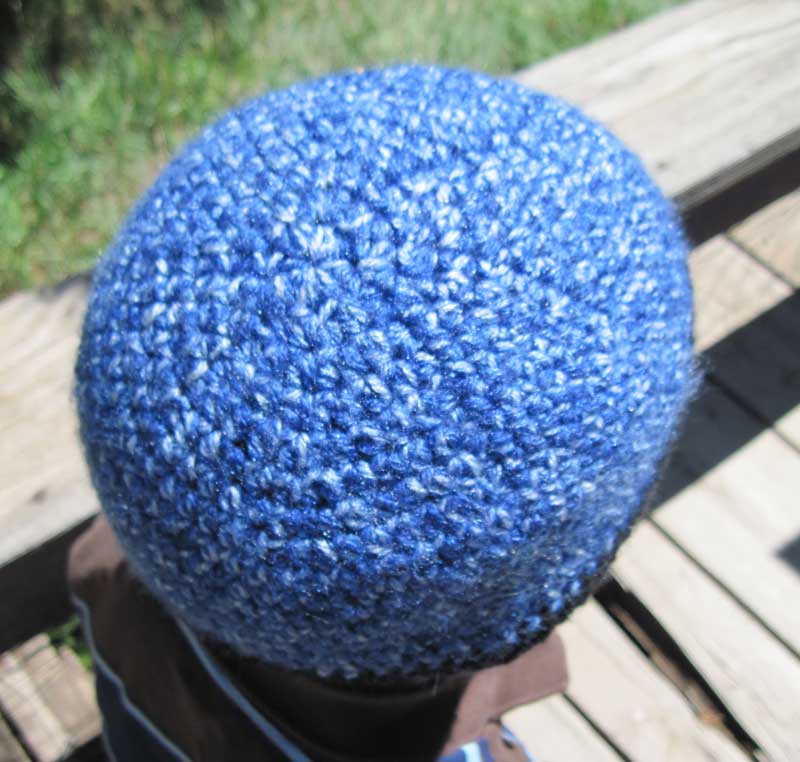
The hdc has been my go-to stitch for hats for years now.  Especially worked in spiral rounds, like the hats I made for my sons this past Christmas.

I just enlarged my Little Bitty Noggin Cap pattern by using worsted weight yarn and adding a few more increase rounds. To create even more visual interest I worked a few rounds in black to make a stripe just above the brim.  When I make a hat with worsted weight yarn I use a Size H (5mm) hook for a denser fabric.

The hdc is very simple to work.

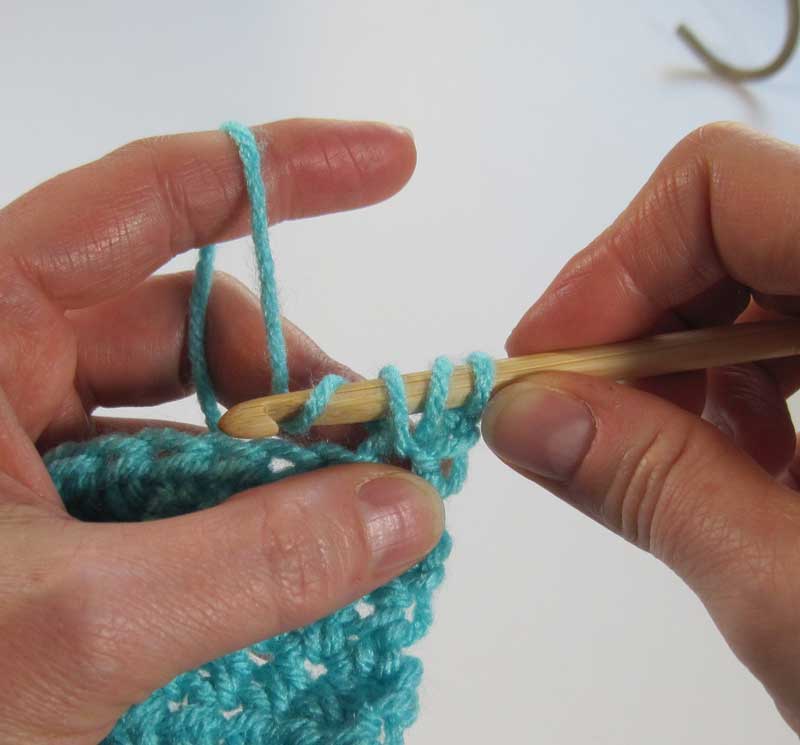
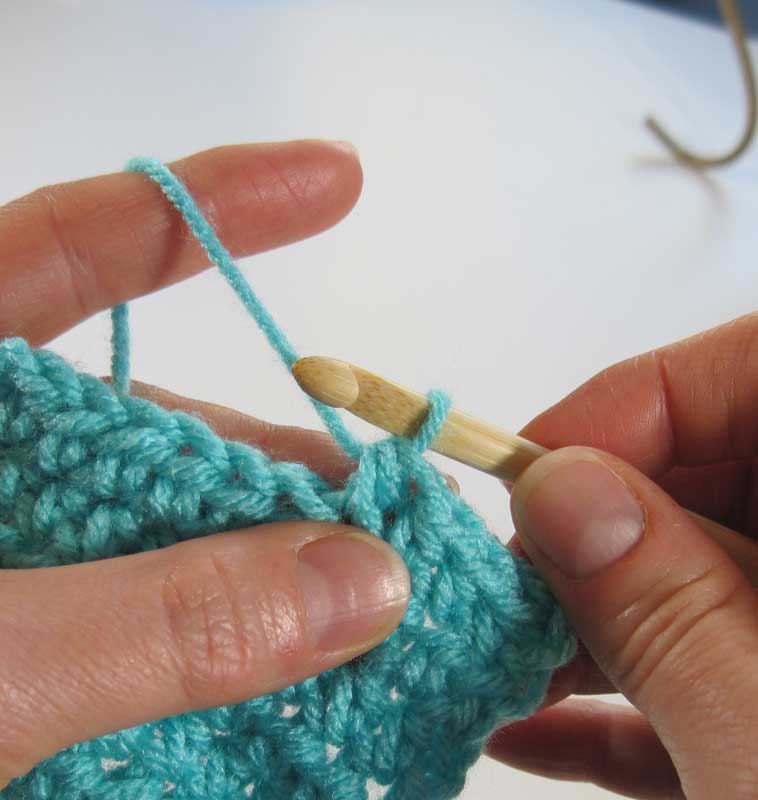
To start the stitch, wrap the yarn once around your hook (just like you do with a Double Crochet), then insert into the space or stitch you are working on.  Wrap the yarn around your hook (YO – yarn over), pull thru a loop.  You now have 3 loops on the shaft of your hook. YO again and pull thru all the loops.

You just made a half double crochet.

Give it a try in your work and see if you like the stretch you get with this stitch.

Transition Helper

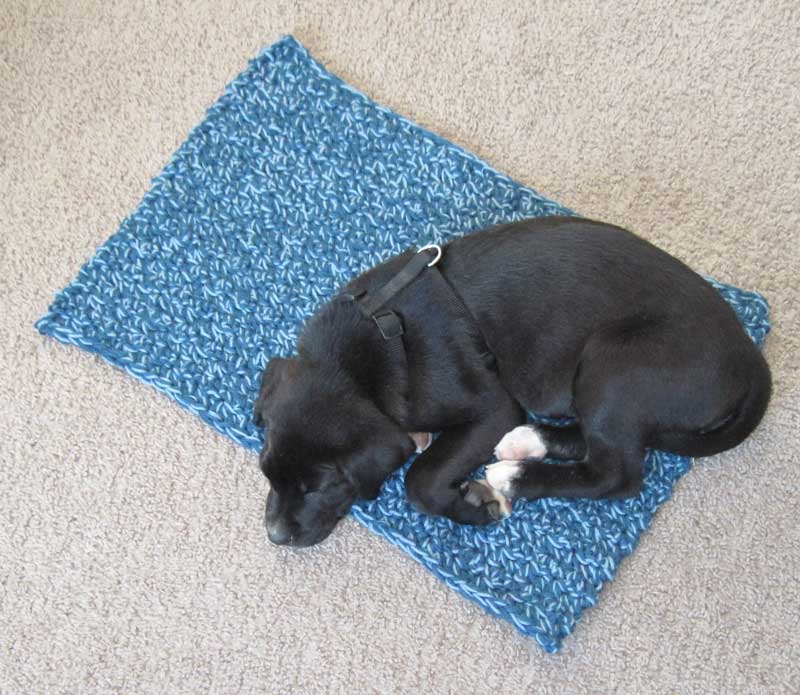
As promised yesterday I’ve come up with a quick little pattern for a “Kennel Blanket”.  This little blanket can work well for dogs and cats and the size can be changed depending on the size of animal or kennel it is intended for.

Many of the kennel enclosures at shelters have wire bottoms or concrete floors, using washable blanket pads like this can offer the animals a bit of comfort while they wait to meet their forever families.  Most local shelters and rescue organizations need blanket/pads.

Since I was making this for our foster puppy I kept it somewhat smallish. Approximate dimensions are 16 x 23 inches (40 x 57.5cm).  My idea was that the blanket will go with Beatty when he leaves with his forever family. It will smell familiar since he has been sleeping on it and will hopefully help him make the transition more easily to his new home.

Kennel Blanket

Designed by Andee Graves

Yarn: 3 balls of Worsted Weight yarn (I used Caron One Pounds and about 2.5 oz/129 yds/71g of each color)

These blankets can also be made using up odds and ends of yarn. Sometimes work best to have one continuous strand in the mix though. Just add in another ball of yarn when you have about 6 inches (15 cm) of yarn left. Make sure you weave in ends good, taking it one direction then back the other direction so that puppies and kitties can’t eat the yarn ends.

Hook: Size P / 11.5mm (I used my Susan Bates Lucite hook)

Instructions:

Foundation: Holding 3 strands together, Chain 41,

Row 1: Turn, sc in 2nd chain from hook, (dc in next ch, sc in next ch) 19 times, dc in last ch. [20 sc, 20 dc]

Row 2:  Ch 1, turn, (sc in next st, dc in next st) 20 times. [20 sc, 20 dc]

Rows 3 – 25: Repeat Row 2 – 23 times.

Fasten off at end of Row 25, weave in tails.

I hope you have fun making kennel blankets for all the four-legged friends you know and your local shelters.

Too Slow

Sometimes my ambitious ideas have a head-on collision with reality.  Like this past weekend.

Between our Spring Break trip, numerous paid project deadlines and my work on the CGOA Design Competition Committee my piece for the International FreeForm Guild’s 2012 Challenge was too neglected. Which means that I did not finish it in time.  The deadline for entries was yesterday.

I only wish I had accepted reality sooner. This weekend was a mad scramble in an attempt to finish, photograph and email the necessary pics and bio info. Some days I don’t make wise decisions.  Of course all of us run into that problem from time to time. The important thing is to forgive ourselves and move forward.

I am still going to finish my challenge piece soon and share it with all of you here on my blog.  The best thing is how inspired I’m feeling about freeform and creating art pieces using mixed media.  Hopefully I will find more time in the coming months to continue to revisit it.

Holey Smokes Batman!

I know far too many folks who have given up crochet because it hurts their hands. This is one reason that I continue to learn as much as I can about how our hands work and modifications that can help us avoid injury when crocheting.

Something I have observed when watching other folks crochet, and when crocheting myself, is that working into actual stitches instead of spaces can create greater tension in the hand and wrists.  That tension can translate to pain in the neck, shoulders and even our backs if it goes on too long.

It is one of the reasons I like crocheting and designing lace or open-work (holey) stitch patterns so much. Those types of stitch patterns are easier when working with “furry” yarns as well.

One of the simplest of open-work stitches is the V-stitch. Once you get the initial foundation rows set up you will very rarely need to stitch into the top of a stitch. I also love how drapey the fabric is with this stitch and have used it often as my “go-to” stitch pattern when I just want to make a quick scarf.

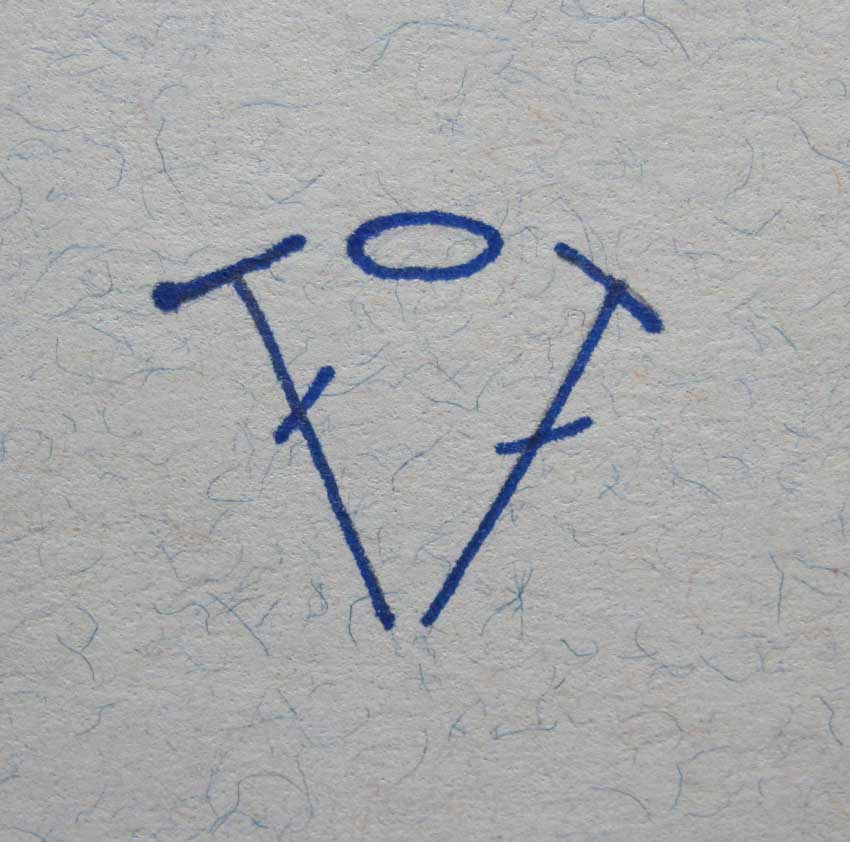
My favorite version of the V-stitch is (Dc, ch 1, dc) in same stitch or space.  The stitches can be worked into the Chain-1 spaces of the V-stitches on the row below or worked into the space between V-stitches to create an off-set pattern.

Another great hand friendly stitch pattern is the classic Granny Square. The “shells” of the square are all worked into spaces with a slip stitch ending each round.

Like the V-stitch there are a number of versions of Granny Squares out there. The version I tend to use the most has 3 dc “Shells” divided by a chain 1, then chain 2s for the corners. After the center “round” or square is completed additional squares can use a new color or be repeated in the same color. I tend to turn each round as I often work my granny squares in a continuous yarn strand, instead of the typical multi-colored squares.

If you find your hands getting sore from tighter projects have a few holey projects at hand to mix things up. You just might be surprised how much happier your hands will be.

Finding Inspiration

One of the groups I belong to is the International Freeform Crochet Guild. Each year the group poses a challenge to its membership. The object being to create a freeform fiberart piece within the parameters of the challenge.

This year it is to create an interpretive piece inspired by a favorite artist or artwork.  Some of my guild friends are choosing to interpret music, and I’m really looking forward to seeing what they create.

Last year I was too busy to participate in the challenge, but I am really hoping to participate this year.  When I first heard of this year’s challenge my mind went immediately to 2 of my favorite inspiring artists from the late 1800s early 1900s.  Charles Rennie Mackintosh and his wife Margaret Macdonald. 

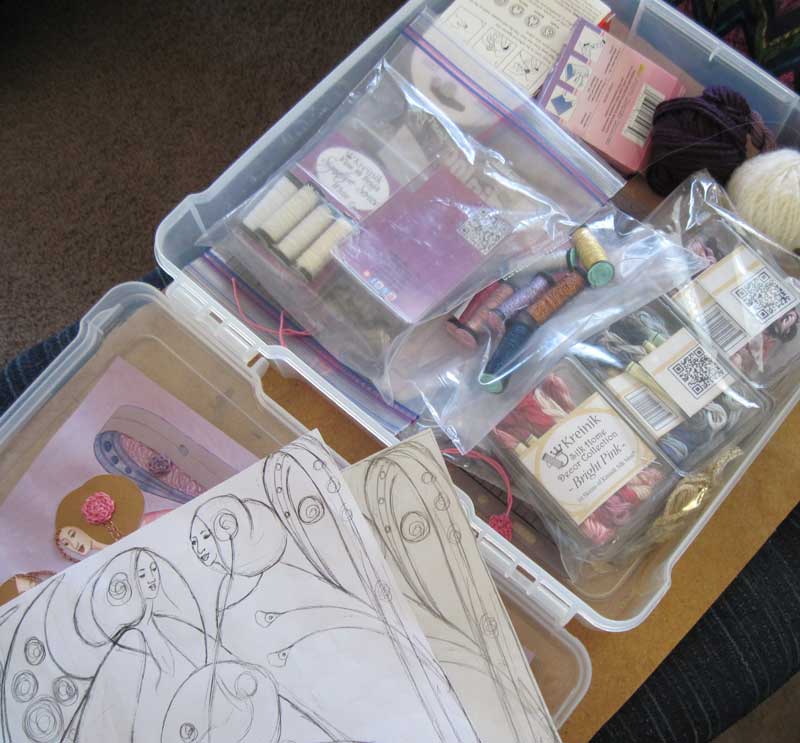
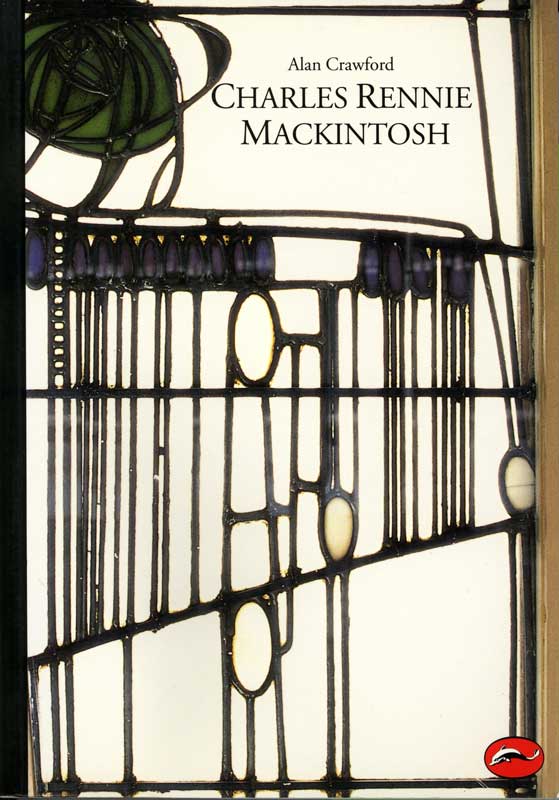
I had known about Charles Rennie Mackintosh before I found this book written by Alan Crawford for the World of Art series by the publishers Thames and Hudson Inc.  But the images of artwork created by his wife Margaret intrigued me even more.

Mackintosh was a Glasgow Architect with such buildings as the Glasgow School of Art and Miss Cranston’s Tea Rooms to his credit.  He and Margaret collaborated on a number of projects and I’ve always loved the melding of Art Nouveau and Art Deco I see in many of the images of their work.

This painting by Margaret has appealed to me for a very long time, so it is my inspiration for this challenge. 

The photos of our challenge pieces are due to the organizer between April 2 & 15.  So hopefully the online exhibit will be up only a few weeks after that. In the meantime you can take a look at previous year’s challenges at the International Freeform Crochet Guild site.

Crocheting Kids

Yesterday was the last day of Crochet Club at my local school.  Since mid-October I’ve been teaching many of the 2nd-5th students (and their parents) the basics of crochet.  It has been a fun experience and I hope to do it again next school year.

Our last lesson was all about making hats from the crown down working in spirals using the half-double crochet stitch. One of my students was also learning how to make curlicues to decorate her hat with.

Even if you’ve never taught before, if you get a chance ,share your love of crochet with others.  I’m always amazed how much I learn from my student’s questions.  Seeing thru the eyes of a beginner, after 40+ years of crocheting, is a wonderous thing.