Retro Ric-Rac Afghan Square

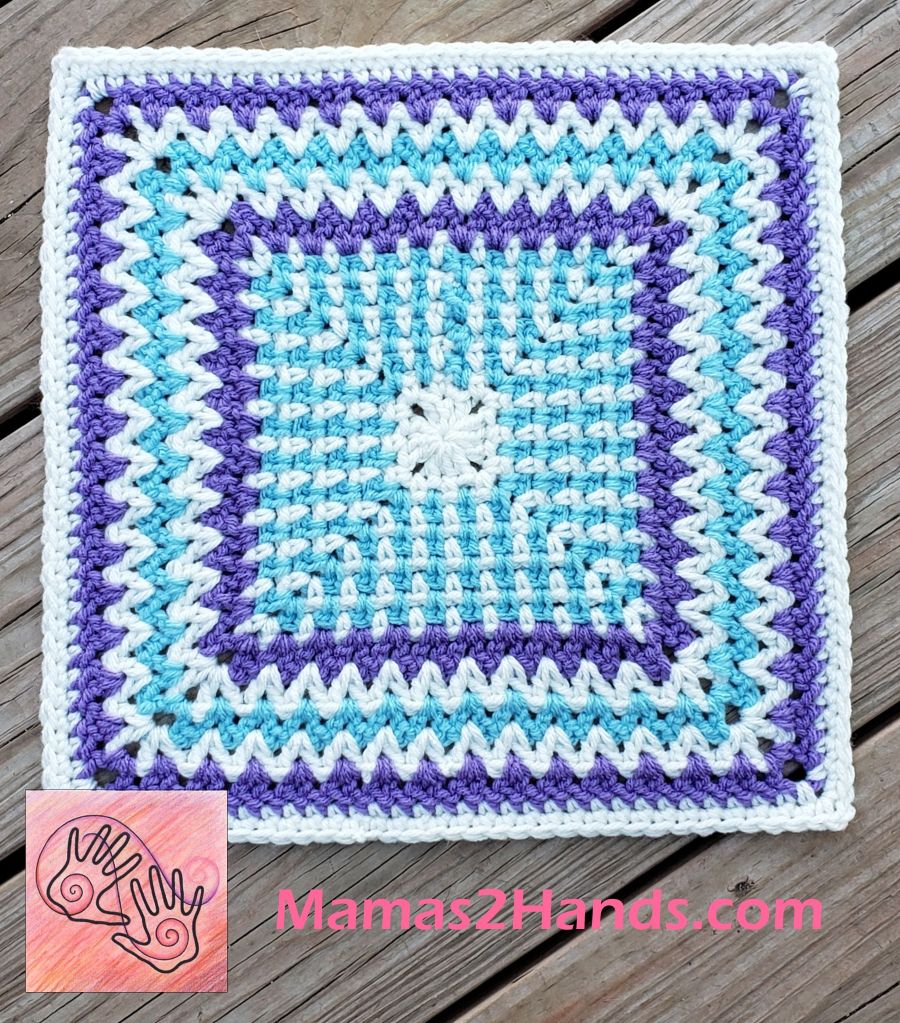
Another trip around the sun and another Afghan Square pattern for my readers. Once again I wanted to create a square that is a little easier than some of my other squares. This square has a bit of a Retro vibe with skinny V-stitches creating the fun Ric Rac border. The square starts off with a classic granny square for round 1, then alternating colors for each round worked in Linen Stitch to create a fun striped effect.

This square is Block #21 in the 2025 Moogly CAL. You can see Tamara’s notes on her square here at MooglyBlog.com as well as finding the links to the other CAL blocks.
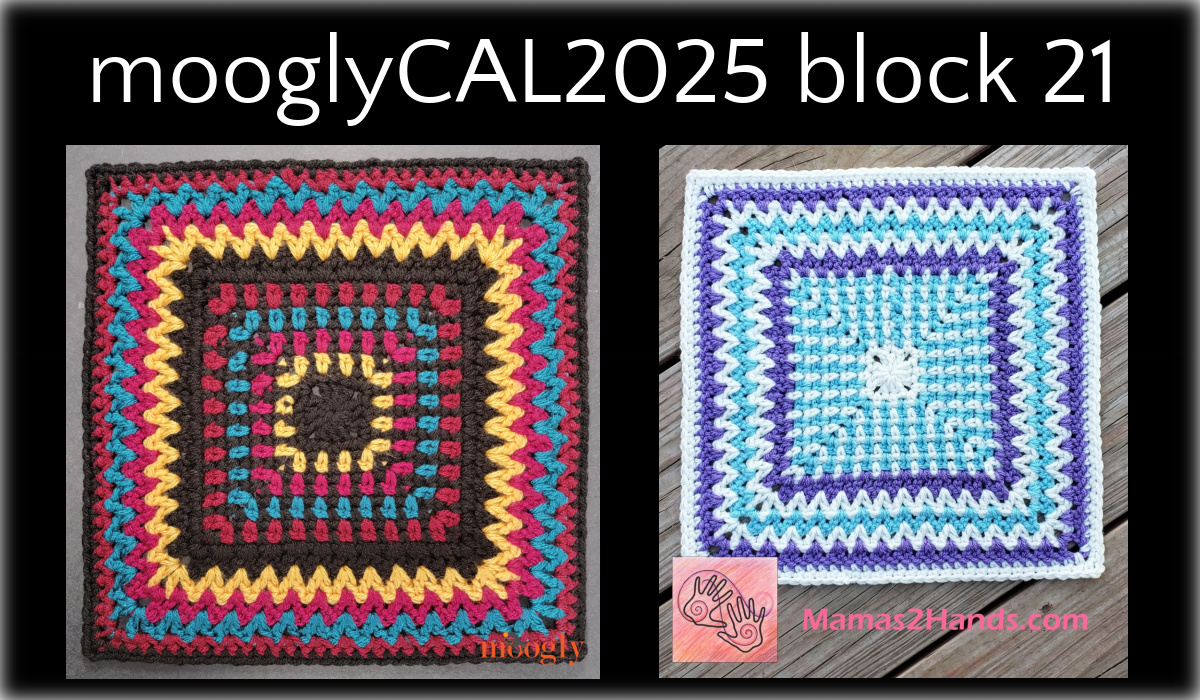
Retro Ric Rac Afghan Square

Designed by Andee Graves

Skill level:         Easy Intermediate

Finished Size:  12” square

Materials:

Yarn  – Worsted weight yarn in 3 colors – Sample uses Red Heart “With Love” 100% Acrylic (7 oz/198 g, 370 yds/338 m),

Color A: #1101 Eggshell {aprox 31 g, 58 yds/53 m}

Color B: #1502 Iced Aqua {aprox 40 g, 74 yds/68 m}

Color C: #1538 Lilac {aprox 14 g, 26 yds/24 m}

Hook – J / 6mm or size needed to meet gauge

Notions – Yarn/tapestry needle, Locking stitch markers (4)

Gauge – First 6 rounds of pattern = 4” across square

Abbreviations/Special Stitches

(RS) Right Side: The side that will be the primary/public side of the fabric.

(WS) Wrong Side: The side that will be the back side of the fabric.

(PM) Place Marker

(sl st) Joining slip st: Insert hook in indicated place, YO, pull up a loop through indciated place and loop on hook, continue to pull up on working loop until original loop is tight. Where instructed for color changes, pull a loop of old color and new color through loop on hook.

(Standing dc) Standing Double Crochet: Make slip knot and place loop snugly on shaft of hook, yo and insert hook into indicated place, yo, pull up a loop, (yo, pull through 2 loops on hook) twice.

(SkV-st) Skinny V-stitch: 2 dc in indicated st or sp, next row or round 2 dc are worked between the 2 dc on previous row or round.

Pattern Notes:

Start square with an adjustable slip knot. Beginning tail tightens the loop on the hook.

Keep tails on wrong side of square as you work to help track which is wrong side and right side.

Stitch counts at the end of each round and row are shown in italicized brackets at end of each round.

Center will be started with granny shells then worked in linen stitch, switching between 2 colors each round {without cutting yarn} to create vertical stripes, then 5 rounds of Stacked Skinny V sts to create zig-zags changing colors each round. Final 2 rounds of single crochet are both worked as RS rounds.

Rounds are not turned for every round, check if Round is listed as RS or WS.

Instructions

Rnd 1 (RS) Color A: Begin with Color A. Starting with adjustable slip knot, ch 4 {counts as center and first dc},

(dc, ch 2, {3 dc, ch 2} 3 times, dc) in 4th chain from hook, sl st to join to top of beginning ch, PM in each ch-2 sp. [4 Shl, 4 ch-2 sp]

Rnd 2 (RS) Color A: Ch 1, sc in same st as join, [ch 1, skip next st (sc, ch 2, sc) in marked ch-2 sp, move marker to ch-2 sp just made, ch 1, skip next st, sc in next st] 4 times, ch 1, sl st to join to first sc of Rnd pulling up a loop of Color B through sl st {you will have a loop both colors on hook} Do Not Fasten off Color A, pull up longer working loop of Color A and move to WS of square along with working yarn of Color A. [12 sc, 8 ch-1 sp, 4 ch-2 sp]

Rnd 3 (WS) Color B: With Color B, ch 1, turn, [sc in next ch-1 sp, ch 1, skip next st (sc, ch 2, sc) in marked ch-2 sp, move st marker to ch-2 sp just made, ch 1, skip next st, sc in next ch-1 sp, ch 1] 4 times, sl st to join to first sc of Rnd pulling up previous loop of Color A through sl st. Do Not Fasten off Color B, pull up longer working loop of Color B and move to WS of square along with working yarn of Color B. [16 sc, 12 ch-1 sp, 4 ch-2 sp]

Rnd 4 (RS) Color A: With Color A, ch 1, turn, [sc in next ch-1 sp, ch 1, skip next st] 2 times, [*(sc, ch 2, sc) in marked ch-2 sp, move st marker to ch-2 sp just made, {ch 1, skip next st, sc in next ch-1 sp*} 3 times, ch 1] 3 times, Repeat from * to * once, ch 1, sl st to join to first sc of Rnd pulling up previous loop of Color B through sl st. Do Not Fasten off Color A, pull up longer working loop of Color A and move to WS of square along with working yarn of Color A. [20 sc, 16 ch-1 sp, 4 ch-2 sp]

Rnd 5 (WS) Color B: With Color B, ch 1, turn, [*sc in next ch-1 sp, ch 1, skip next st*, Repeat from * to * until reach marked ch-2 sp, (sc, ch 2, sc) in marked ch-2 sp, move st marker to ch-2 sp just made, ch 1] 4 times, Repeat from * to * until reach beginning of Rnd, join with sl st first sc of Rnd pulling up previous loop of Color A through sl st. Do Not Fasten off Color B, pull up longer working loop of Color B and move to WS of square along with working yarn of Color B. [24 sc, 20 ch-1 sp, 4 ch-2 sp]

Rnd 6 (RS) A: With Color A, ch 1, turn, [*sc in next ch-1 sp, ch 1, skip next st*, Rep from * to * until reach marked ch-2 sp, (sc, ch 2, sc) in marked ch-2 sp, move st marker to ch-2 sp just made, ch 1] 4 times, Rep from * to * until reach beginning of Rnd, join with sl st first sc of Rnd pulling up previous loop of Color B through sl st. Do Not Fasten off Color A, pull up longer working loop of Color A and move to WS of square along with working yarn of Color A. [28 sc, 24 ch-1 sp, 4 ch-2 sp]

Rnd 7 (WS) B: Repeat Rnd 5. [32 sc, 28 ch-1 sp, 4 ch-2 sp]

Rnd 8 (RS) A: Repeat Rnd 6. [36 sc, 32 ch-1 sp, 4 ch-2 sp]

Rnd 9 (WS) B: Repeat Rnd 5. Fasten off Color B. [40 sc, 36 ch-1 sp, 4 ch-2 sp]

Rnd 10 (RS) A: Repeat Rnd 6. Fasten off Color A. [44 sc, 40 ch-1 sp, 4 ch-2 sp]

Rnd 11 (WS): With Color C and wrong side facing, begin with Standing dc in any ch-1 sp along a side, dc in same sp as first st {counts as first SkV-st of Round}, skip next st, [SkV-st in each ch-1 sp until reach marked ch-2 sp at corner, (dc, ch 2, dc) in ch-2 sp, move st marker up to ch-2 sp just made] 4 times, 2 dc in each ch-1 sp until reach start of Rnd, join with sl st to Standing dc at start. Fasten off Color C. [40 SkV-st, 8 dc, 4 ch-2 sp]

Rnd 12 (RS): With Color A and RS facing, begin with Standing dc between 2 dc of any SkV-st along a side, dc in same place as first st {counts as first SkV-st of Round}, skip next 2 sts, [SkV-st in between the 2 dc of each SkV-st until reach marked ch-2 sp at corner, (SkV-st, ch 2, SkV-st) in ch-2 sp, move st marker up to ch-2 sp just made] 4 times, SkV-st in between the 2 dc of each SkV-st until reach start of Rnd, join with sl st to Standing dc at start. Fasten off Color A. [48 SkV-st, 4 ch-2 sp]

Rnd 13 (WS): With Color B and WS facing, begin with Standing dc between 2 dc of any SkV-st along a side, dc in same place as first st {counts as first SkV-st of Round}, skip next 2 sts, [SkV-st in between the 2 dc of each SkV-st until reach marked ch-2 sp at corner, (dc, ch 2, dc) in ch-2 sp, move st marker up to ch-2 sp just made] 4 times, SkV-st in between the 2 dc of each SkV-st until reach start of Rnd, join with sl st to Standing dc at start.

Fasten off Color B. [48 SkV-st, 8 dc, 4 ch-2 sp]

Rnd 14 (RS): Repeat Rnd 12. [56 SkV-st, 4 ch-2 sp]

Rnd 15 (WS): With Color C, repeat Rnd 13. [56 SkV-st, 8 dc, 4 ch-2 sp]

Rnd 16 (RS): With Color A and RS facing, attach with sl st to any st along the side, ch 1, [sc in each st until reach marked ch-2 sp, (sc, ch 2, sc) in marked ch-2 sp, move st marker up to ch-2 sp just made] 4 times, sc in each st until reach start of Rnd, join with sl st to first sc of Rnd. [128 sc, 4 ch-2 sp]

Rnd 17 (RS): Ch 1, [sc in each st until reach marked ch-2 sp, (sc, ch 2, sc) in marked ch-2 sp, move st marker up to ch-2 sp just made] 4 times, sc in each st until reach start of Rnd, join with sl st to first sc of Rnd. [136 sc, 4 ch-2 sp]

Finishing

Weave in tails and block.
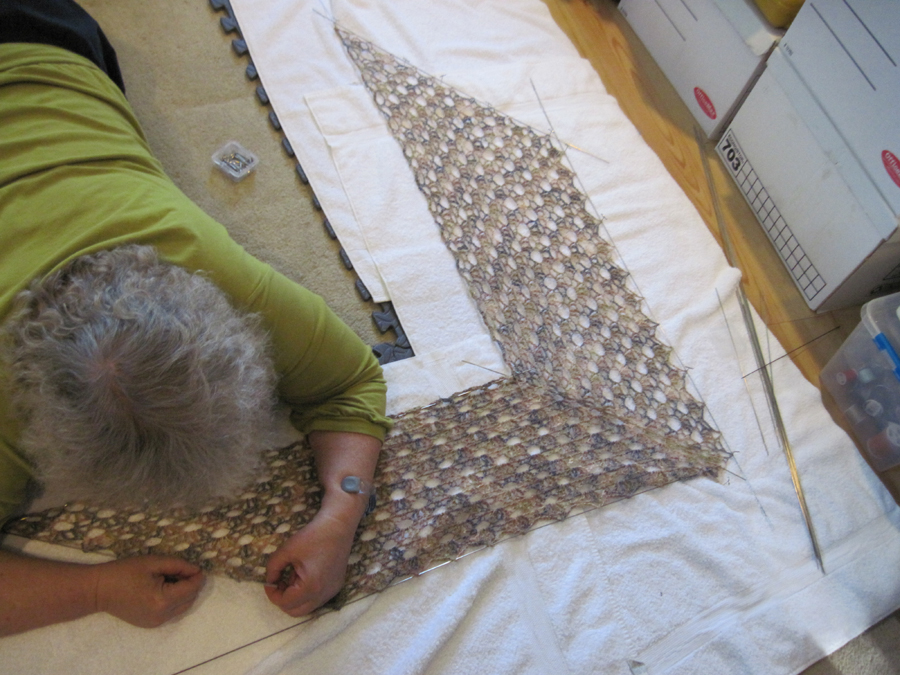
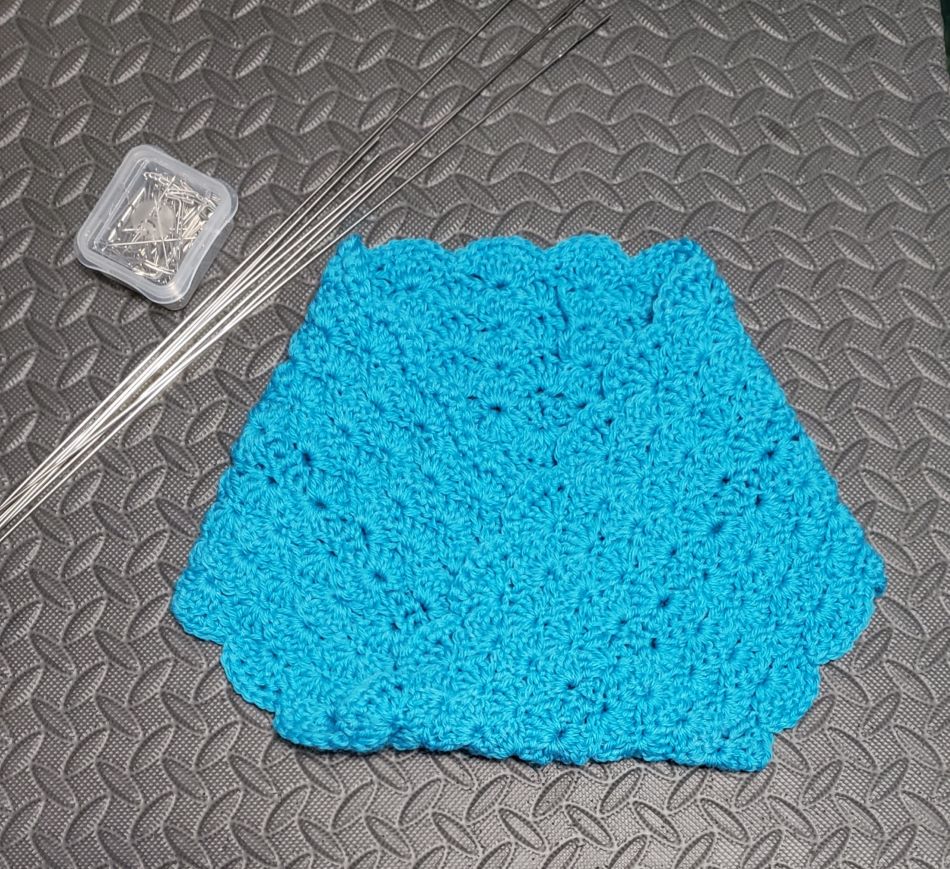
Wire Blocking Your Crochet Projects

Blocking is a great way to give a professional appearance to your finished projects. Especially if you are crocheting something with a lot of open space in the design, like lace. Wire blocking is my favorite way to block lace as it allows me to use fewer pins and to stretch the fabric aggressively to really showcase the lace. It can be transformative to see how a piece changes before and after wire blocking.

During one of my friend Jan’s visits to Colorado we had a lot of fun wire blocking her version of the “Right Angle Wrap”. You can read all about that project in this blog post: Water, Pins and Magic. You can see in that post how much the fabric changed after blocking.

I also really like using wires to block unusual shapes, like a moebius. You can see how I use the wires to keep the moebius shape and it’s fabric open in this blog post: Blocking with a Twist. This is the method I used for the Anna’s Moebius that I just made.

Floating Diamonds Shawlette before Blocking
Floating Diamonds Shawlette after Blocking

My design Floating Diamonds Shawlette was worked in a cotton/silk/rayon blend and really met it’s full potential with blocking. You can get the free version of the pattern in this blog post: Floating Diamonds Shawlette or purchase the version with a stitch chart in my Ravelry Shop.

When blocking using wires you can start with your project wet or dry. Generally you can get a more dramatic change to the fabric by starting with your project wet. If you prefer a more gentle block, you can lay out the dry project and then mist it with water or use a steamer. I live on a mountain in arid Colorado so I tend to really soak my project before wire blocking as it takes some time to weave the wires and pin them out. Oftentimes I find my project has almost dried before I have finished setting it up. If you are in a dry climate you may want to also soak your project.

In humid climates you are generally going to want to use steam for blocking. Some of my friends that live in hot humid climates have had good luck letting the natural heat and moisture activate their blocking. Once they have the blocking result they want while the project is stretched with the wires, they let it sit in a protected outdoor location for 24 hours, then bring it indoors in the air-conditioning to let it dry.

I usually leave all my tails unwoven until after my project has been blocked and dried. Especially if I am blocking a lacy fabric that I want to open a lot. I have found that if I weave in the tails ahead of time it can create tight spots in the fabric that restrict the blocking.

Blocking isn’t just for natural fibers like cotton, linen, silk or wool. You can also get beautiful results with blocking synthetic fibers like rayon, polyester or acrylic. With acrylic and polyester you will get the best results using a steamer once you have the wires inserted and pinned for your project.

What do you need to wire block?

Obviously you’ll need some blocking wires, you can purchase a variety of blocking wires on Amazon, you just want to be sure that the wires you are going to use are rust proof, especially if you will be using the wet method of blocking. The last thing you want is to end up with rust spots everywhere the wires touched your project. You will also need some nickel-plated T-pins. These are for anchoring the blocking wires as you stretch your fabric.

For the most secure hold of the pins you need a blocking mat. The size of mat needed depends on the size of the project you are blocking. Again you have quite a few options for blocking mats on Amazon, but I tend to use 18″ x 18″ foam rubber floor mats that are made to use on concrete floors. I have purchased mine over the years at Costco. Much more affordable and they work great for me.

For larger projects you need either floor space, or in my case I use my bed, where you can spread out your blocking mats. If you are fortunate enough to have a large work table that is even better. Crawling around on the floor to block a project can be a bit tiring and hard on the back.

Now you are ready to use wires to block your crochet project. Just weave the wires through the edges of your fabric or where you need to stabilize the shape. Then use T-pins to secure the wires. Once you have pinned the wires you may want to adjust to add more even stretch to your fabric. Mist or steam as needed to relax the fabric, then let it dry completely before releasing the wires.

I hope you feel ready to wire block your next crochet project.

Find Your Tribe

We are starting into the last week of March and the end of National Crochet Month, though it’s always time to celebrate crochet for me. One of the best ways to celebrate is to find a tribe of fellow crochet and yarn enthusiasts to gather with. I spend a lot of time with my group at Longmont Yarn Shoppe “Casual Crochet”. We meet each month on the first and third Wednesday of the month (and the 5th Wednesday if the month has five).

Last week we got together and we had some fun celebrating the end of NatCroMo. We had a lovely spread of snacks and drinks. Gail, the owner of Longmont Yarn Shoppe, treated us to these goodies. The core of our group, including myself, have been gathering together to crochet and learn from each other for at least 8 years now. Might actually be longer, I’ve sort of lost track of when exactly we started getting together.

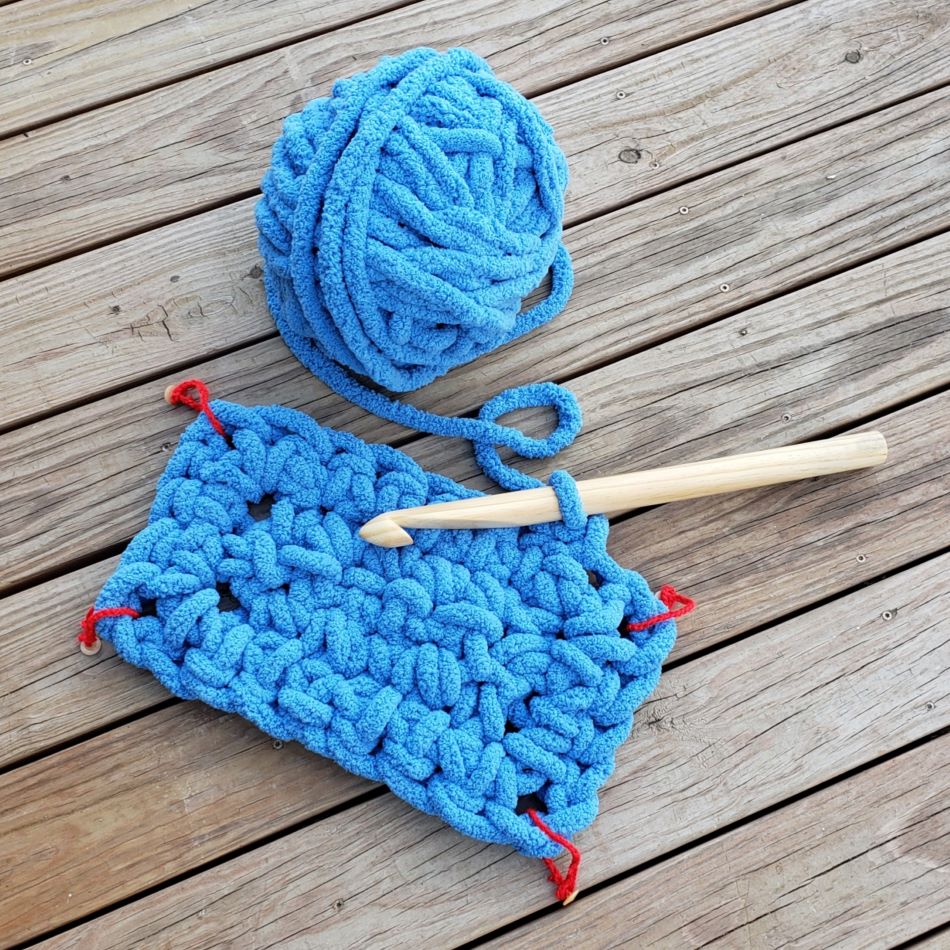
I even brought in my latest big crochet hook. This hook is 31 mm in diameter (approximately 1.22 inches) and is a bit of a workout to crochet with. The smaller hook in the photo is a Clover Amour P/Q 15mm. Big difference in size between the 2.
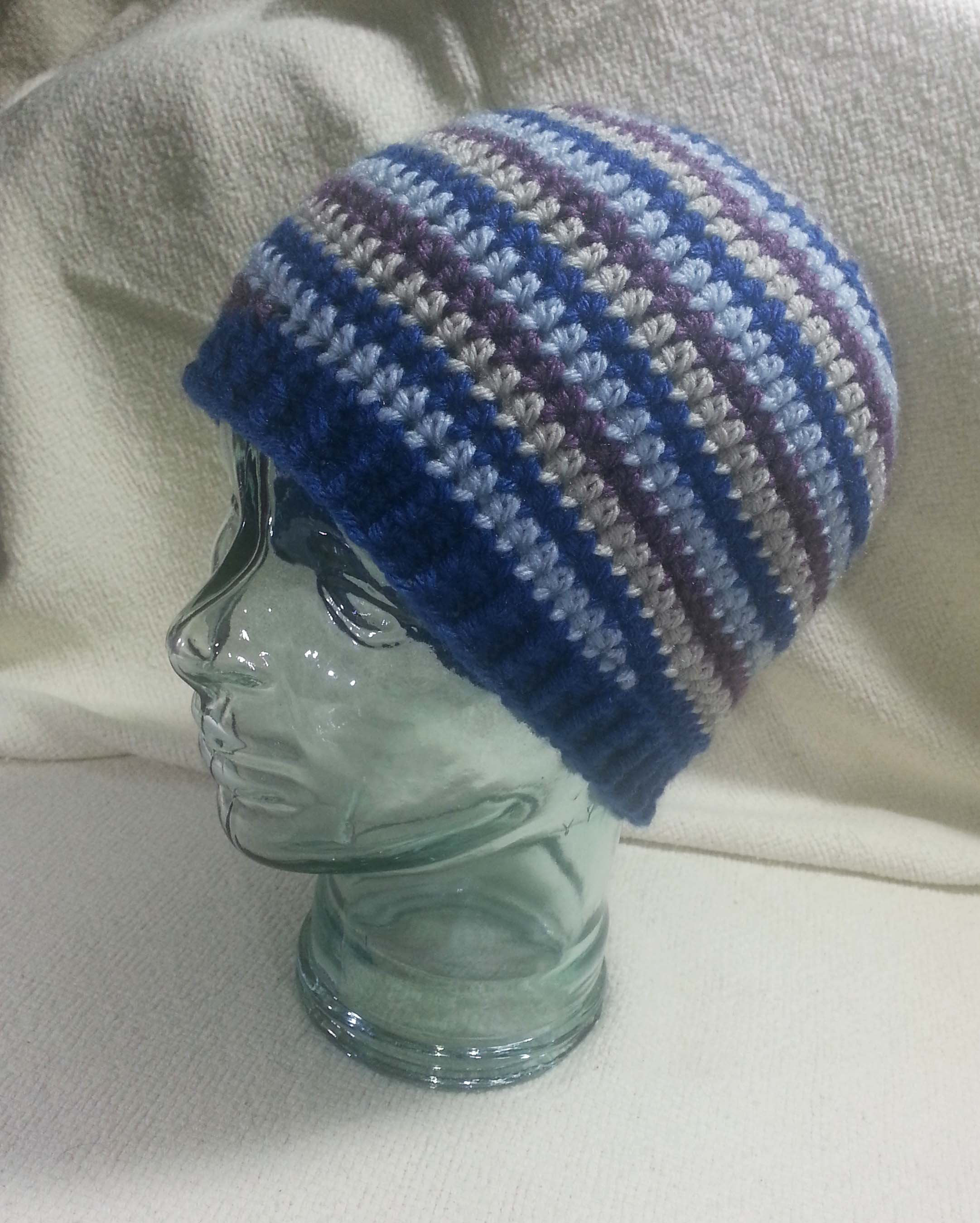
Karen was the only one that was game for trying it out though. We had a lot of fun crocheting and laughing.

I am planning on working the 2 balls of Bernat Blanket Extra Thick I got to test out the hook into a lapghan. I picked a simple single crochet rectangle for the pattern as I plan on putting this on my lap when my cat wants to sit with me. Otherwise his claws get a bit pokey.

That was the second large hook I made this month. The first is hanging in the shop window and is even larger.

It was made from a 2 inch diameter pine dowel and was quite the workout to carve. The small hook in the picture with the dowel is the same in the photo further up with the big hook. I’ll be making a paper mache version of this giant hook after we take it out of the window. That way the shop can have one for display that isn’t quite so heavy. Seriously, this hook is like a baseball bat.

I hope you all have a great start to your last week of NatCroMo 2024. I’ll have a few more blog posts for you before April rolls around.

Happiness in a Circle

If you didn’t know, today is Pi-Day. For those of you that are new to visiting my blog I am a bit of a geek. I use geometry in my designing process all the time, but my favorite geometrical shapes are circles.

This blog post contains affiliate links, purchases through these links help support me without additional cost to you.

For those of you uncertain what Pi is and how it relates to circles…it is a mathematical constant that is the ratio of a circle’s circumference to its diameter, approximately equal to 3.14159. It also appears in many formulae across mathematics and physics. For most uses the abbreviated version of 3.14 is more than enough. March 14 is written as 3/14 for most of us here in the US, so some of us geeky souls like to refer to today as Pi-Day.

I have been playing with some circles lately, I made this fun little pouch as an experiment. It is still a work in progress, but so far I like what I’ve come up with. This was just 2 flat circles worked in 5 rounds of double crochet, I then crocheted them together and added a Romanian Cord to create a little wearable pocket for my phone and a few odds and ends when I am running around the house. The crochet hook is to give you a feel for the size of the pouch.

If you are wondering about how to get your flat circles as round as mine you can check out my post about Crocheting Really Round Circles here. I get very detailed in that post about crocheting flat circles and keeping their edges round.

If you are more interested in using Pi to crochet hats that fit the person they are made for, check out my Perfect Fit Crocheted Hat pattern. It is basically my Perfect Fit Crochet Hat class in a pattern. Everything you need to know for adjusting the size of your hat for fit and for the yarn you are using. You don’t even need to be a wizard at math, because I have some easy visual cheats included in the pattern. Once you have worked through the pattern you will understand how to adjust any crown-down constructed hat to fit your yarn and whomever you are making the hat for.

I recently purchased some 24 inch diameter floral hoops to use for creating some crochet art. The first piece I have been making is fairly free-form, so math hasn’t been as much help in this project. This is just the start of it. Once the hoop is filled in and the crochet open work is anchored to it, I’ll be adding crochet pieces to the foreground to make a fun little scene. The whole thing is currently anchored to my work surface so that I can stretch it as I go.

I do have some additional pieces planned that will involve more math as I fill in the hoop. I’ll share more images as these projects progress.

I bought my hoops on Amazon and am very happy with the quality of what I received. You can check them out by clicking here. These hoops are strong and well shaped without any distortion from shipping. They have them in variety of sizes, so I may be ordering some of the smaller ones for making framed snowflakes in the fall. The 24″ diameter ones were the largest offered on that product listing.

Quick Shamrock Pattern

Saint Patrick’s Day is this coming Sunday and I decided to make up a little clover for all my lovely readers.

This quick little shamrock can be crocheted up in just a few minutes with about 4 yards of worsted weight yarn. I used Berroco’s Ultra Wool and a 5mm hook for the shamrocks shown above. You can sew or glue your shamrock onto a pin back to create a fun brooch to wear or sew the finished shamrock unto a hat, gloves, or scarf.

I have a PDF version available through my Ravelry shop that also includes a stitch chart. The PDF version is available for free in my Ravelry shop with coupon code 2024QSSPD through 11:30 p.m. Mountain Time Saturday, March 16, 2024. Just place the pattern in your cart and when checking out put the coupon code in the code spot.

Quick Shamrock Pattern

By Andee Graves

Skill Level: Easy

Finished Size: 2.25 inches (5.7 cm) tall x 2.25 inches (5.7 cm) wide

Materials

Yarn  Berroco “Ultra Wool” Worsted Weight, 100% Superwash Wool,

3.5 oz/100 g, 219 yds/200 m (1.8 g/4 yds for 1 Shamrock)

Hook  H / 5 mm or size needed to obtain consistent fabric

Gauge is not critical to this project; fabric needs to be consistent and tight. Shamrock can be worked with different weight of yarn, just adjust the size hook so you get the desired result.

Notions  Yarn/tapestry needle, pin back if turning into brooch/pin

Special Stitches and Abbreviations

Adjustable Slip Knot: Make like a regular slip knot but use the beginning tail to form the working loop. Pulling on the beginning tail snugs the working loop on the shaft of the hook. If desired can use the magic circle method instead, just count your circle as the first chain stitch. Click here for my YouTube video if you need help with the Adjustable Slip Knot.

2 Extended Double crochet Cluster (2ExDcCL):  [Yo, insert hook into indicated stitch, yo, pull up a loop, yo, pull through 1 loop, yo, pull through 2 loops] 2 times, yo, pull through remaining 3 loops on hook.

Pattern Notes

This shamrock is worked from the center out in 2 rounds, at the end of the second round you chain a length then work back towards the body of the shamrock to create the stem.

Pattern Instructions

Rnd 1: Make an adjustable slip knot, ch 2, 6 hdc in second ch from hook, join with a slip st to first hdc of round. (6 hdc)

Rnd 2: (Ch 4, 2ExDcCL, hdc, 2ExDcCL, ch 4, slip st) in first st, [slip st loosely in next st, (slip st, ch 4, 2ExDcCL, hdc, 2ExDcCL, ch 4, slip st) in next st] 2 times, slip st loosely in next st,

{Stem} ch 6, sc in back bump of second ch from hook, slip st loosely in back bump of each of next 4 chs, slip st to join to Rnd 1 between last and first hdc. Fasten off.

(6 2ExDcCL, 3 hdc, 6 ch-4 sp, 7 loose slip sts, 1 sc)

I used Vanna’s Choice with an I hook (5.5mm) for the brighter green Shamrock shown above, you can see that it came out a bit bigger than the shamrocks made with Berroco Ultra Wool.

Happy Saint Patrick’s Day to all my Irish and Irish Heritage readers.

Yarn Bombing the Tree

2023 Yarn Bombing of Tree
at Longmont Yarn Shoppe

Last year the crochet group (Casual Crochet) at the Longmont Yarn Shoppe covered the trunk of the tree in front of the shop with a multi-textural yarn bombing. It was a big hit with the community and so yarn-bombing the tree is now becoming a regular thing for the shop. In December the machine knitting folks made a red and white striped fabric that they wrapped the tree with.

This year Gail, the shop owner, and I decided for National Crochet Month we needed a new yarn-bombing. We got going on this a little late, so we did it in stages. Yesterday we finally finished it.

The exterior of building the shop is housed in is currently undergoing some renovations, so it is harder for folks to find us at times. This means the yarn-bombing will help make our location easier to spot. I used one of the colorful shopping bags and turned it into the first stage of our yarn bombing that we put up on March 1st.

Then this past Wednesday we put up Stage 2, which is our Random Acts of Crochet Kindness (RAoCK) section. It has been really popular and the group is going to be busy keeping up supplies to re-stock it.

It was also our first Wednesday of the month gathering, and we spent a lot of our time sewing pieces to the Stage 3 piece. My friend Margie helped me a lot on this project and has really been the inspiration for lots of our RAoCK projects.

Finally yesterday, Margie and I got together for a couple hours at the shop and finished attaching all the pretties to the Stage 3 section and put it on the tree. I think it came out really well. Yesterday was pretty chilly with snow in the air, so our colorful spring and summer feeling yarn bombing was a fun way to add some warmth to the day.

Our group has more crochet activities planned for NatCroMo at the shop. Stop by again regularly this month for all the excitement.

There’s No Place like Gnome

Happy National Crochet Month my friends! March has started off with a bang for me. I”m helping out with all sorts of fun stuff at the Longmont Yarn Shoppe and will be sharing more about that. Suffice to say that I’ve been so busy that I didn’t get a chance until today to do my first post of March to celebrate NatCroMo.

3 Colorful Crocheted Gnomes on a Gray background. Front Gnome had yellow body, gray beard and orange hat with floppy brim. Middle Gnome has bright blue body, white beard and magenta hat with small brim. Last Gnome has orange body with arms up in air, cream beard and green hat with small brim.

First of all say hello to my newest design, this is my “Cute Lil Gnome” pattern. This fun amigurumi is made using small bits of worsted weight yarn. Approximate yardage for each of the 4 pieces are: body -14 yards, Hat – 8.5 yards, Nose – 2 yards, and Beard – 3.5 yards.

Gnome held in hand with gray background. Gnome body is bright blue with a white beard, taupe nose and magenta hat. Hat has small brim.

I’ve been having fun making these little gnomes from various weights of yarn. The worsted weight gnomes are worked with Berroco Ultra Wool using a H (5mm) size hook and are 4.5 inches (10.6 cm) tall.

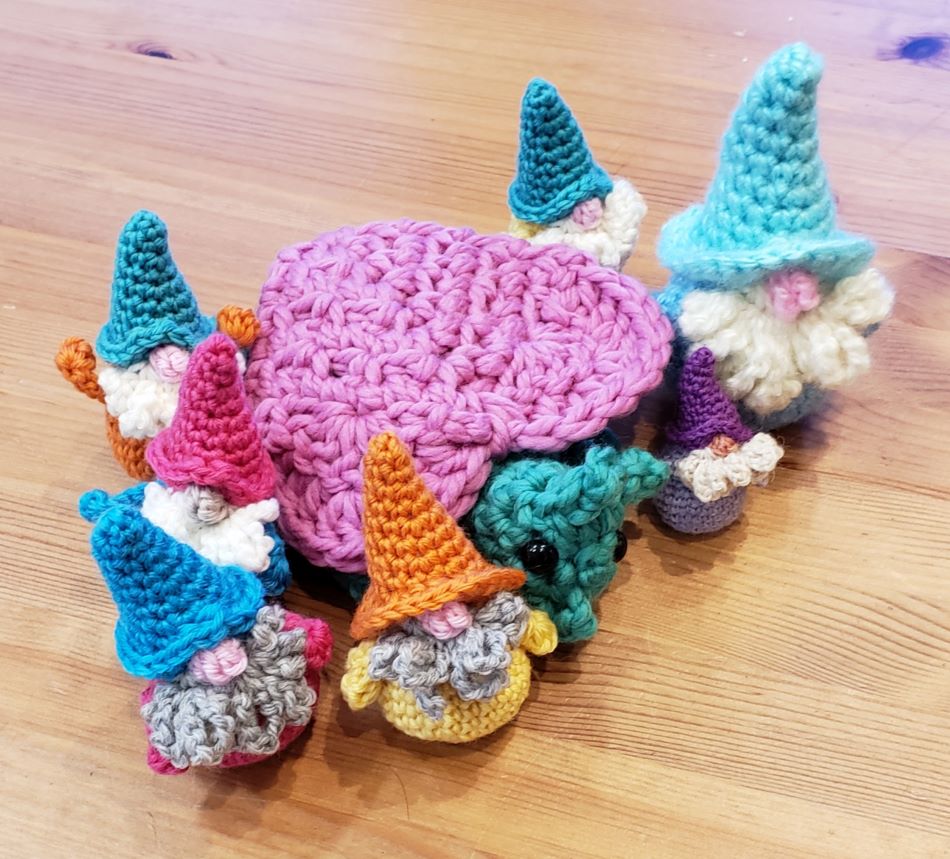
All my current crop of gnomes were having a little party with the Luv Bug at the shop on March 1st. The majority of the gnomes were made with Berroco Ultra Wool. The tiny one was made with KFI Collections “Teenie Weenie Wool”. The big one in pastel colors was made with some discontinued Lion Brand “Jiffy” that I had in my stash.

Crocheted toys, different sizes of gnomes surrounding a large Luvbug.

The big Gnome and Luv Bug are being crochet mascots at the Longmont Yarn Shoppe, so if you are in the area stop by and get your photo taken with them. We are also looking for suggestions for a name for the Gnome. If you stop in with a finished crochet project to get your photo taken at the shop, you can get a cute little butterfly or sheep stitch marker and enter the shop drawing to win an awesome product prize at the end of NatCroMo.

I designed this project so you only have to sew one seam. The hat is worked top down with the nose and beard crocheted at the end of the hat. The body is worked bottom up with the arms crocheted along the way. You fasten off the body with a long tail and use it to sew the body to the hat/head. A couple of fancy cluster stitches make the nose and hands, post stitches create the first round of the hat brim, but the rest of the project is single crochet, slip stitches and chain stitches.

The pattern currently has written instructions with some clarifying photo tutorials and 1 stitch chart. I’ll be updating the pattern at the end of March with stitch charts for all the parts and more photo tutorials. Once it is updated the price will go up. If you purchase your pattern now at the lower price, you will get the updated version for no additional cost when it is available.

Purchase the “Cute Lil Gnome” pattern here on Ravelry.

Make sure to check back regularly this month as I reveal more new patterns and all the creative ways I will be celebrating crochet with my local crochet community.

Estes Park Wool Market

For those of you that may not have heard, I will be teaching at the 2024 Estes Park Wool Market. If you have followed my blog for a while you may have seen a post or two about my visits to this fun event that is practically in my backyard. Estes Park is a 40+ minute drive from my house. It is a gorgeous drive too, especially in June.

In 2024 the workshop days are June 6 & 7 and the vendor marketplace is June 8 & 9. I will be teaching 3 workshops there, 2 crochet and 1 needle felting. Registration for workshops is open now on the Wool Market website.

Thursday, June 6 I’ll be teaching 2 Crochet Workshops.

Stitch Chart Bootcamp (9 a.m. – Noon): For those of you that have been stymied by stitch charts, this is the perfect workshop to help you unravel them. Once you have finished this workshop you will have the skills to tackle any stitch chart and create crochet projects from them that will please you. The handout for the workshop will include lots of fun stitch charts for you to work from while attending and afterward.

Inside Out Rectangles (1 p.m. – 4 p.m.): Working from the center out in rounds is my favorite way to create crochet projects. I especially love the way it gives a lovely edge to the finished project. Rectangles worked in square rounds are really handy. They can be placemats, towels, scarves, wraps, tablecloths, throws and blankets. But how do you know what size of a foundation to start with to get the size rectangle you want. In this workshop you will learn everything you need to know to always get the size rectangle you were aiming for, as well as some fun stitch patterns to work your rectangles in.

Friday, June 7 I’ll be teaching 1 Needle Felting Workshop.

Needle Felting in 3D (9 a.m. – Noon): Needle Felting is the perfect way to create sculptural objects. You don’t have to worry about expensive tools, materials or finding a kiln to fire your pieces. With Needle Felting you can play with shape and color easily and affordably. Make everything from toys to jewelry to art. You don’t need to be experienced with needle felting to be able to step right into this craft and begin making fun 3 dimensional shapes that you can turn into anything you want.

June is a wonderful time to visit Colorado and especially the Estes Park area. The national park is just outside of town for scenic drives and fun hiking. Downtown Estes Park is full of fun shopping and great places to eat. After the workshop days are done there is the fun exploration of the vendor marketplace and meeting all the fiber bearing critters in the barns. Come check it out!

Spiraling Blocks Blanket

This is the perfect way to wrap up my Spiraling October on the last day of the month! I’m so excited to be able to share with all my readers about this new project with Furls Crochet. This is my “Spiraling Blocks Blanket” that is available as a kit on the Furls Website. This lovely blanket is a fun way to work with spirals in blocks that are then sewn together for a cozy layer that is perfect for decoration and warmth.

The kit comes with an intermediate level pattern and has instructions for making the blanket in 2 sizes. The Small Throw Kit – 6 blocks x 8 blocks; 40” x 53” {100 cm x 132.5 cm} is $95. The Regular Throw Kit  – 8 blocks x 10 blocks; 53” x 66” {132.5 cm x 165 cm} is $145. That price includes your pattern, all the yarn for the size selected and a beautiful size I/5.5 mm Furls Streamline Hook.

For just this week my readers can get this kit for 15% off by using the coupon code ANDEE15 before November 3rd at 11 p.m. EDT, so go grab yours quick!

The kit is available in 4 color palettes at the Furls website: CLICK HERE TO GET YOURS! My blanket used the Vortex color pallette. Colors A – H (the first 7) are the arms of the spirals. For my blanket I picked the “Tundra” color as my Color A. Color I (the 8th Color) is your overall border color. It is used to border each spiral and for the finishing border of the blanket. You can see more details about the colors in each palette on the Furls website.

My Hawaiian inspired colors that I used.

The 8 Colors I selected for my blanket were colors that reminded me of my trip to Hawaii a couple years ago. A variety of blues and greens for the amazing changing shades of the ocean and some earthy tones for the gorgeous shoreline. If those colors aren’t appealing to you there are 3 other color combinations selected by the folks at Furls for you.

I designed this so my color A gives a pinwheel effect, yes it was the inspiration for my Block #21 for the Moogly blog that you saw earlier this month. You don’t have to fuss too much for this design as long as you have 1 arm of your spiral made with color A, it’s just all about how you orient the squares when you join them together.

The really great thing about this project is that it is very portable way of making a blanket. Each bordered spiral square is about 6.5 inches square, so they are super portable. I worked the individual spiral blocks carrying around the 4 colors I needed. Then had a bag of 10 spiral squares that I used while working on the outside border whenever I had a moment.

The photo above shows my pile of blocks as I was working on the block borders. I had a lot of fun taking this project along when I was running errands, especially when I was waiting in line.

Once I finished the blocks I laid them all out on my bed to decide on the order to join them. In the pattern I have provided a joining map and list of the number of blocks with the combinations of colors. I was going for a shore to sea feeling with my layout. You can mix and match colors and placement however you like it best though. That is part of the fun.

I hope you have as much fun making your Spiraling Blocks Blanket as I did. I was nice and cozy under it as I finished sewing together my blocks and then crocheting a final border around the outside. Be sure to grab your kit before November 3rd to get the 15% discount.

Thanks for going on this fun journey of spirals with me during the month of October. Next month is going to be all about Hats and the Holidays. If you are interested in taking my class on Zoom for the Linked Stitches Hat this coming Sunday, be sure to register online at the Longmont Yarn Shoppe.

Hats using Spirals

In keeping with my crochet spirals theme I wanted to share some dimensional spirals with you. So far everything I’ve shared has been flat spirals but they are also wonderful for making hats with. I like making my hats from the crown down to the brim to take full advantage of the stretchiness of the fabric. My favorite method is to work continuous rounds, which is basically a spiral. Creating hat patterns that use different color spiral arms is an easy adjustment. 2 of my favorite spiral hats are below.

Whirlwind Hat

This hat pattern is sized for a small adult head (circumference 21″) here on my blog. This pattern uses a four-arm spiral to create a colorfully striped top-down hat. It is a great pattern for using up leftover bits of yarn from your stash. Each spiral arm uses approximately 28 yards, 1 spiral uses 46 yards as it is a spiral arm and the brim. Click here to check out the pattern.

Spiraling Stripes Hat

This 2 arm spiral hat that was inspired by the folks at Round Mountain Fibers. They hand-dye some incredible colors. I wanted to create a hat that would blend a semi-solid and variegated color together. The sample I made had some interesting pooling of the colors so I got an almost plaid look in the finished hat.

This is another sample I made from the pattern using 2 solid color worsted weight yarns. This was made with Berroco Ultra Wool. The pattern is available for purchase in my Ravelry Shop. The pattern includes stitch charts and is written for a small adult size (21″ circumference).

If you are interested in making these hats in smaller or larger sizes you just need to stop increasing the crown of the hat when you reach the size you want, then work the sides of the hat in keeping with the size of the crown.

If you want a really detailed run-down on adjusting the size of top down hats you can purchase my “Perfect Fit Crocheted Hat” pattern in my Ravelry Shop. This pattern is basically my hat class in pattern form, it walks you thru the ins and outs of making a hat just the size you want.

I hope you are having a wonderful October, I’ll have a few more fun posts about crocheting spirals before the month is out.