Reading the Pattern

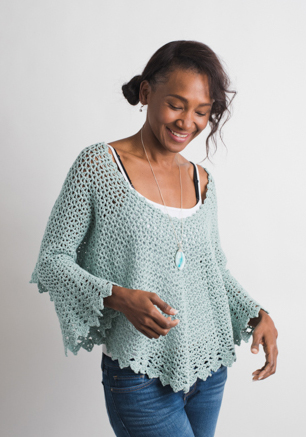
Sierra Swoncho – I Like Crochet – February 2019

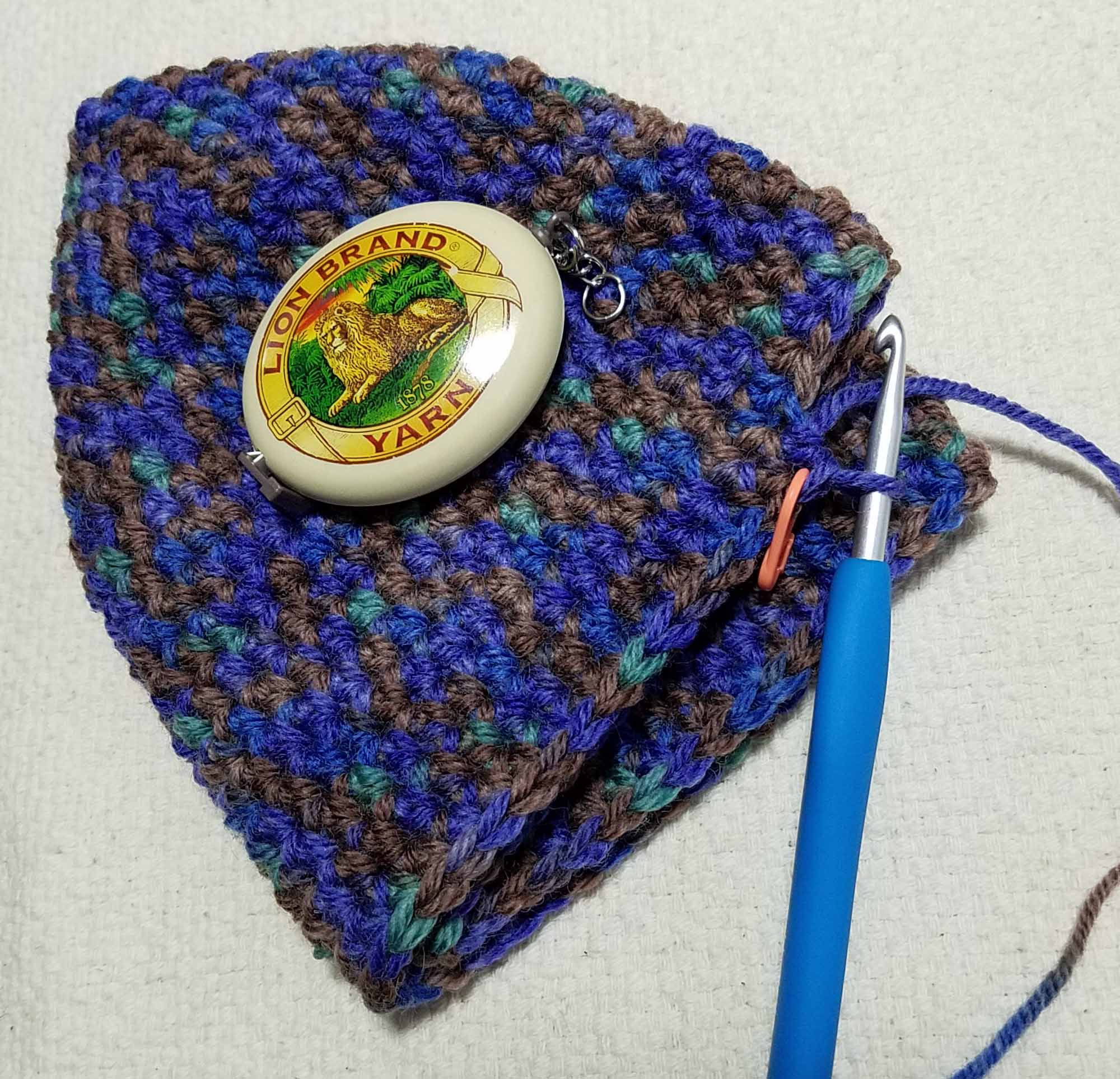
This past week I seem to be getting a few messages about my “Sierra Swoncho” pattern that was published in the February 2019 issue of “I Like Crochet”. It is marked as an intermediate skill level pattern, and uses a simple stitch pattern and increases for the majority of the garment.

One thing that is really key in working this pattern (and any pattern for that matter) is reading carefully thru the information at the beginning of the pattern like abbreviations, special stitches, and pattern notes before jumping into the pattern instructions.

For this design in particular, I used stitch marker placement to simplify the pattern instructions. So reading carefully for where you place the stitch markers is very important.

I also designed it with the option of changing the bust sizing. Often in garment patterns it is assumed that a small sized garment is for a small bust, and that a large size garment is for the largest size bust. As my readers know women’s bodies come in an endless variety of sizes, including large busted small women and small busted large women. I wanted this design to reflect that variety.

The other thing that seems to be confusing some folks is my stacked rows foundation that creates the neckline. For those of you that are struggling with that my blog post: “2 by 2 Cowl pattern” may be of some help. I also have a video on my YouTube Channel that demonstrates working a stacked rows foundation.

I hope these tips will help those of you that may be struggling with this pattern.

The Anatomy of Your Stitches

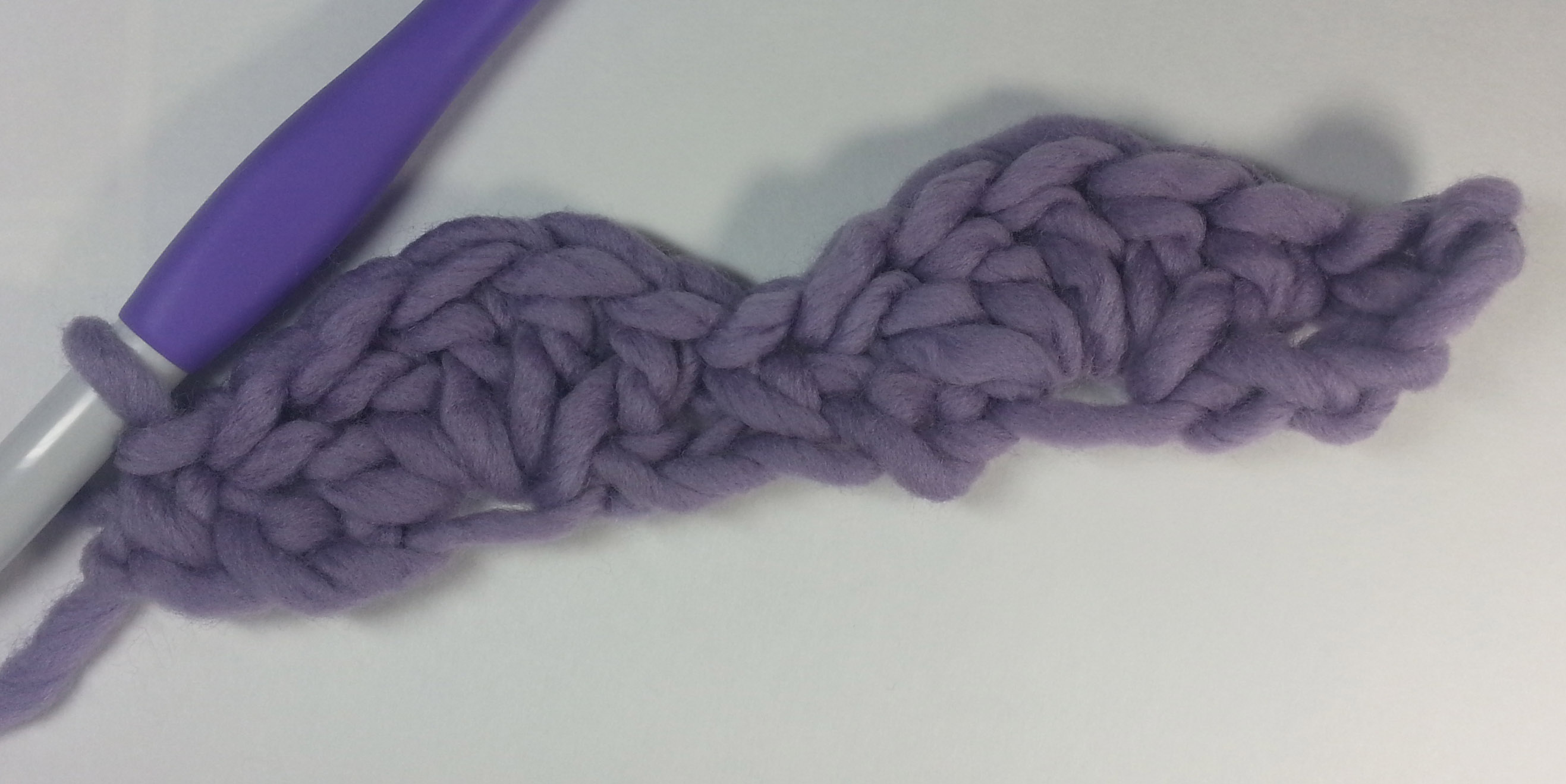
No matter what your crochet skill level it is helpful to understand the anatomy of your stitches. This is especially handy when you are weaving in tails or repairing crochet fabric. It is also very useful when teaching crochet so you can show your students what to look for while working on their projects.

The anatomy of a Chain Stitch

The first stitch most of us learn in crochet is the chain stitch, it is used in many ways in crochet patterns.

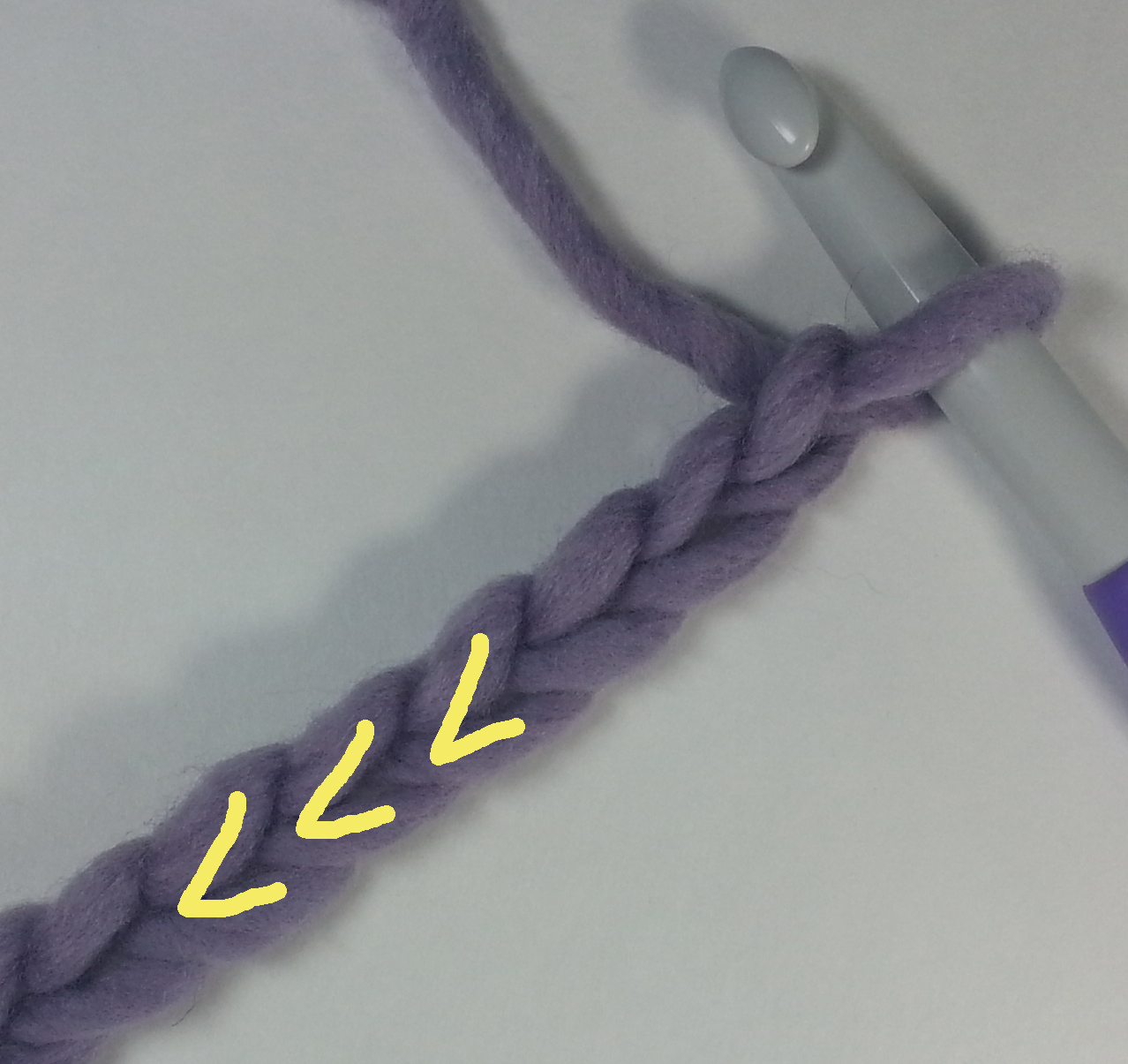
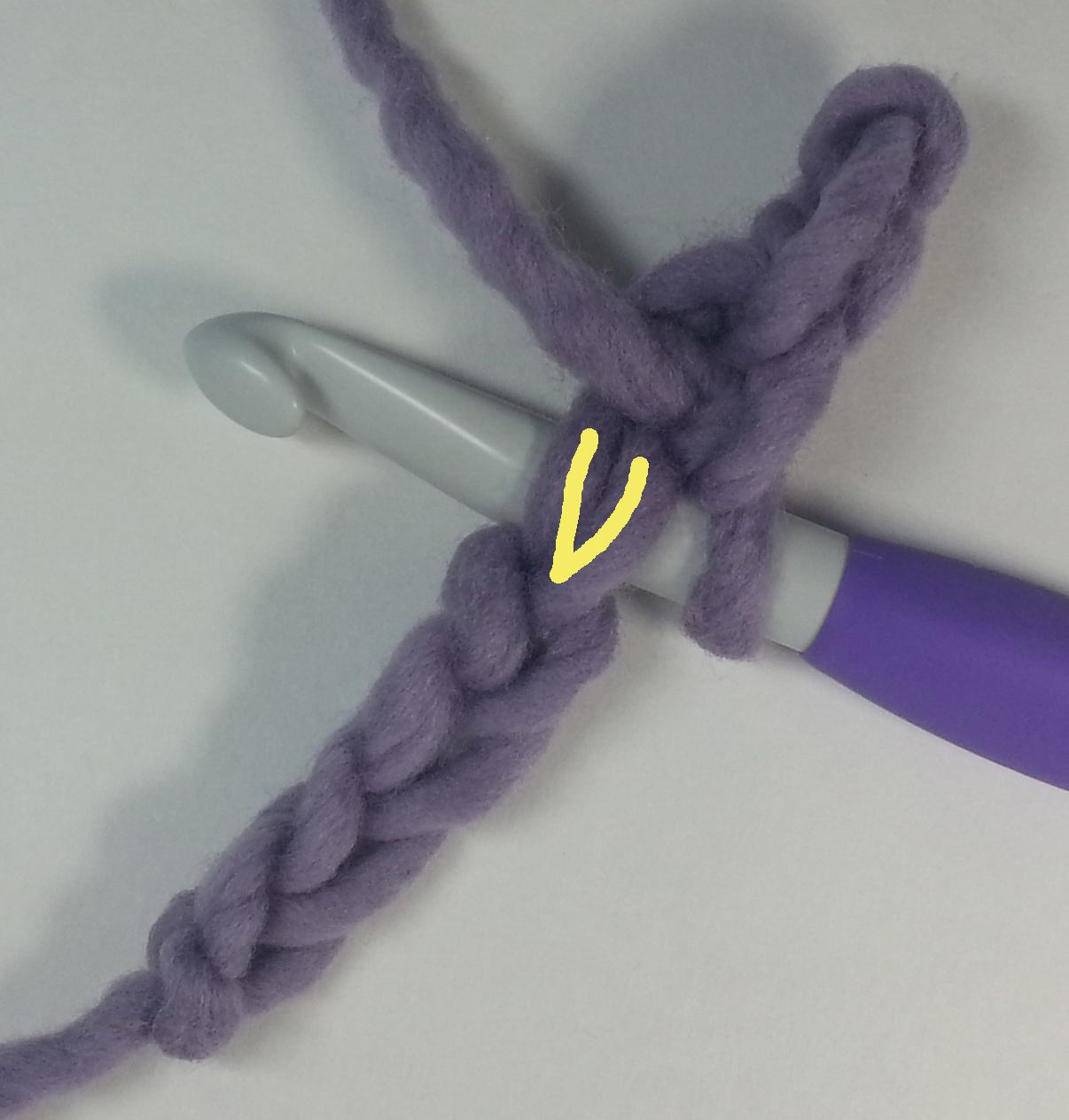
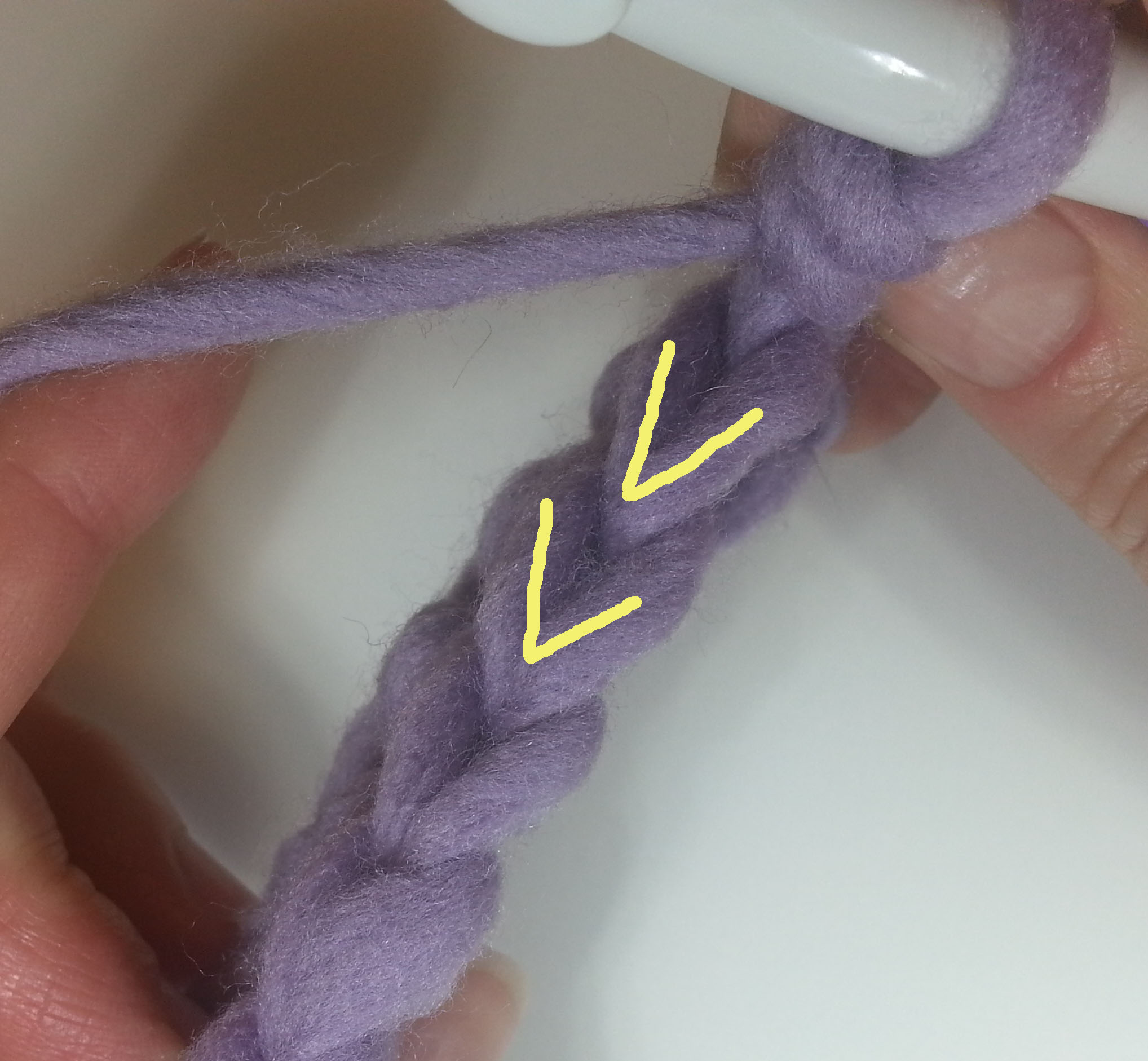
Vs on front of Chain Sts

The tops of the stitches are the V that you see in the above photo. They are what the working loop on your hook becomes as you make each stitch.

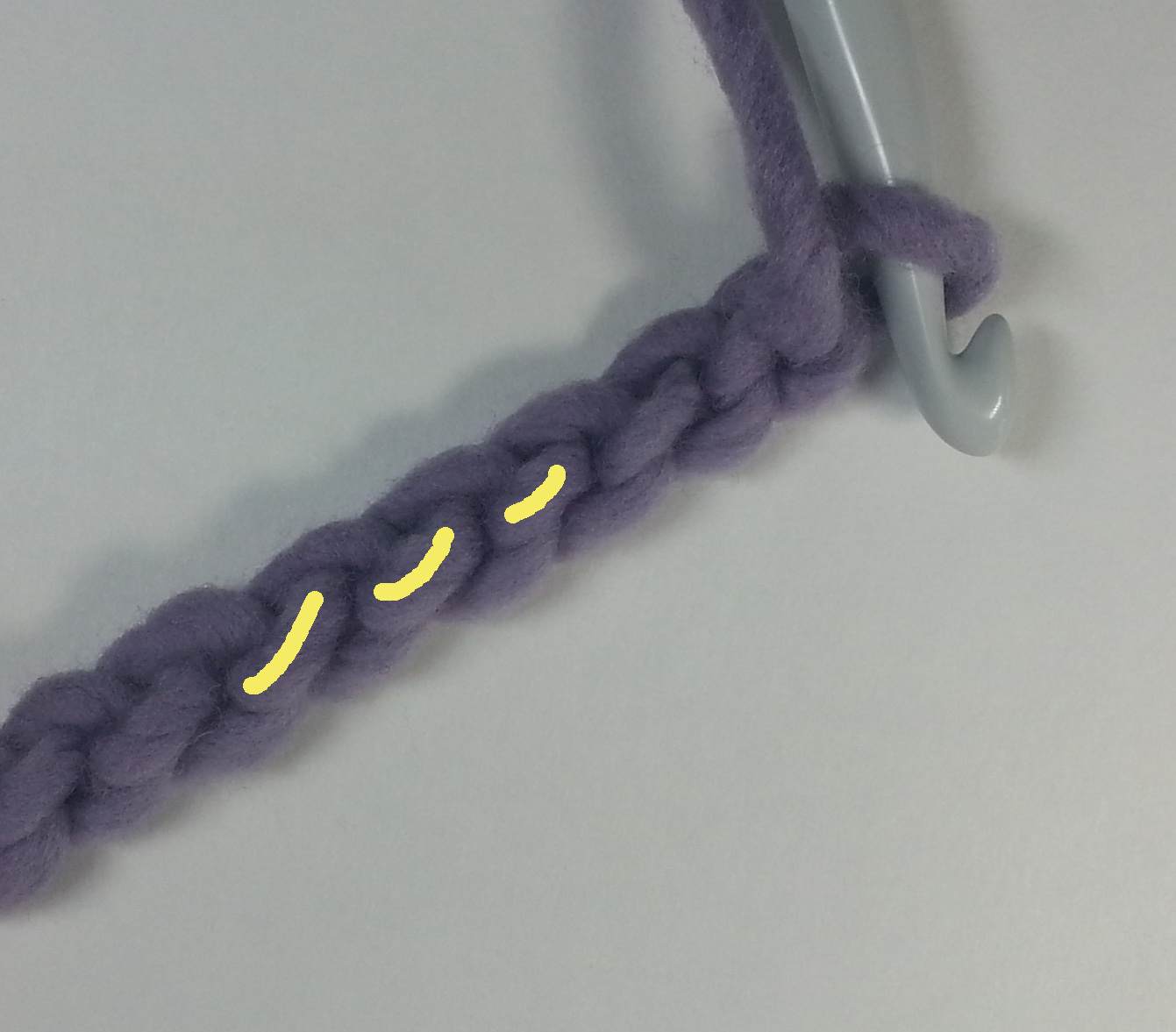
Back Bumps of Chain Sts

The chain stitch doesn’t have a “post” or “legs”. There is simply the back “bar” or “bump”. You will see either term used in patterns. It will depend on the publication what terminology they chose. This back bump is formed by the working yarn each time you pull thru a new loop with your hook to make a chain stitch.

The anatomy of a Single Crochet Stitch

The single crochet stitch is usually the first regular crochet stitch we learn to make after the chain stitch. The instructions for this stitch are: insert hook in stitch, yarn over, pull up a loop, yarn over, pull thru both loops on hook. But where do all those various loops end up?

Like with the chain stitch, the working loop on your hook is key. When you finish a stitch you have a working loop of yarn on your hook (yellow arrow pointing to it in above photo).  That loop becomes the top of the next stitch you make, no matter what stitch you are crocheting it will still become the top of the stitch.

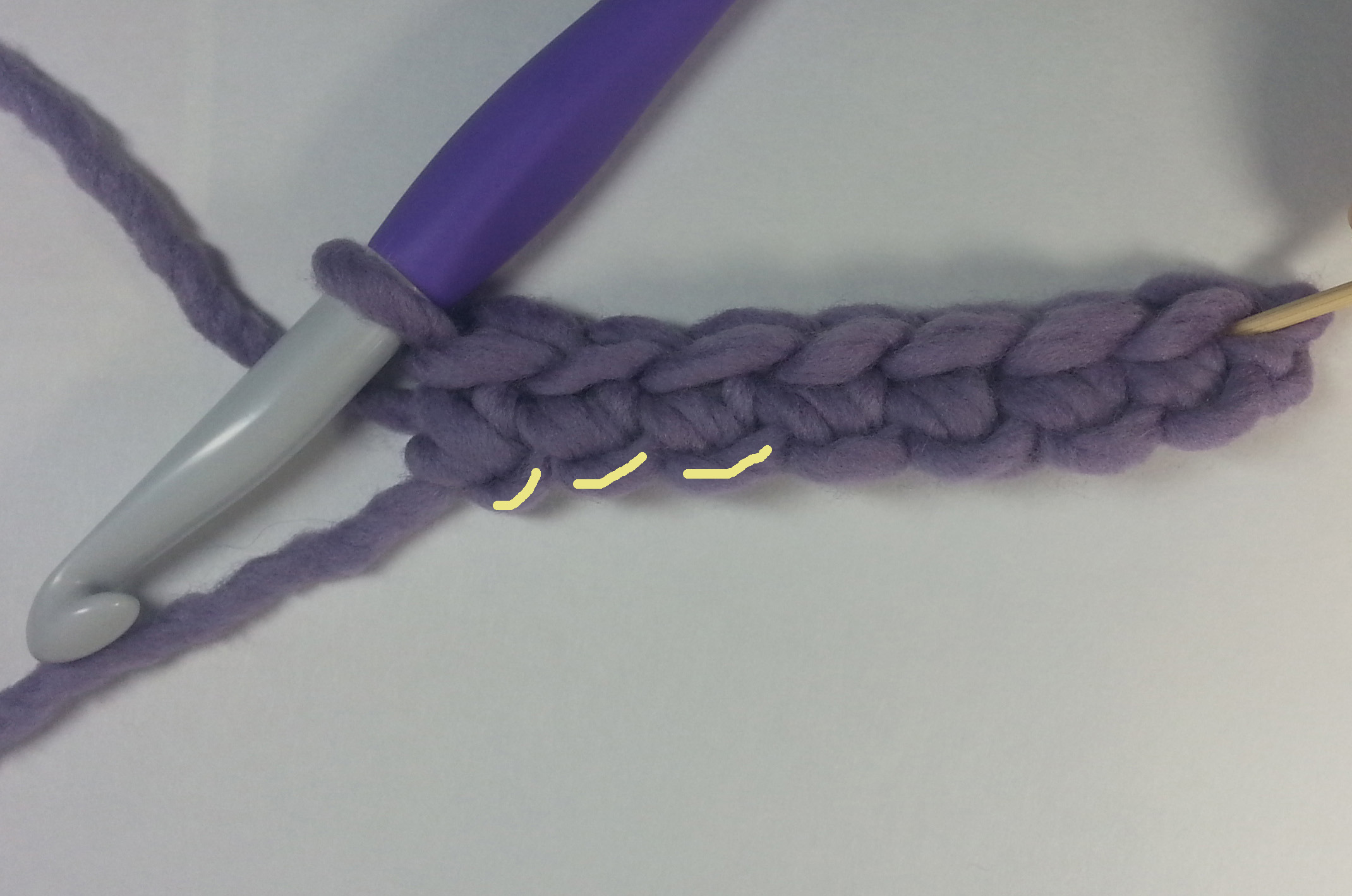
When looking at your single crochet stitches as you make them (this is the Right Side row) you can see 2 “legs” (vertical yellow lines in above photo), these are the bottom of the loop you pulled up thru the stitch. Looking at the single crochet stitches from the back side (this is the Wrong Side row) you can see the top of that same loop (horizontal yellow lines in above photo) just below the top of the stitch.

If you turn your work over and look at the stitches from the back you can see the path of the working yarn coming into the stitch and out of the stitch (marked with bright pink and arrows in above photo) forming the “post” of the stitch and the new working loop (top of next stitch) on your hook. The aqua and pink line shows the top of the stitch that had been the working loop previously.

The above image shows all the parts of the stitches in 2 rows. The top row is the right-side row being worked and the next row below is the wrong-side row stitches being worked into. Agua lines highlight the tops of stitches, yellow lines show the second loop made for the single crochet stitch, pink lines and arrows show the path of the working yarn and “back legs” of your stitches. If you look closely you can see that the pink back legs are wrapped around the top of the stitches in the third row below.

How do I work into my foundation chain?

Answering and understanding this is one of the most important skills to have in your crochet tool box. The typical start for a crochet project is to chain a length and then work back into the chain. Of course this often leads to the questions  about how to work into the chain. Which loop do you work under and how many of them?


Traditional method

One of the first ways I learned to work into a chain was by going into the center of the V on the top of the chain and catching the back bar and top leg of the V in the stitch being made. This is the more traditional way of working into a foundation chain.


Trad method free loops

This leaves a single strand at the base of the stitches in your first row. This can work well if you are working pieces of a garment that are going to be seamed together along the base of the foundation rows.

Trad method showing twist

The first row worked into the chain using the traditional method tends to have quite a bit of twist to it before you work additional rows.

Shells worked into chain

It also is more stable when you are starting a stitch pattern that requires multiple stitches worked into some of the chain stitches of your foundation. For example…shell stitches.

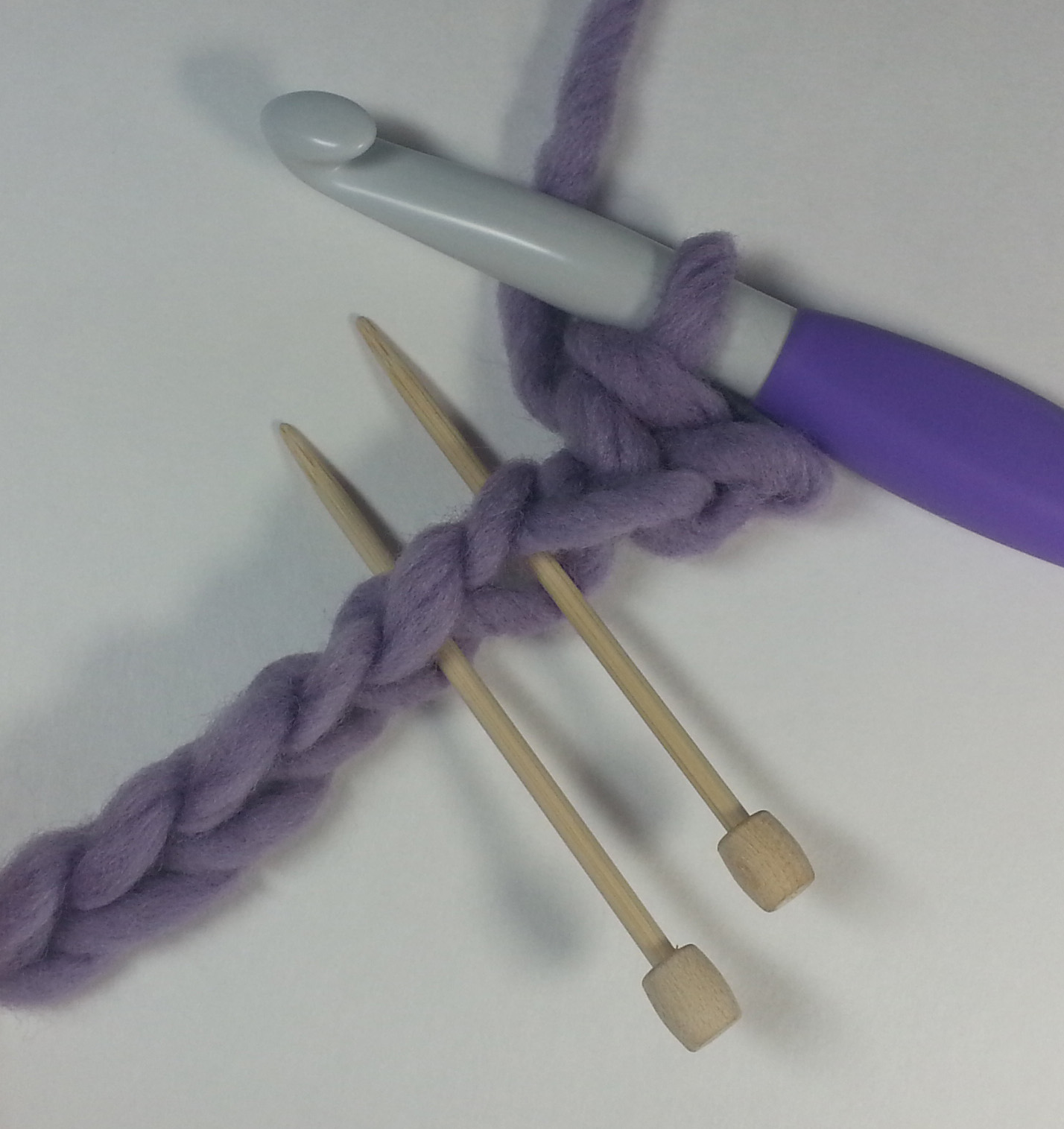
Another option is to work under both legs of the V on each chain stitch. I find this to be the most difficult way to work into the chain. It does give you a very stable foundation and the single strand at the base is free for seaming pieces together along the foundation. Working into a chain using this method is easier with a very loosely crocheted foundation chain.


The finished row will again have single strands at its base, but they will be a bit more centered. This row will have a lot of twist to it like the traditional method of working into a chain.


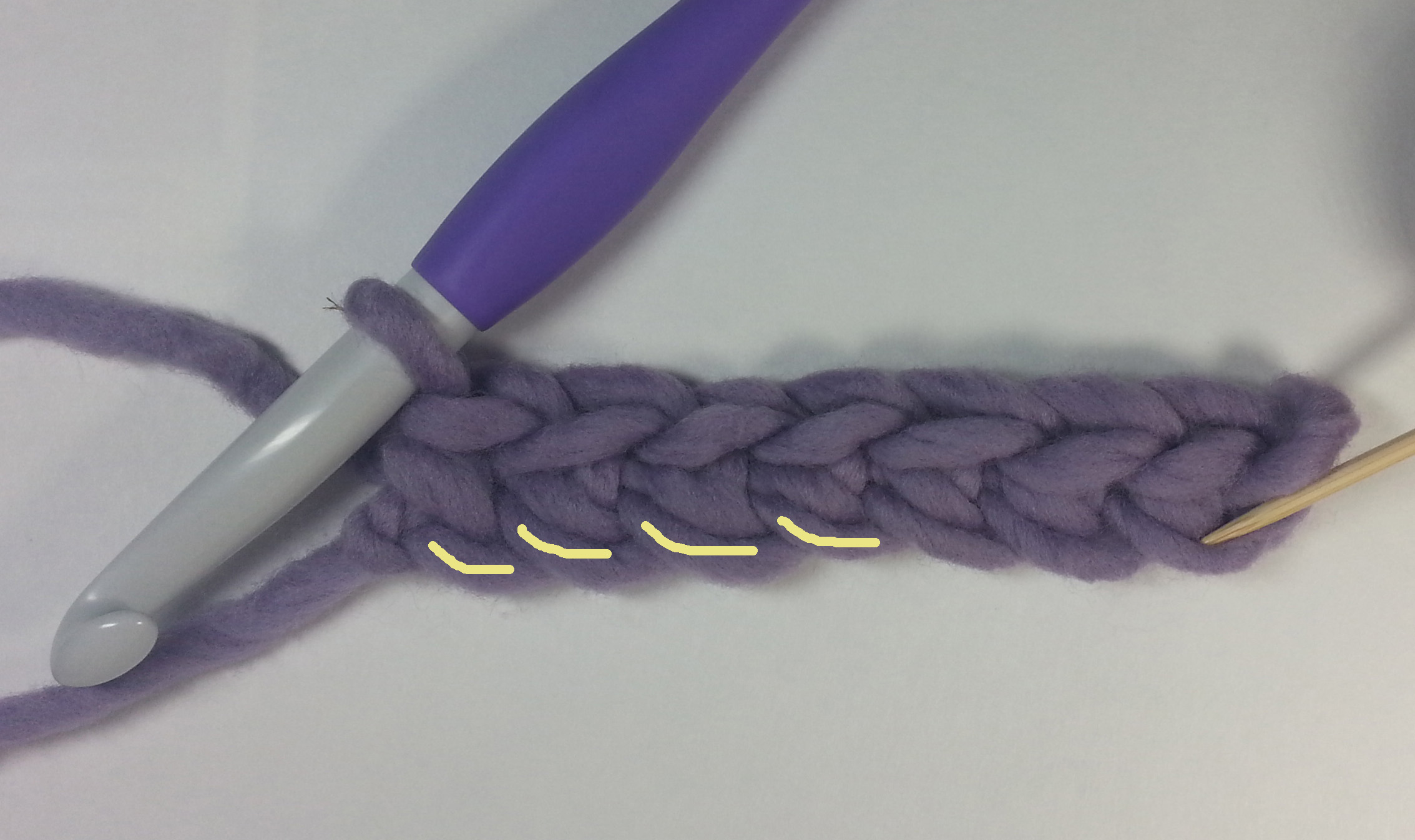
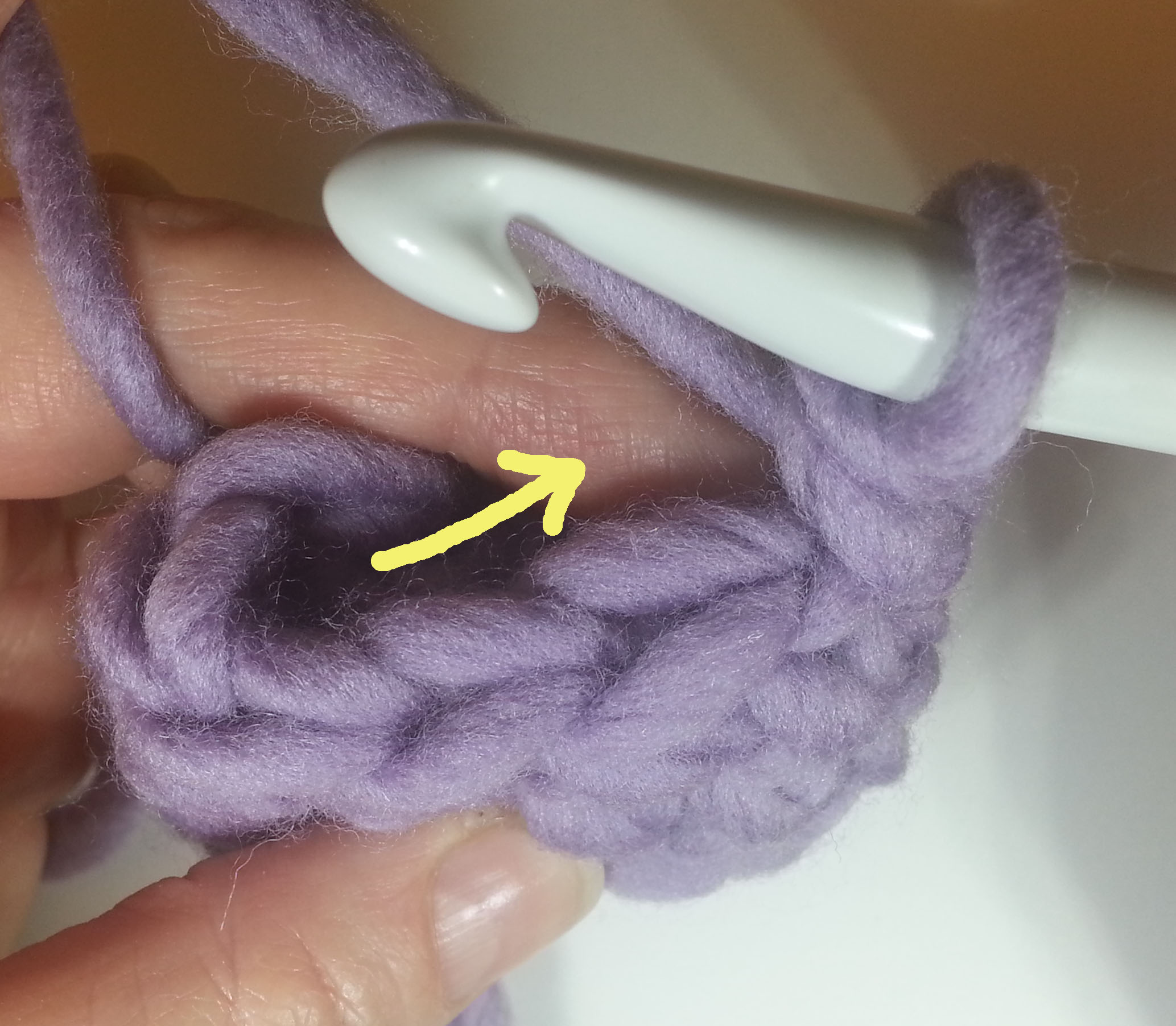
Sts wrkd in back bump base view
Arrow points to foundation chain’s loose Vs when stitches are worked into back bar.

If a pattern doesn’t specify which loop of the chain to use, I tend to use the back bar (or back bump). I like the way the finished foundation looks as it echoes the top of the stitches on the last row of the project. When putting an edging all the way around the finished project I find the base of this foundation easier and neater looking to work into.

Unless a pattern specifies a particular way of working into the chain you can do whatever works best for you. You only need to be consistent for the stitches of your foundation.


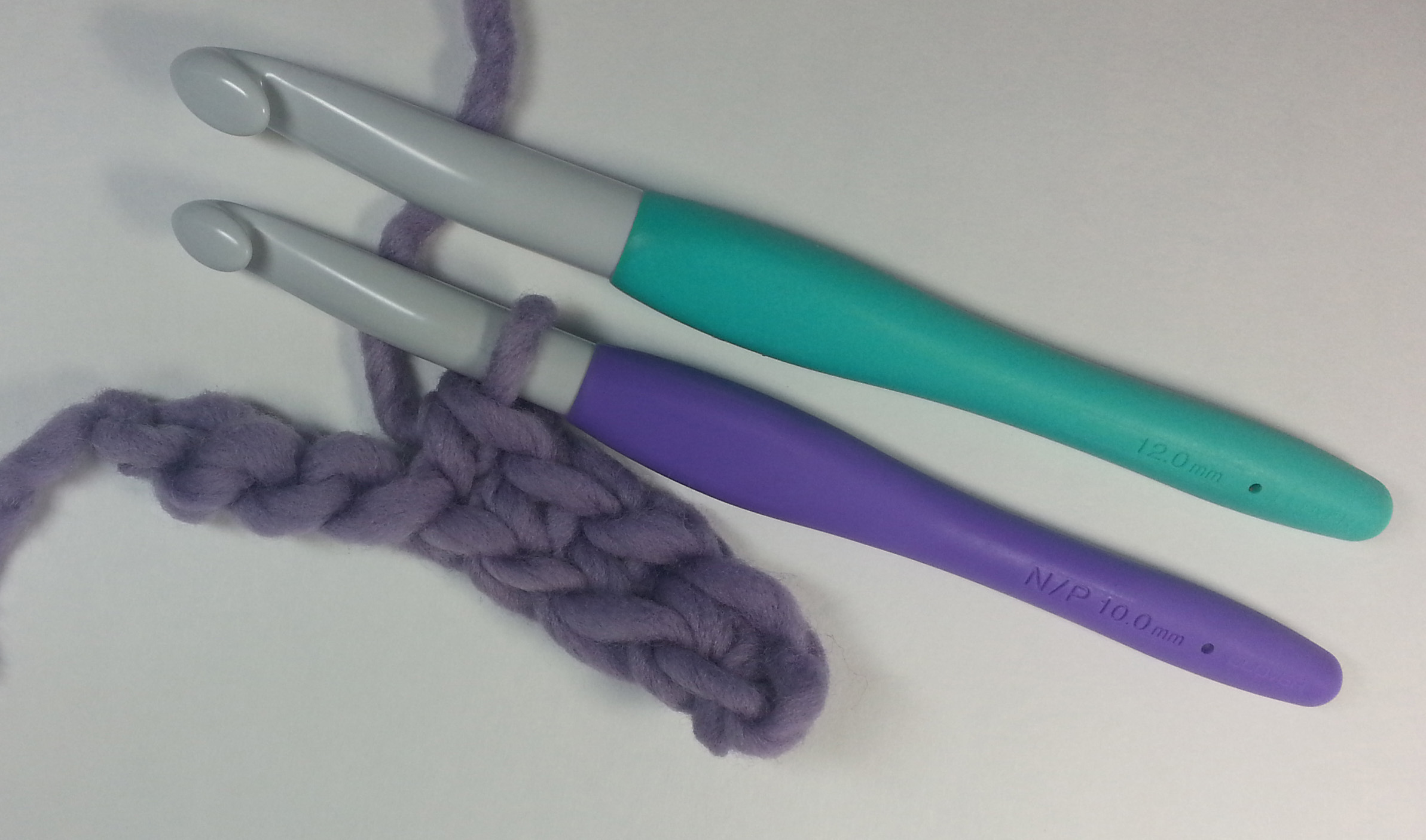
Chain w larger hook

If you find that your chain foundation stitches seem to always be tighter than the rest of your crochet fabric it can help to use a hook one size larger for the foundation chain, then switch down to the next hook size when you are ready to begin your first row of stitches into the chains. 

Finding the top of the stitch

Now you have an idea of where to spot the tops of your stitches in a chain, but how do you tell where the top of a regular stitch is?

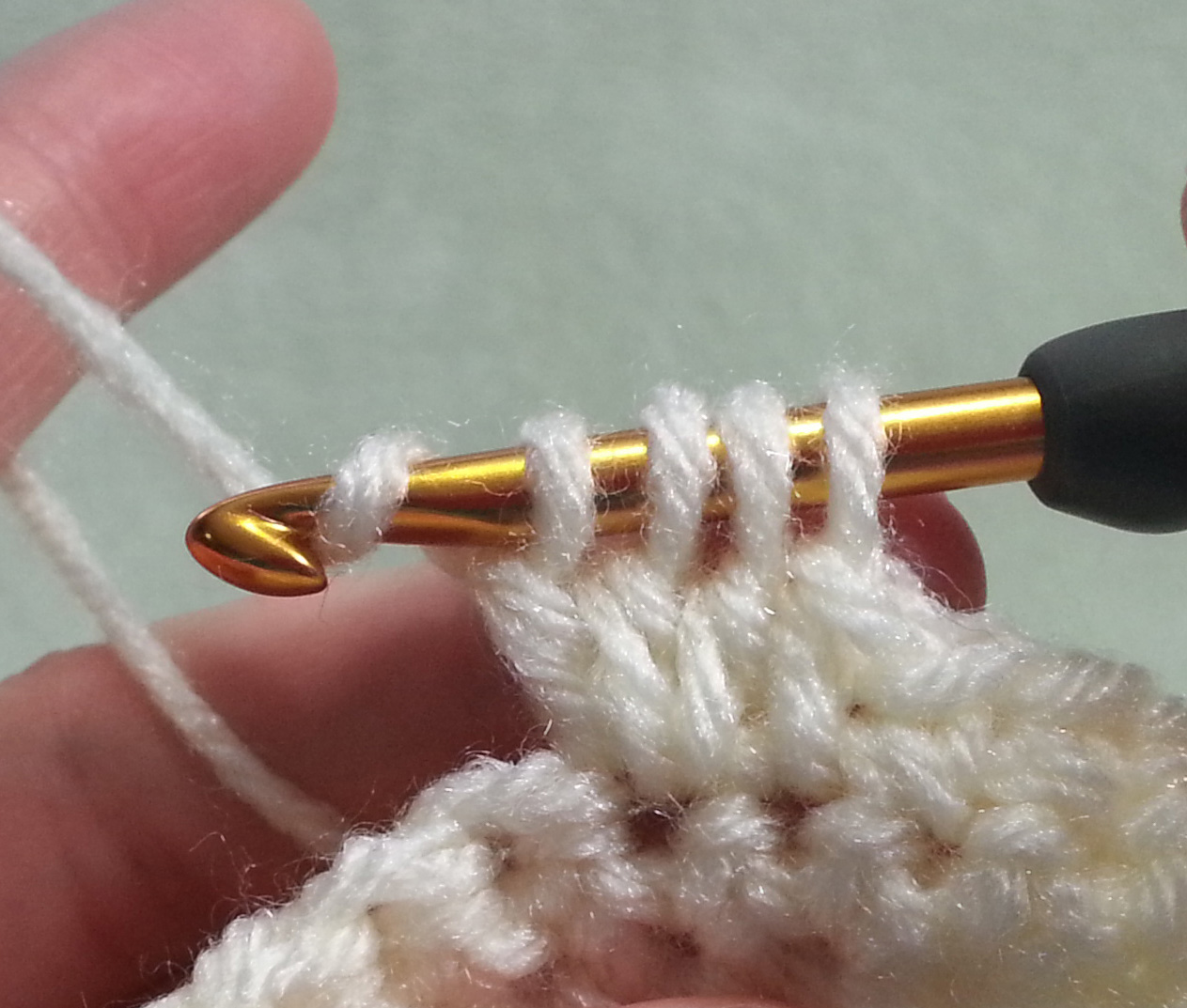
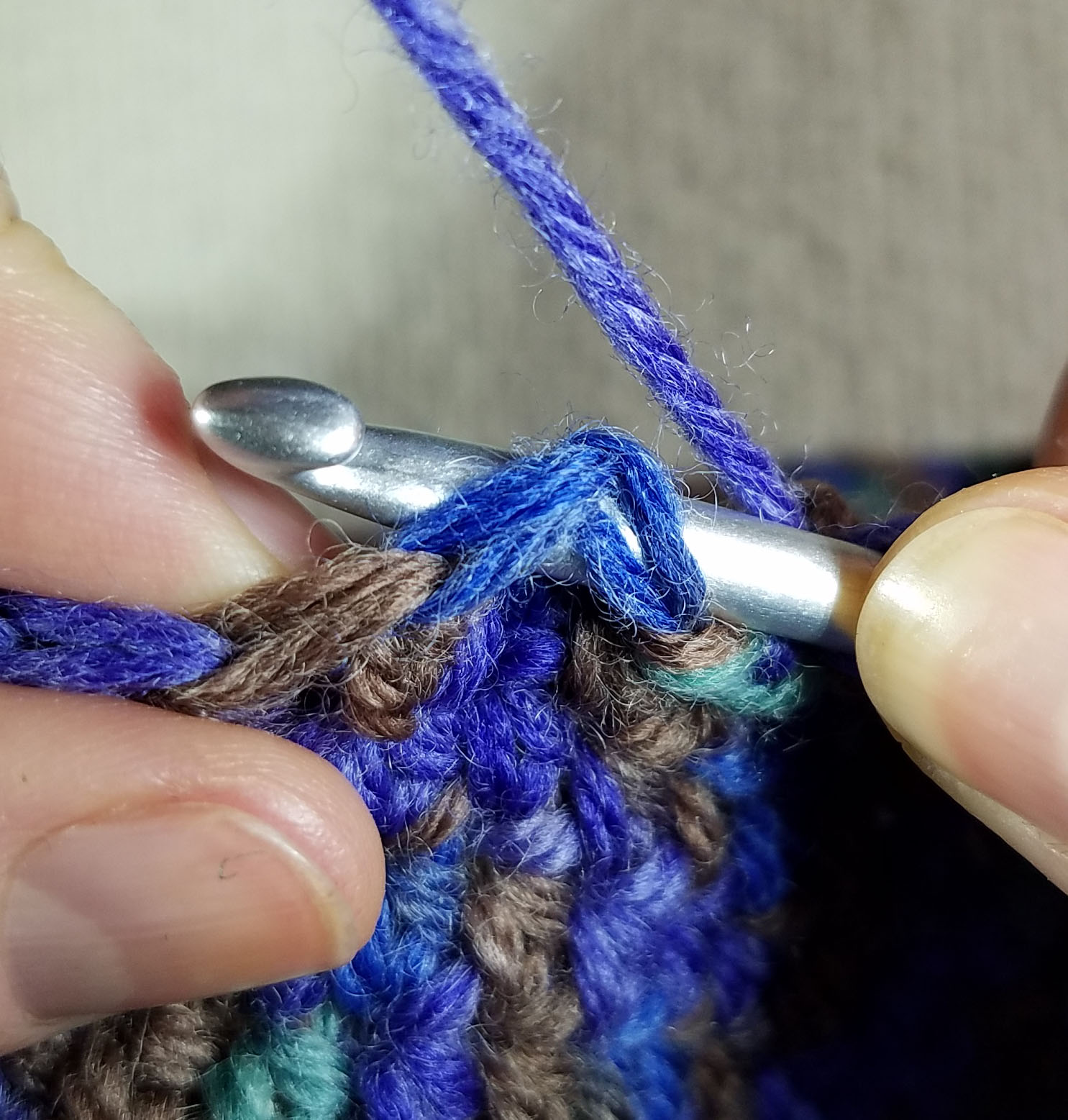
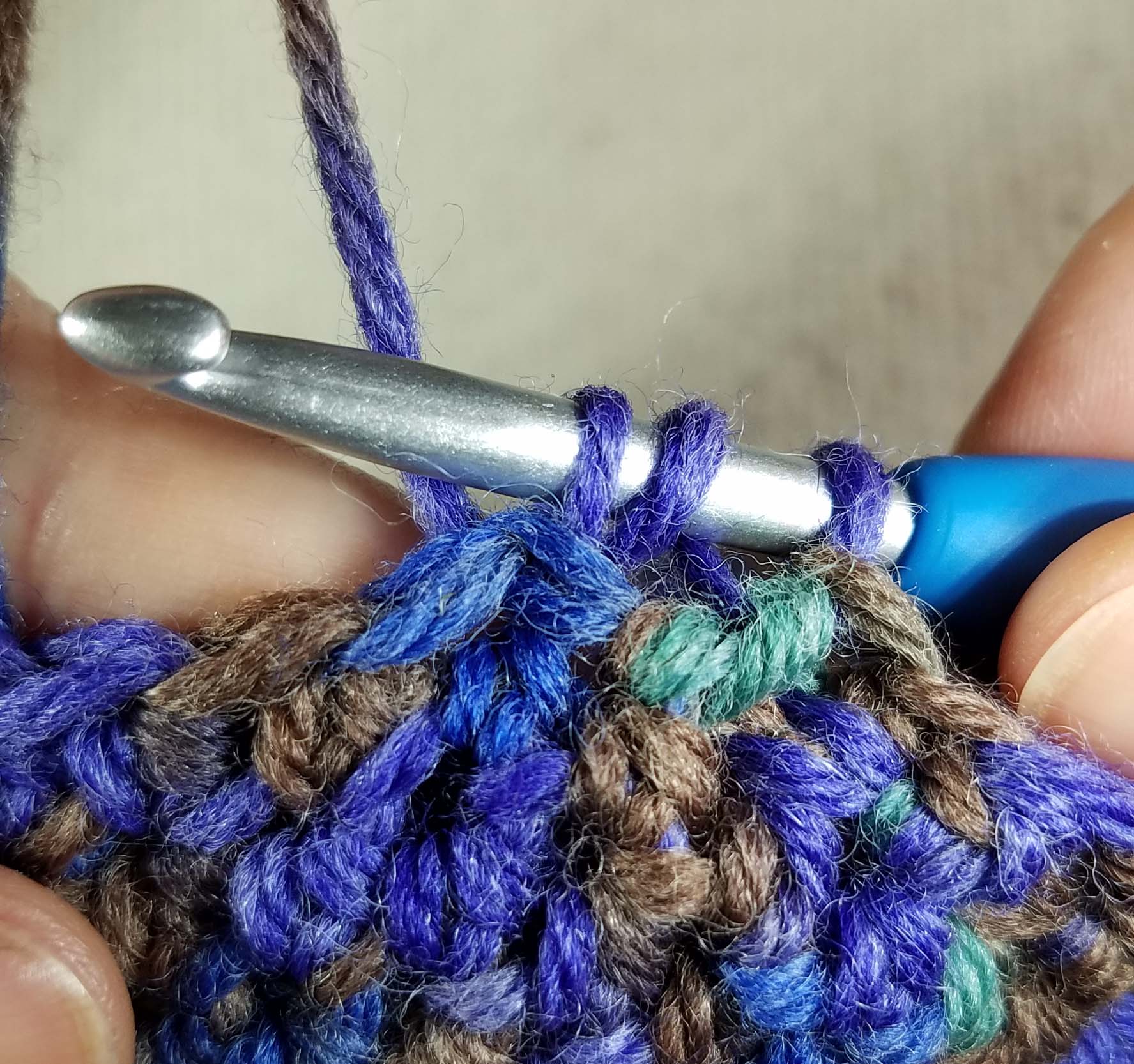
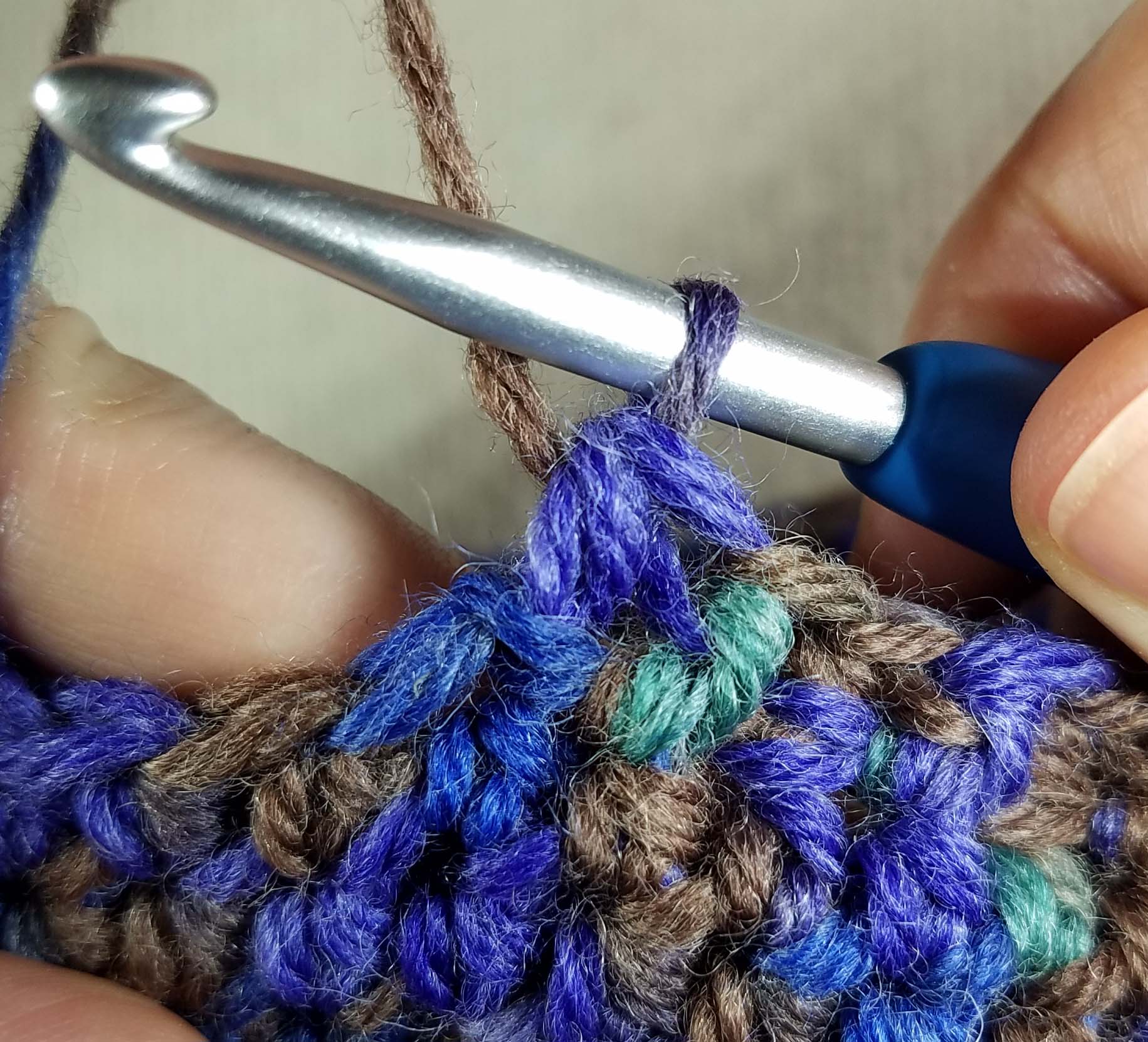
The simple answer, just like for our chain stitch, the top of the stitch looks like a V.  If you stop and hold your work so the Vs appear stacked they are easier to identify. As long as you don’t remove your hook from your working loop you can manipulate your fabric without losing any stitches.

Am I working in the right direction?

Once you can identify the top of your stitch it becomes a lot easier to tell if you are working in the right direction.

Vs pointing away

If your pattern tells you to turn at the end or beginning of a row, then the Vs of the stitch tops of the row you are working into, should be pointing away from your hook.

Working in the Round

If you are working in the round without turning at the end of each round, then the Vs of the stitch tops of the round you are working into, should be pointing at your hook.

Where do I insert my hook in the stitch?

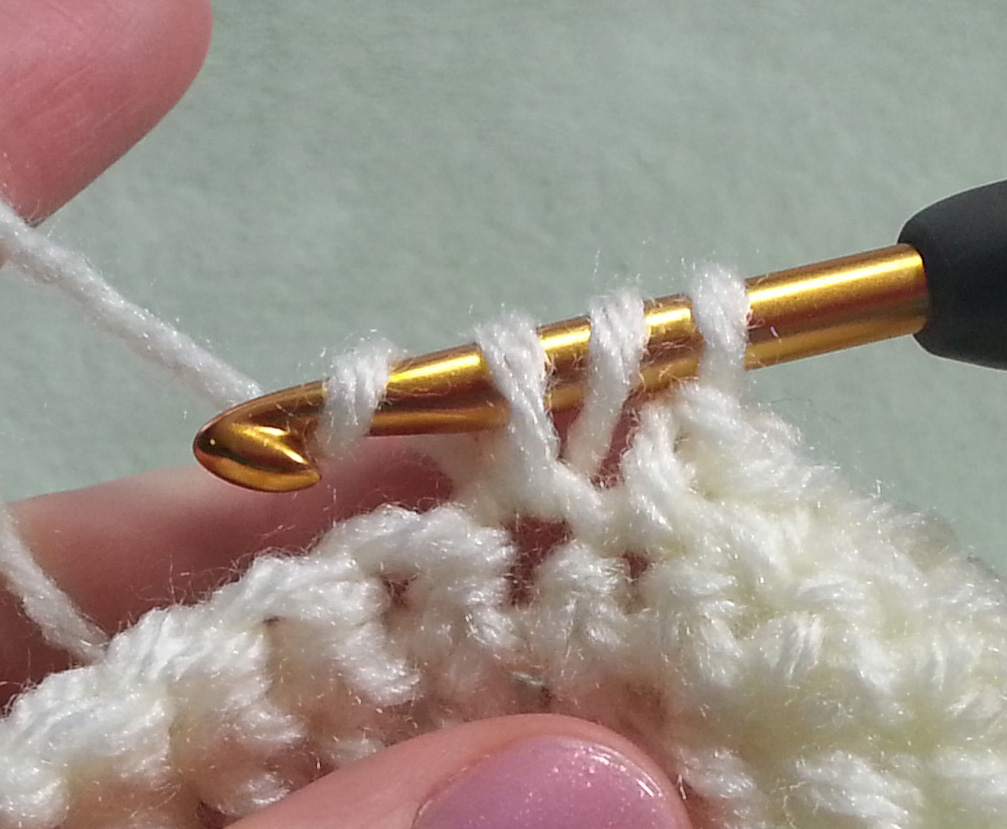
Insert hook under 2 legs

For your standard crochet pattern you are going to insert your hook under the 2 legs of the V in the top of your stitch.

Gap to Insert Hook thru

To avoid splitting your yarn look for the little gap on the side of your stitch just under that V.

Some patterns will give you special instructions about where to insert your hook to create different textures in your fabric.

Back loop

If your pattern instructs you to work in the back loop of your stitch.  This is generally referring to the back leg of the Vs after you’ve turned your work to begin your new row.

Front loop

The same is true for working in the front loop of your stitch. You would be inserting your hook under the front leg of the Vs after you’ve turned your work to begin your new row.


What if you need to work more than one stitch in the same stitch?

This can be tricky when you are new to crochet. Especially once you work the first stitch the V top of the stitch is obscured. My favorite trick involves manipulating the fabric.

Pulling up to find stitch

If you gently pull up on the stitch just made it becomes easy to see where the base of that stitch goes into the previous row. This hole is where you will insert your hook for your next stitches if the pattern tells you to work multiple stitches into a particular stitch.

Now you have a better understanding of your stitch anatomy time to experiment with some crochet swatches.

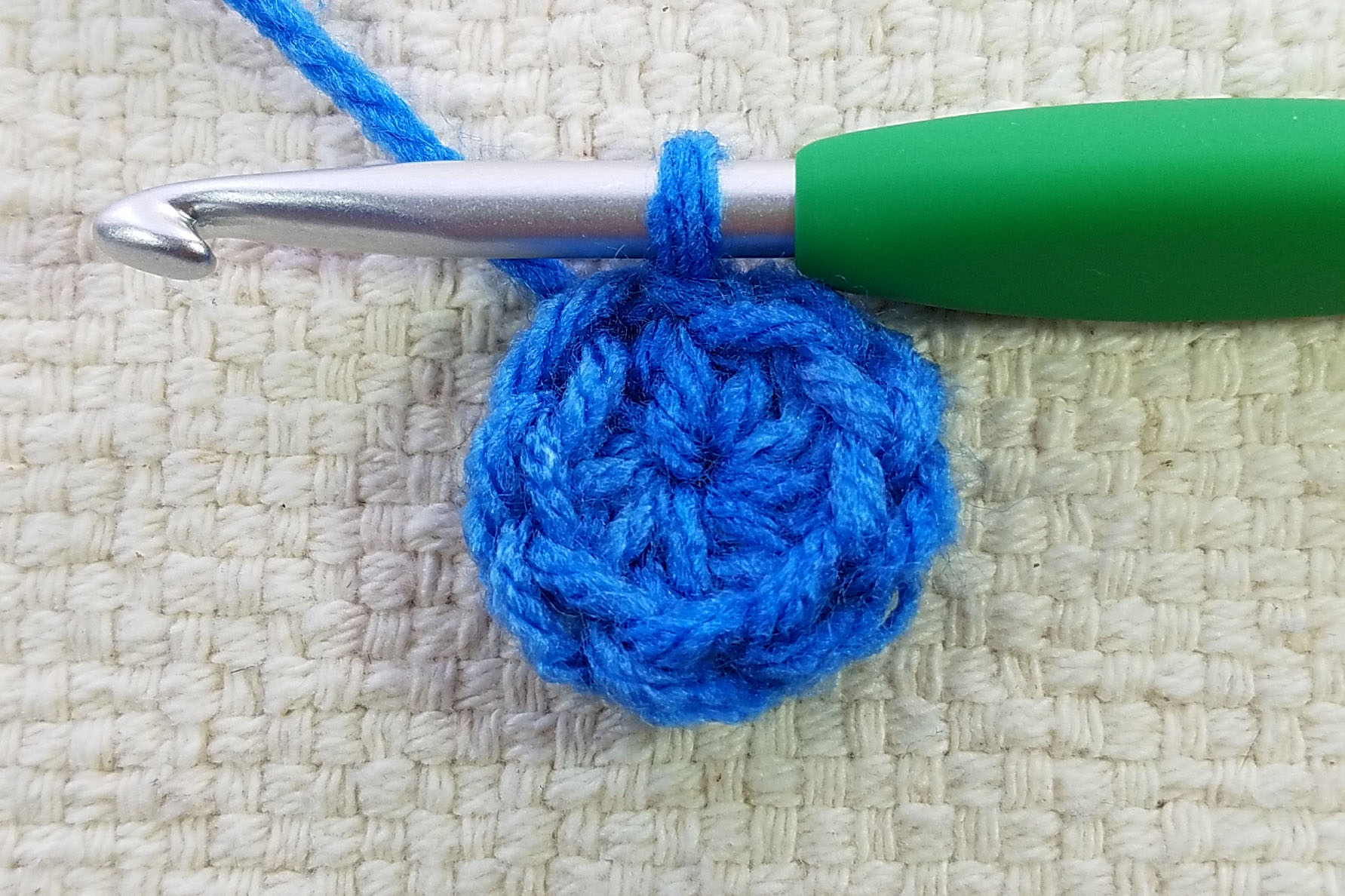
Chain 15, then work single crochets back along the chain (using whichever method you like) starting with the second chain from the hook.

Chain 1 and turn to work back along the first row of stitches working a single crochet in each stitch to the end of the row.

Right-side view of blue row

Wrong-side view of blue row.

If you change colors for each row of single crochet stitches you can see more clearly how the stitches fit together.

Sparkling Ice Snowflake

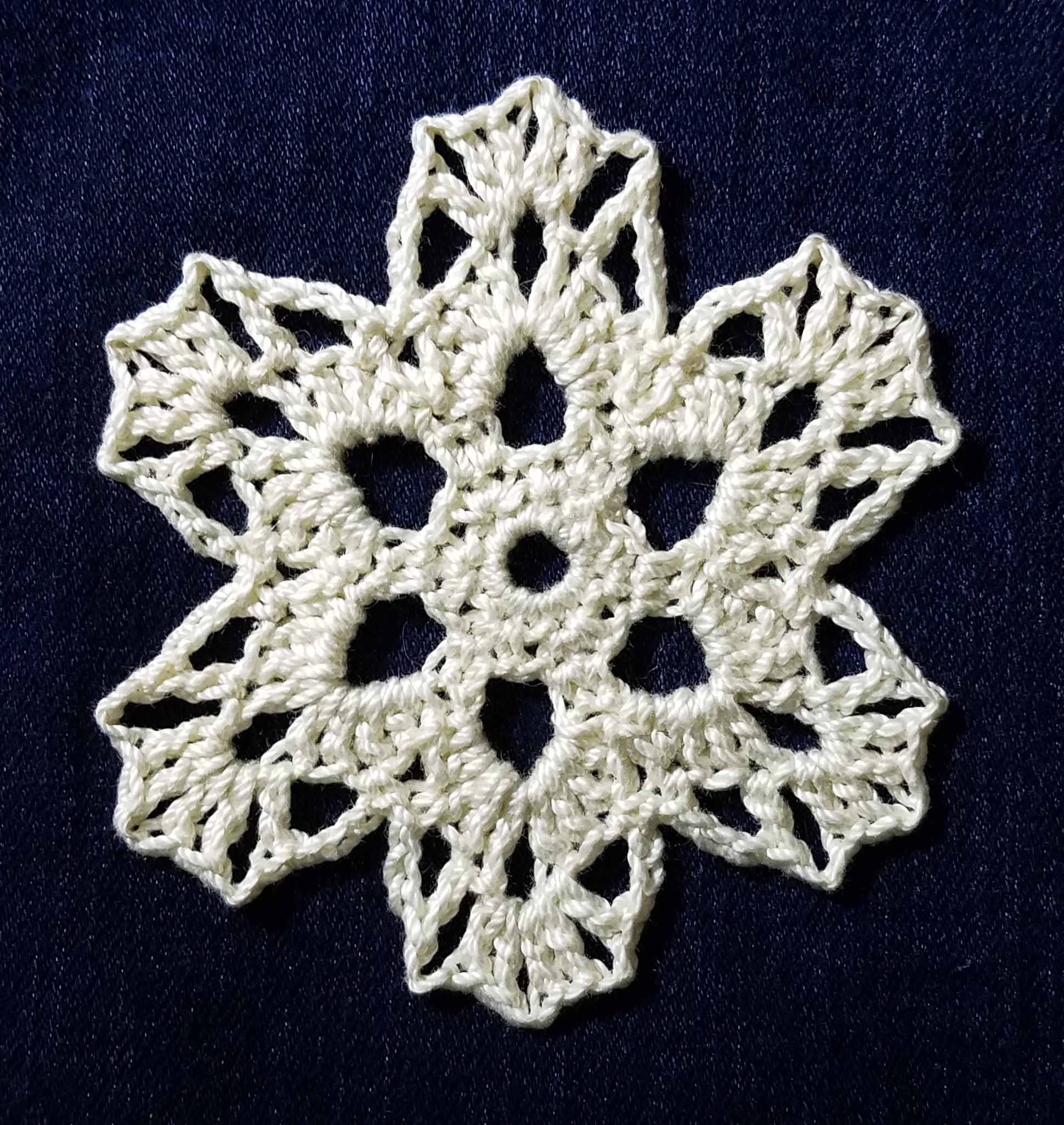
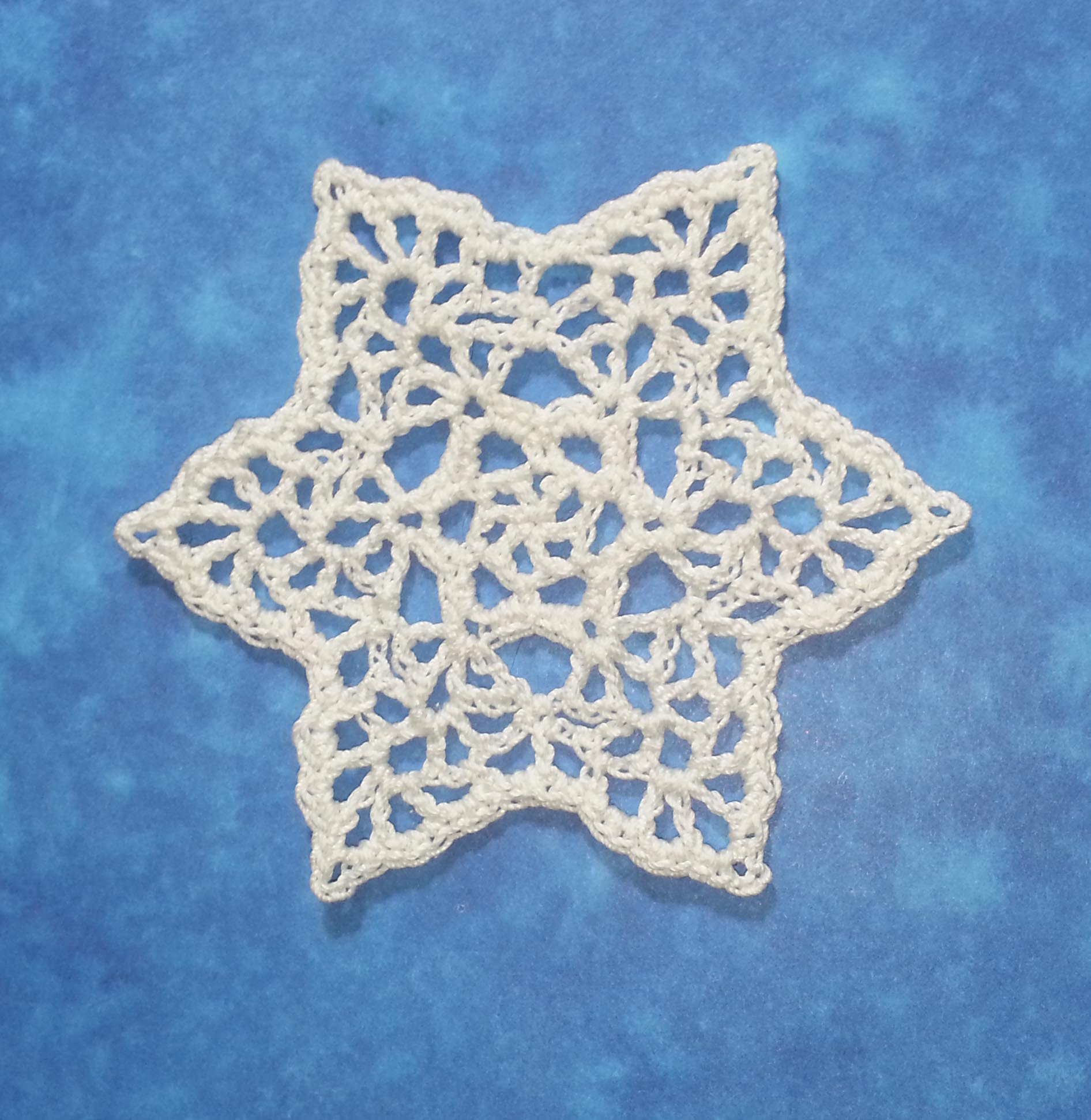
Row of Sparkling Ice Snowflakes - Andee Graves M2H Designs 

It is Winter up here on my mountain again, though technically it is still Autumn on the calendar. We have had numerous snow storms and a number of days that the temperatures barely crawled above freezing. I’m looking forward to the days of winter when the air sparkles with snowflakes in the sunshine.
I’m happy for the colder weather though, as it has helped me feel more in the mood for Christmas time.

I’m listening to my Christmas music and will be digging out my Christmas movies for watching after we’ve eaten our Thanksgiving dinner. Having gotten into a Christmas mood I’ve decided to get a head start on my Christmas gifts, and especially my gift to all my lovely readers.

Yes, my friends, it is time for a snowflake design again. This year I’m giving us all a bit more time to work on the new snowflakes. That way you can send some out with your Christmas cards if you want.

Not only do I have a pattern for you, but I am also including a photo tutorial on stiffening your snowflakes. Pattern first, since you’ll need some snowflakes to work with.
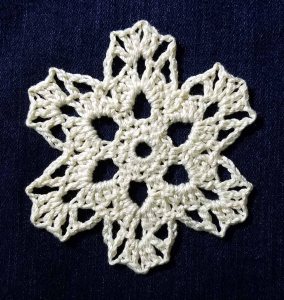
Sparkling Ice Snowflake

Designed by Andee Graves

Skill level: Easy

Materials:

Size 3 Cotton Crochet Thread with hook size: B (2.25mm)

Size 10 Cotton Crochet Thread with hook size: Steel 0 (1.75mm)

Notions

Tapestry needle for weaving in ends

Gauge

Gauge is not critical to this project.

Instructions

Rnd 1: Starting with Adjustable Slip Knot {if you need help with this technique check out my YouTube Video}, ch 2, 12 sc in second ch from hook, slip st to first sc of Rnd. {12 sc}

Rnd 2: Ch 1, (2 sc in next st, ch 1, skip 1 st) 6 times, slip st to first sc of Rnd. {12 sc, 6 ch-1 sp}

Rnd 3: Ch 1, sc in next 2 sts (ch 6, skip next ch-1 sp, sc in next 2 sts) 5 times, ch 6, skip next ch-1 sp, slip st to first sc of Rnd. {12 sc, 6 ch-6 loops}

Rnd 4: Ch 1, [(sc, hdc, 3 dc, ch 3, 3 dc, hdc, sc) in next ch-6 loop] 6 times, slip st to first sc of Rnd. {12 sc, 12 hdc, 36 dc, 6 ch-3 sp}

Rnd 5: Slip st in next hdc, *sc in next st, ch 3, skip next st, dc in next st, ch 2, (2 dc, ch 1, 2 dc) in ch-3 sp, ch 2, dc in next st, ch 3, skip 1 st, sc in next st,** skip 4 sts*; Repeat from * to * 4 times, Repeat from * to ** once, slip st to first sc of Rnd. Fasten off {12 sc, 30 dc, 6 ch-1 sp, 12 ch-2 sp, 12 ch-3 sp}

Finishing

Weave in all ends. Block snowflake and use favorite stiffening method.


If this snowflake doesn’t please you, I have 3 other snowflake patterns available here on the blog:

Frozen Star – Pattern available here.


Lacy Snowflake – Pattern available here for free text instructions only.

Or your can purchase the pattern in my Ravelry shop, this version includes a stitch chart as well as text instructions.
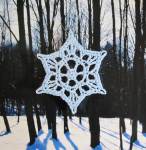
 

Little Snowflake Ornament – Pattern available here.


Stiffening Your Snowflakes

When stiffening your snowflakes you want to consider the climate you live in. Especially the humidity of your region will effect what stiffening agent you should choose, as well as how you want to set up your drying area.
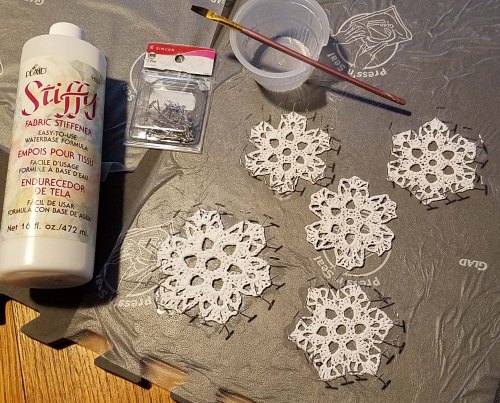
The basic supplies you will need to stiffen your crocheted snowflakes are:

Pins – Nickel-plated or rust proof pins are best, otherwise you can end up with rust marks on your finished snowflakes. My favorites to use are nickel-plated T-pins, Size 16, 1 inch long.

Waterproof (or resistant) Surface – You want to use something that will hold the pins firmly in place and can either be thrown away or washed off.  Wax or Parchment paper over cardboard is an affordable option. Afterward the paper goes in the bin and the cardboard can be recycled or re-used if not too punctured. I didn’t have wax paper in the house for this latest batch of snowflakes so I used Press-n-Seal plastic over my surface. I liked using one of my foam blocking board as it held the pins better than cardboard.

Stiffening Agent – This can be anything that is initially wet enough to be absorbed in the cotton of your stitches without obscuring them, and that dries rigid. I use a product I purchase at my local Michaels store called “Stiffy” from the Plaid company (same folks that make Mod Podge), but something like PVA school glue can work too.

Some of the PVA glues are a little too flexible when dry, so if you want a more rigid finished object you can try adding a bit of corn starch to the glue. If your glue is too thick, you can experiment with adding water to thin it. I use distilled water when doing this. I find a very thin liquid to be best for maintaining the stitch definition of my snowflakes.

This post contains affiliate links. I may receive compensation (at no added cost to you) if you make a purchase using these links.

Brush and Bowl – No matter what application method you prefer you will need both of these objects. If you are planning on using the “soak” method you will want a bowl wide enough that your snowflake will fit inside it. For your brush you will want stiff short bristles, that can help get the stiffening solution down into the stitches or help remove excess solution from the pinned snowflake.

Drying Surface – An old towel or a piece of fine metal screening. If you live in a humid climate you really want a drying surface that lets air circulate around your snowflakes, you might even want to use a fan or a blow-dryer on a low setting. I tend to use a dry towel.

Getting Started

Obviously you first want to crochet your snowflakes, I like to have a pile to work with before I begin the stiffening process. Sometimes I will wet block my snowflakes first. The pinning process is the same as when I am stiffening my snowflakes.

If your snowflake is crocheted tightly and you wet block it with pinning you may have a stable shape without additional stiffening. Or it will hold the shape well enough to just brush on the stiffener without it being pinned. You will want to experiment.

I prefer to use the brush method of applying the stiffener as it helps me keep better stitch definition. If you want to do the soak method you will immerse your snowflake in your solution, then remove it from the solution letting excess drain off. Proceed to pin the snowflake to the desired shape. Once you have the snowflake pinned out, use paper towels to blot off excess solution. Be careful during the blotting that you don’t glue bits of paper towel to your snowflake.

In this demonstration we are trying to get a symmetrical looking snowflake. I approach the pinning like stretching a drumhead (something I learnt from my younger brother, Cy the Drum Guy).

Pinning dry 1 - Andee Graves M2H Designs

This means securing one point on the snowflake then stretching to the opposite point, continuing to work around the points of the snowflake back and forth.
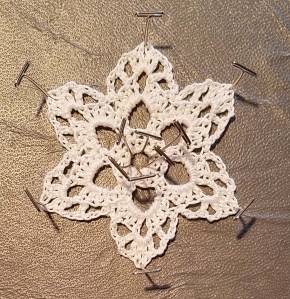
Center and Pts pinned dry - Andee Graves M2H Designs

It can be helpful to also place pins in the center of the snowflake after securing the first 2 points. This is especially helpful with really open stitch work, it will keep the other 4 points from pulling it off center. I remove the center pins once I’ve got the 6 points secured.
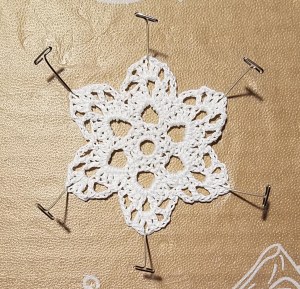
Pinning dry 6 - Andee Graves M2H Designs

Then look at the other areas of the snowflake that you might want to open up. This is how you can really change the look of your snowflakes even when they are crocheted from the same pattern.
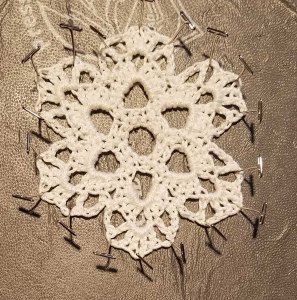
In the case of the Sparkling Ice Snowflake I added 2 pins to each point in the ch-2 spaces  to square up the points of the snowflake, or….

Placing the 2 additional pins in the ch-3 spaces creates a pointed look.
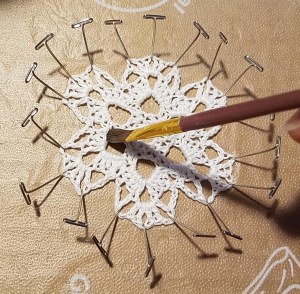
Painting on stiffener - Andee Graves M2H Designs

Now it is time to brush on the stiffening solution. I usually pin my snowflakes wrong side facing up and brush on the stiffening solution to set the shape. I keep brushing the solution to help it absorb and get deep into the stitches. Usually your thread will change color enough that you can see where you still need to brush on more solution.

Once the solution is dry I carefully un-pin the snowflake. Usually this isn’t stiff enough to hang, so I will turn over the snowflake and paint the other side of it with a light coating of stiffening solution. The shape of the snowflake is already set though and I don’t pin it in place again.

If you want to add some sparkle to your snowflake this is a good time to add glitter.  Sprinkle glitter over the wet surface. Tap off any excess and set aside to finish drying.

5 snowflakes 2 sizes Sparkling Ice - Andee Graves M2H Designs

I usually move the snowflake to the drying surface after painting on the second coating of stiffener to prevent it from sticking to the work surface. If you are in a humid climate you may want to un-pin and move your snowflake to the drying surface once it is mostly dry and set from the first coat, this will help it dry quicker.

Nylon Hanger - Andee Graves M2H Designs

Once your snowflakes are completely dry use ribbon or light weight nylon line to create hangers. I prefer the nylon line because it is nearly invisible. I usually use about 4-6 inches and thread it thru an opening on the edge of the snowflake and tie a knot over the 2 ends.

Have fun making snowflakes.


This post contains affiliate links. I may receive compensation (at no added cost to you) if you make a purchase using these links.

Is it a Rock?

The other day I saw a really cool video on FaceBook of rugs that looked like river rocks. I love river rocks. I have five medium sized ones that sit on top of my woodstove in our living room. They act as heat sinks as well as looking pretty. A heat sink is a solid or liquid filled object that retains heat and slowly releases it as the air around it cools. Occasionally I put one of my river rocks in a thick cotton towel to warm my feet on when the temperatures really drop up here on the mountain.

The rugs in the video were made with felted wool rocks by the artist/designer Martina Schuhmann from Vienna, Austria  (you can see the video on YouTube here). I was very intrigued since I’ve been playing with needle-felting so much. I decided to find out as much as I could about felting wool rocks or “stones”.  I first went to the artist’s Etsy shop to see if there was more information. You can check her shop out at: FlussDesign

In the video there is a close-up of one of her rocks being squeezed and it bounced right back.  That made me wonder how she was felting her rocks, were they solid wool or was there something else? Looking at Martina’s shop got me part of the answer. She stated that her rocks were made with a foam core.

I had the video on my facebook page and stated that I was wondering how she felted her rocks. My friend Angela sent me a link to a video on YouTube where they were felting around actual rocks. That got me wandering around YouTube looking at a variety of felted rock and other wet felting videos. I decided it was time to try felting my own wool river rock.

I dug out this piece of 1 inch thick foam that I had leftover from another project. It was a little dusty, so I gave it a good wash and hung it up to dry overnight. You can see in the photo above where it was clipped to my drying line. It wasn’t a very pretty piece of foam, but it was going to be enclosed in wool anyway. I drew an ovoid shape for my rock.

Once I had cut out the foam rock I trimmed up the edges to soften them. I figured wrapping the wool fibers and felting them around it would likely soften any hard edges, but I wanted to make this first rock as easy as possible.

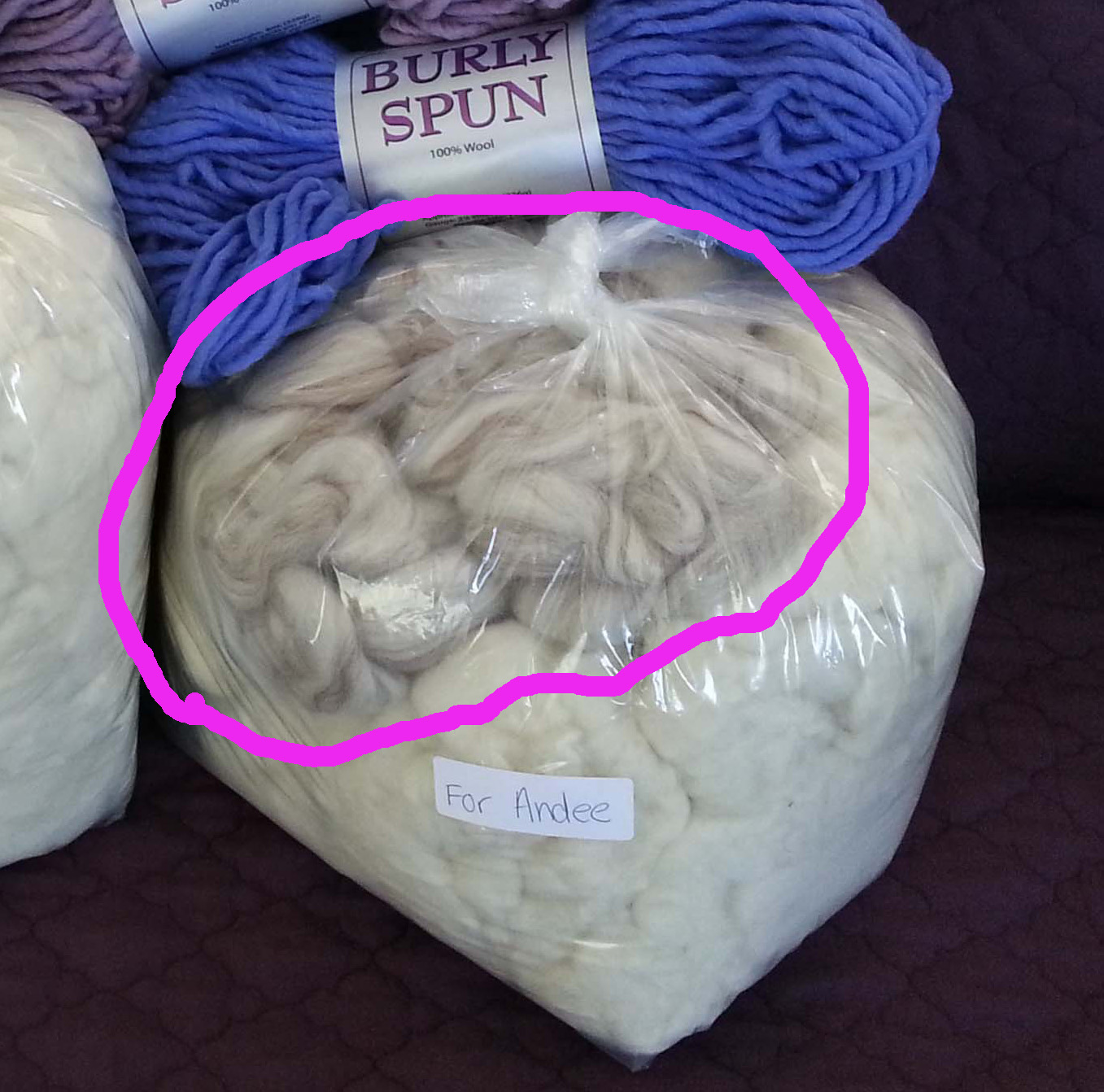
Remember when I purchased that wool fiber from the Brown Sheep Company at the Loveland Yarn Fest last April? There was some interesting striped fiber in one of the bags. I had taken it out and placed it aside in another bag because I knew it would be great for a “special” project someday. It’s day had come, I thought it would be ideal for giving some “rock” texture to my felted faux river rock.

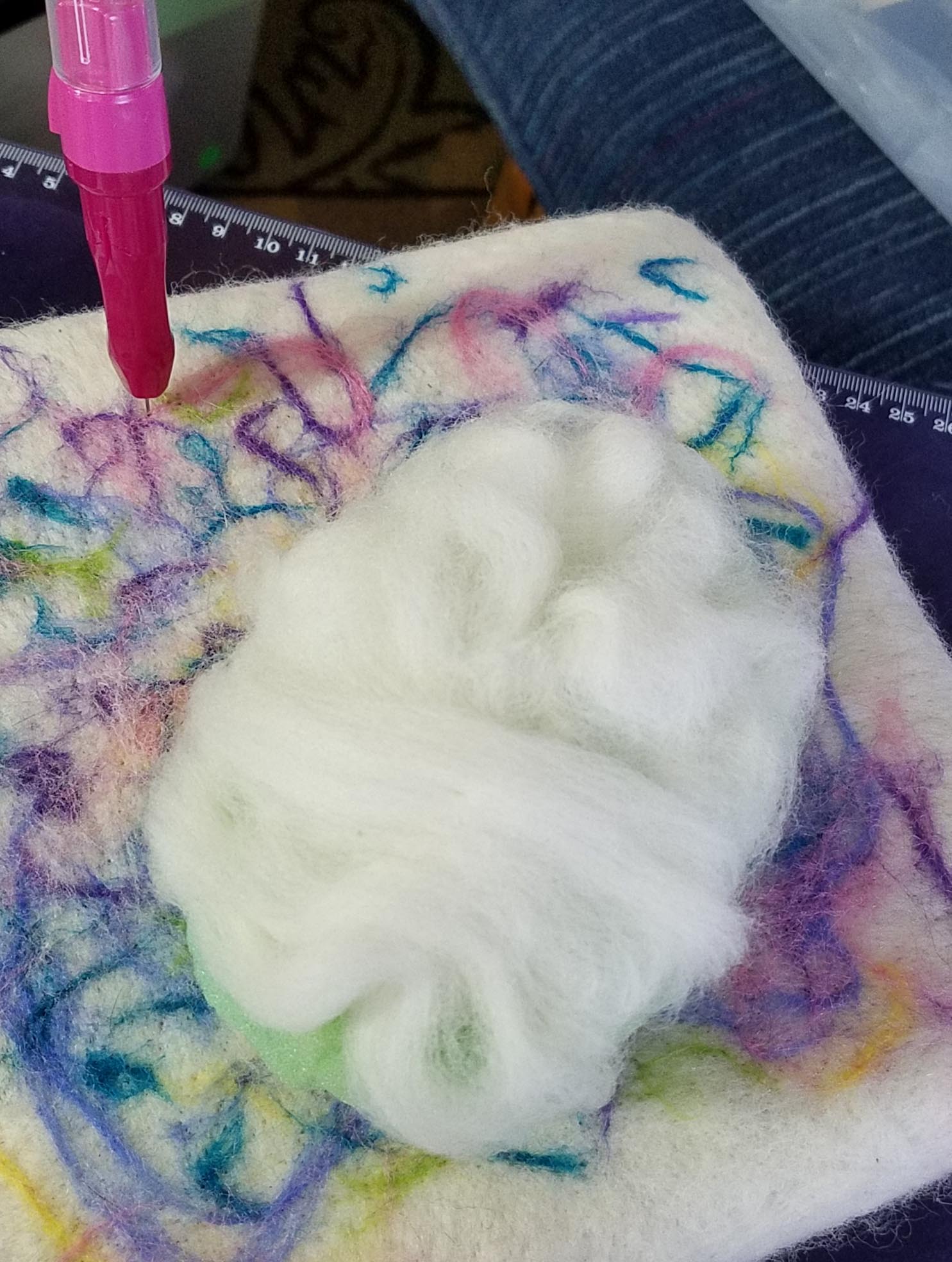
Before I started with that fiber though, I wanted to add a bit of my plain wool to the flat sides of my foam rock. Of course, my handy felting needle came out for this part of the project. I used the felting needle to tack the wool to the foam, just enough that it wouldn’t come loose.

I then did the same to the opposite side of my foam shape.

Now I had a little wool and foam sandwich to wrap with my special fiber. I set that aside for the moment.

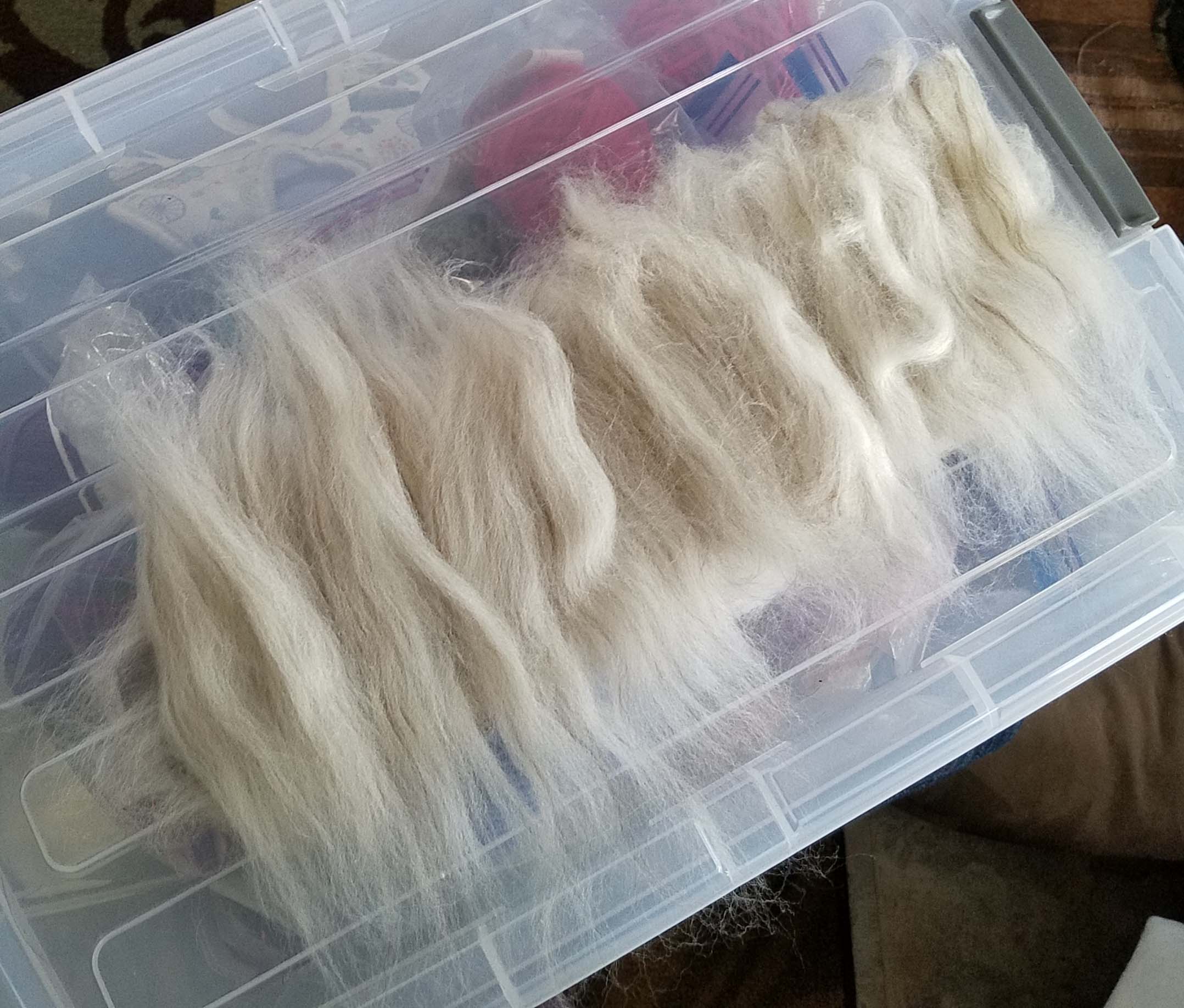
It was time to lay out my fiber that would be the outside of my rock. I first pulled out drafts of fiber laying them out lengthwise on my work surface.

Next I laid out a second layer perpendicular to the first layer.

I was ready to wrap my little foam sandwich. If I do this again I will make my strip of wool fibers wider, I ran into some small challenges getting the core wrapped well.

I rolled the core up as snugly as possible with my strip of loose fibers. Then I was ready to use my felting needle to tack the fiber down well to the core.

At this point I had covered the entire core with the fiber and secured it well using the felting needle.

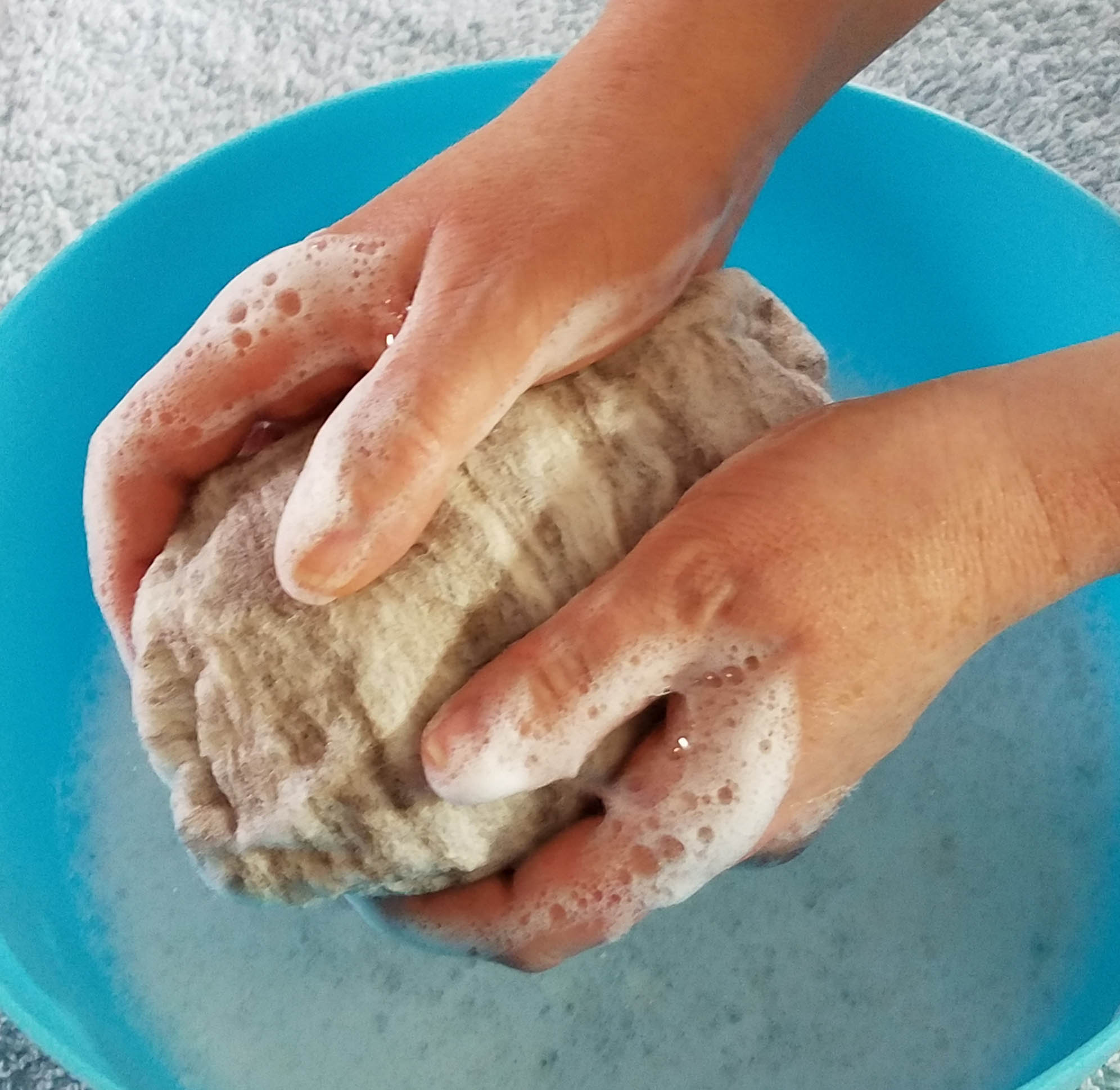
It was time to submerge the rock in my bowl of hot soapy water.

Now it was just all about working the wet felt to shrink it snugly around the foam core. This is the really wet and messy stage of this project. I also think I had a bit too much soap in my water. I alternated going to my kitchen sink and rinsing my rock with cold water to shock the fibers further, and working with the hot soapy water.

I also used my felting stone when I started getting the rock closer to the shape I wanted. The felting stone helped me smooth the surface of my “rock”.

I had finally gotten it felted well and I set it out to dry overnight. It was still a bit furry looking and had some odd shaping issues on the “bottom” side. I knew I would be doing a little “fixing” with my felting needle once it was dry again.

The next afternoon my rock was dry and I was happy with the squish factor of it.  I wanted to correct some shaping issues on the bottom and ends. Especially this odd little flap that had formed at one end. Of course, real river rocks do sometimes have cracks and little protuberances, but I wanted my rock to be an “ideal” river rock.

Fortunately this was easy to fix, I just added some bits of fiber and needle felted them until they were smooth. No more flap. I continued shaping and smoothing my rock with my various needle felting tools. All of them joined the party; single, 3 and 5 needle tools. The 3 needle tool was especially useful for smoothing the surface of my rock with lots of shallow needling.

Before

After

I am pretty pleased with how this rock came out. You can see how much the fiber shrank from the starting size to the finished size in the Before and After photos above.

The finished rock is only a little bit bigger than the foam core. You can get an idea of the relative sizes by looking at the shape in the remaining foam.

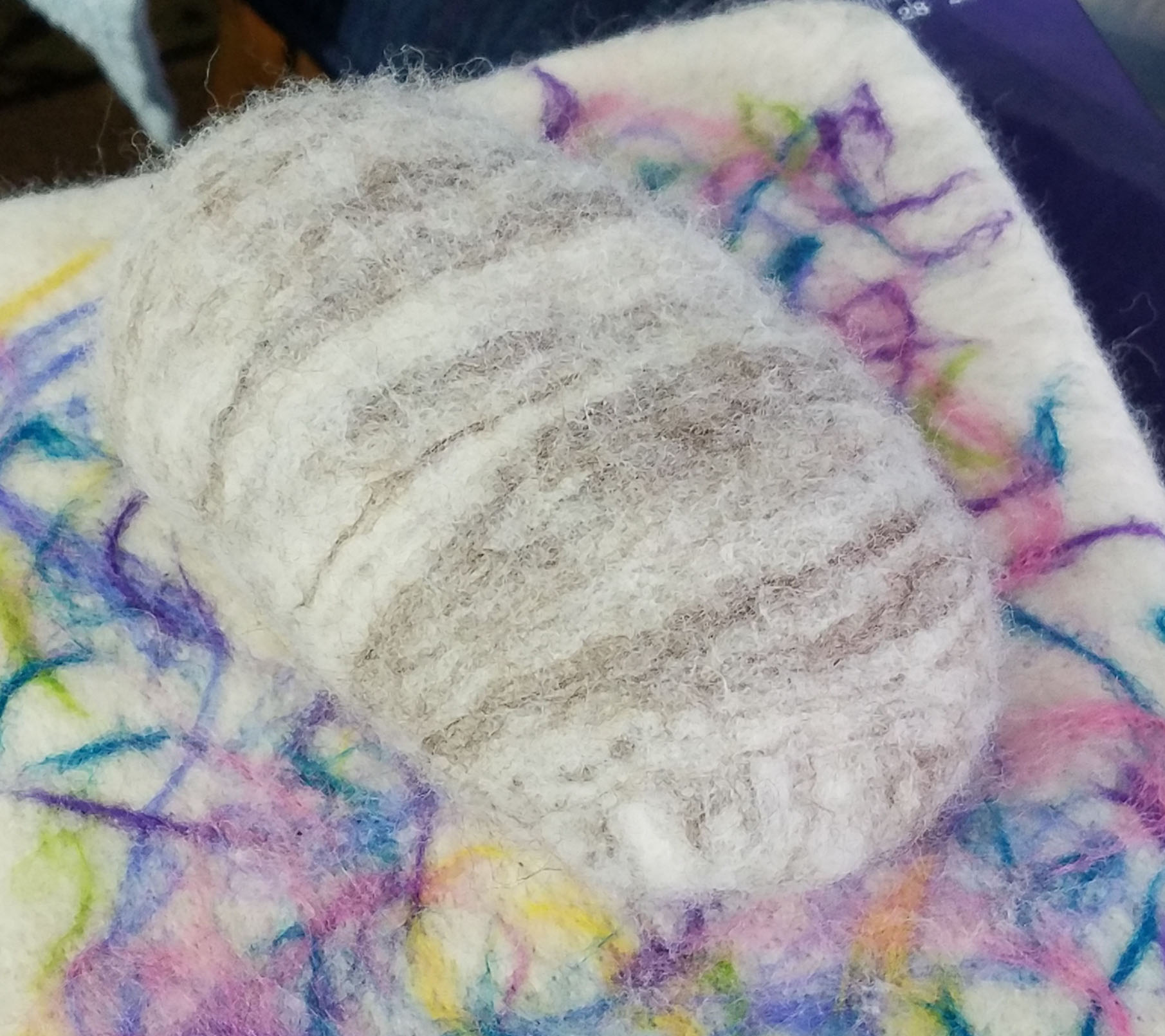
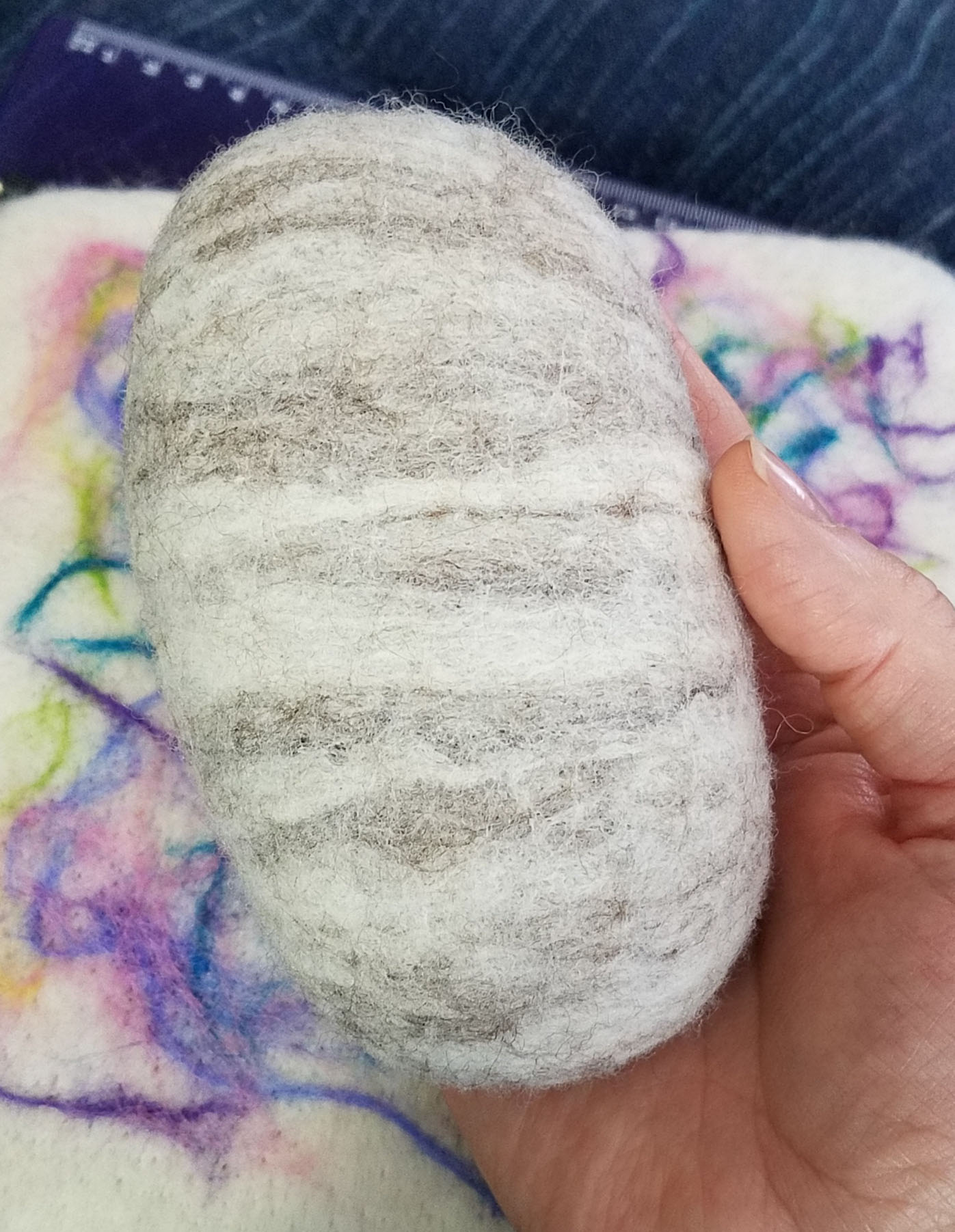
The patterning on the rock from the “special” fiber actually came out very well. I definitely have a side I consider the “top” of my rock.

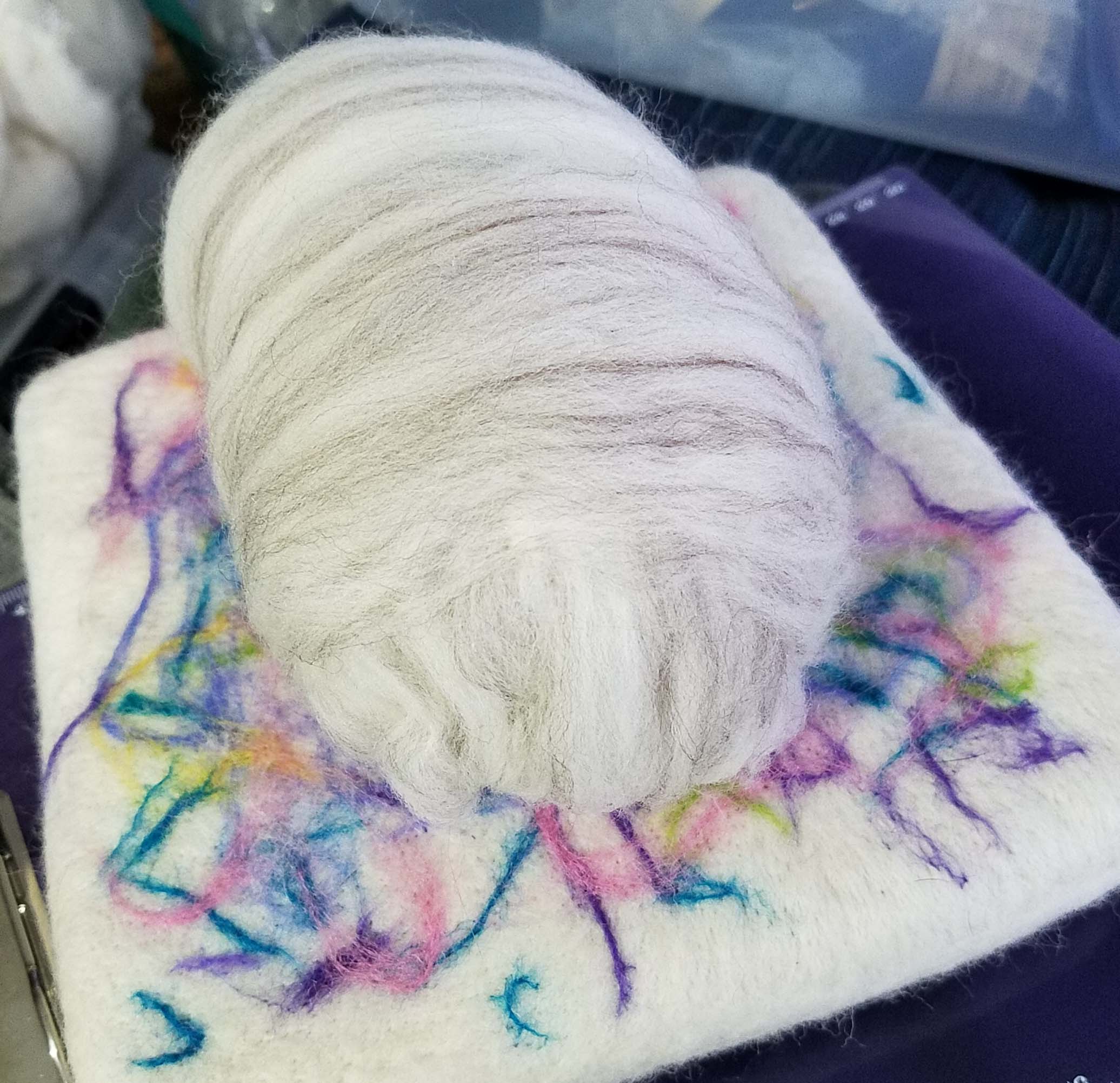
This is my finished rock from the bottom.

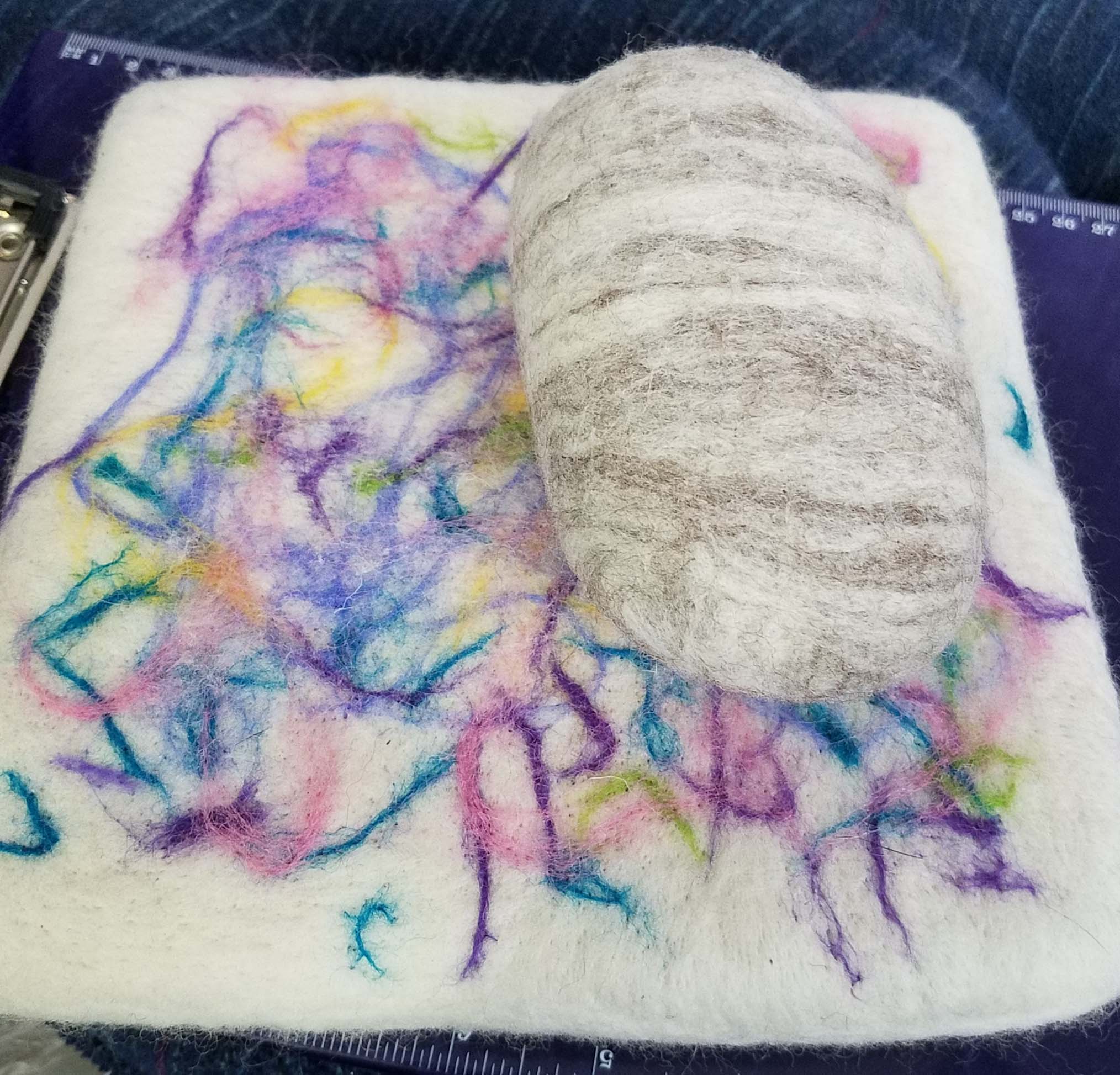
And the side. Any way you look at it is pretty “rock like”.

I learned so much making this rock, one of the most important things was how much work it is felting a rock. I’m sure with practice I would get faster and have better results. But I would say it would be worth every penny to purchase a rug or other item from Martina. There is an incredible amount of labor in her pieces.

I may make some more rocks, but I think they will become a pillow for the sofa and not a rug. I was thinking that I could crochet the backing for the rocks to be sewn to, or I might even needle felt the rocks to my crocheted fabric. That would be the ideal marriage of both my current favorite crafts.


Making Your Own Felting Pad

You may recall when I took the needle-felting class back in January 2016,  the teacher introduced me to the idea of using felted wool pads to work on, instead of the usual foam rubber option. The wool pads don’t break down like the foam ones, and they are better for the environment.

One of the first things I did after returning home was make my own felted pad for working on. You can see my adventures with creating it in my blog post “Playing with Sharp Objects Again”. I also knew that I would eventually be teaching needle-felting classes, so I started making small felting pads that I could loan my students during classes.

I had someone ask me the other day if I would be making the pads to sell to other crafters. I won’t say a definitive “no” to that, but currently it isn’t at the top of my list. I would always rather teach folks how to make their own.

I had made 5 or 6 of the smaller pads during my last big needle-felting spree. I had attempted a number of different methods for creating my pads and wasn’t really pleased with any of them. During my needle-felting hiatus, while crochet took the front seat in my attention, my subconscious must have been chewing over the problems I had encountered.

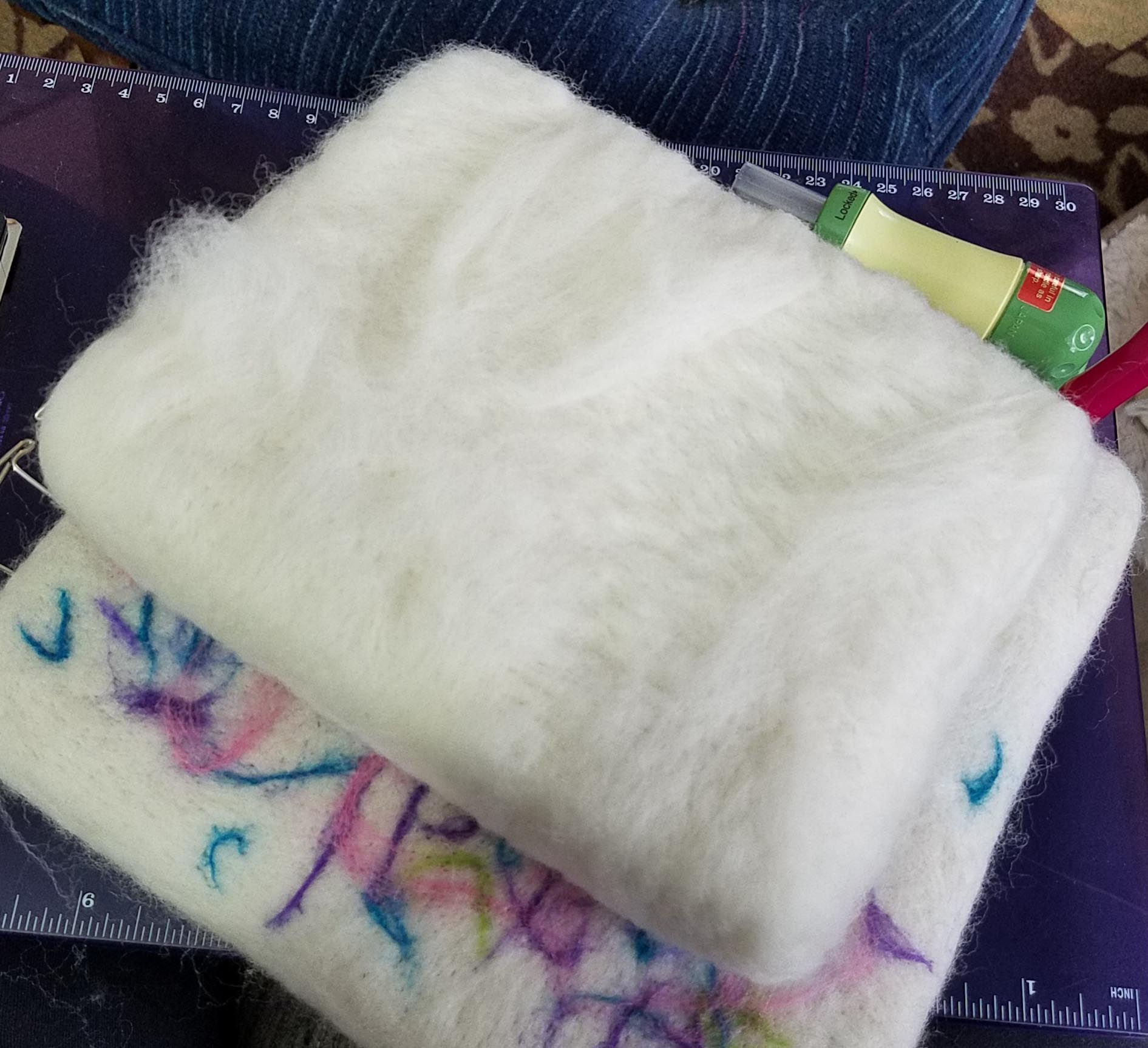
When I decided to make more felting pads I realized I could use the “framing” method for at least getting my basic shape started for each pad. The question then was, what to use for the frame? In my house there are always lots of recyclables waiting to go to the recycling center in town. I dug thru what was in there and found an empty box that was just the right size.

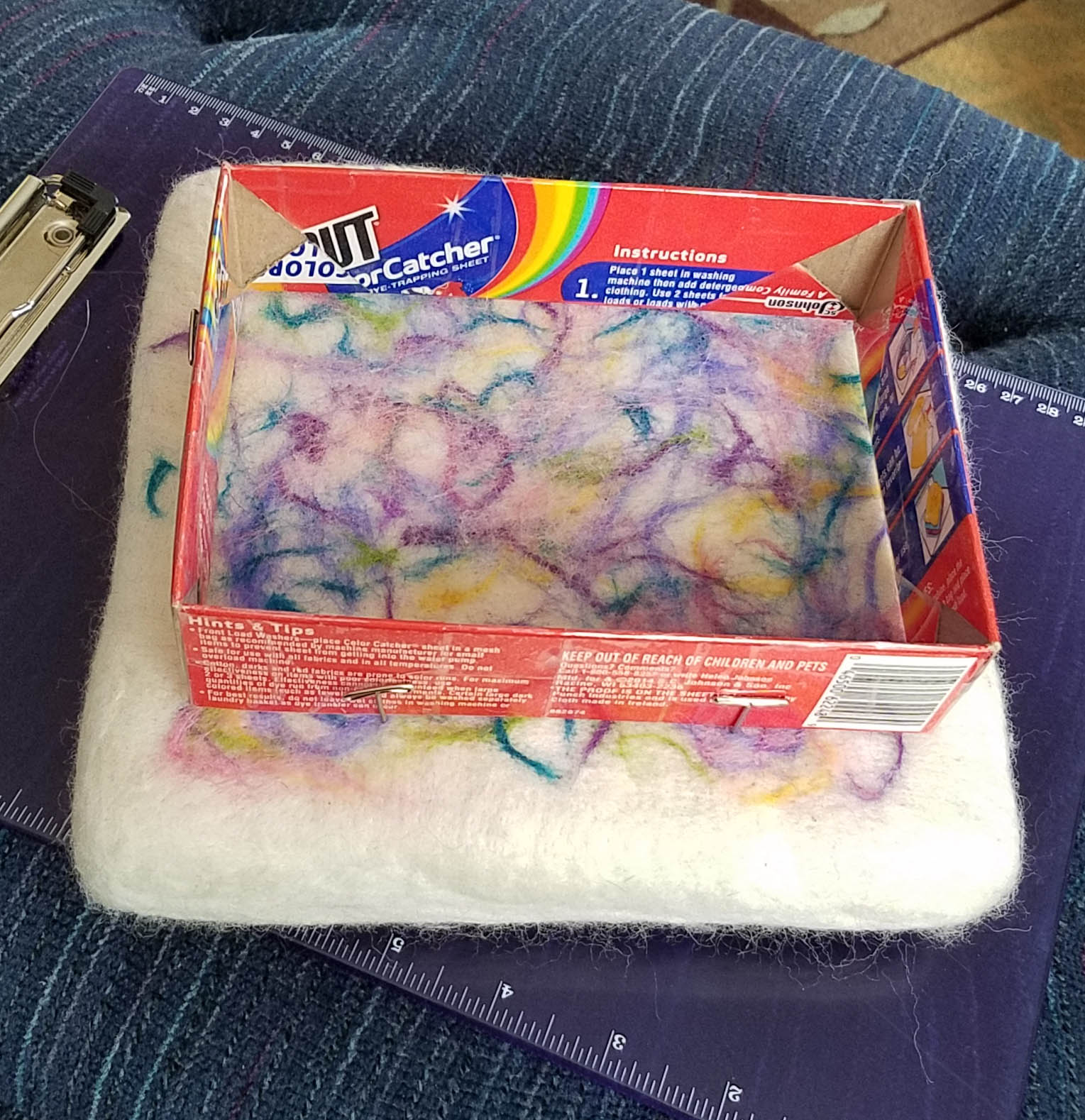
I cut the sides that I wasn’t going to use and folded them over the sides I was keeping, then strapped the whole thing in place with clear packing tape.

The final box was a bit floppy and wanted to turn into more of a rhombus shape than a rectangle. How would I keep it from deforming when I was working on the pad?

My solution was to use some of my T-pins that I use for blocking. I squared up the box on top of my working pad, then used 2 pins along each side to hold it in place.

I didn’t place the pins at an angle to the sides, instead I slid them straight down the side of the box into the pad. Once the box was sitting securely on the pad I was ready to add fiber.

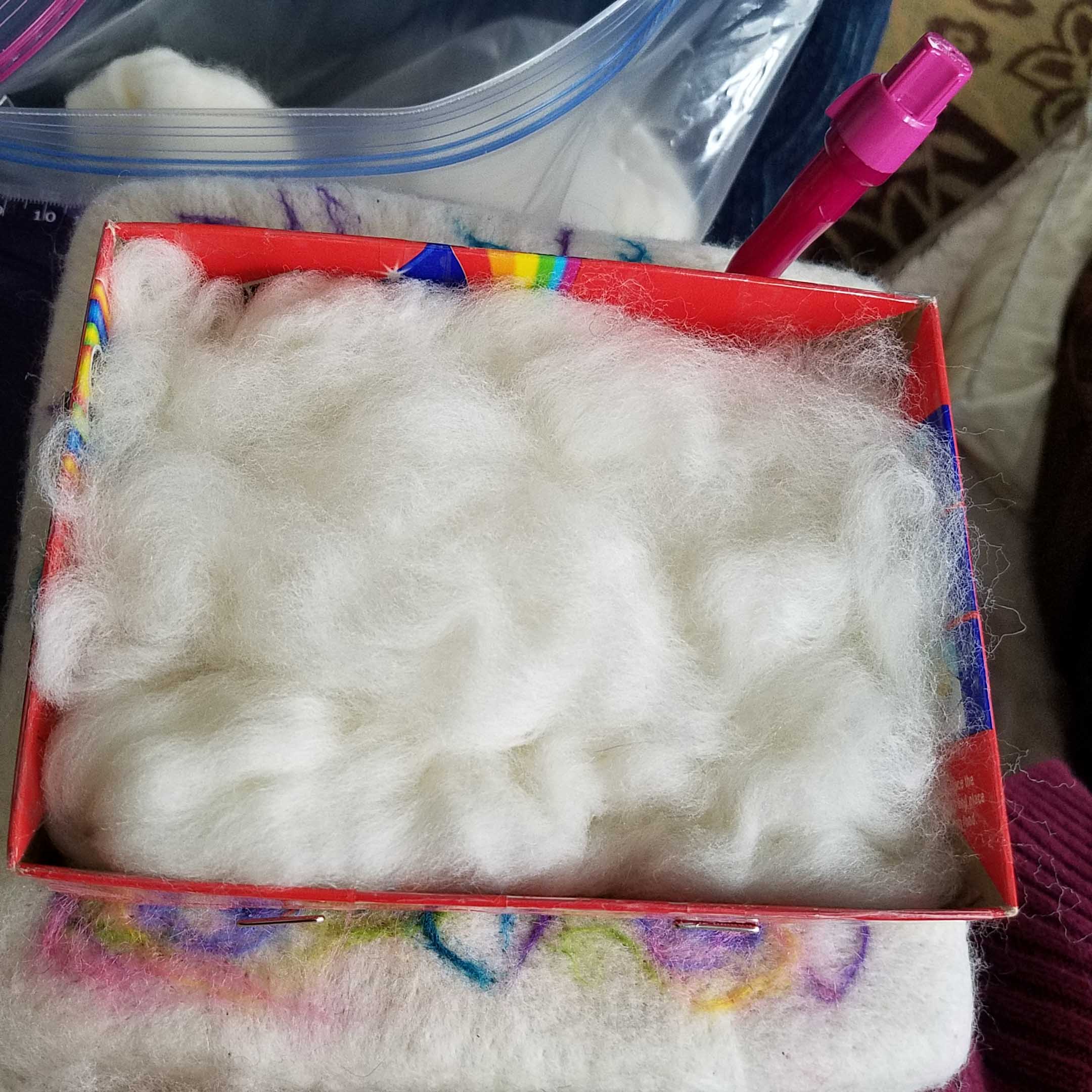
For this pad I decided to work on keeping the corners as squared as possible. To do this my plan was to fill the corners first to increase the density.

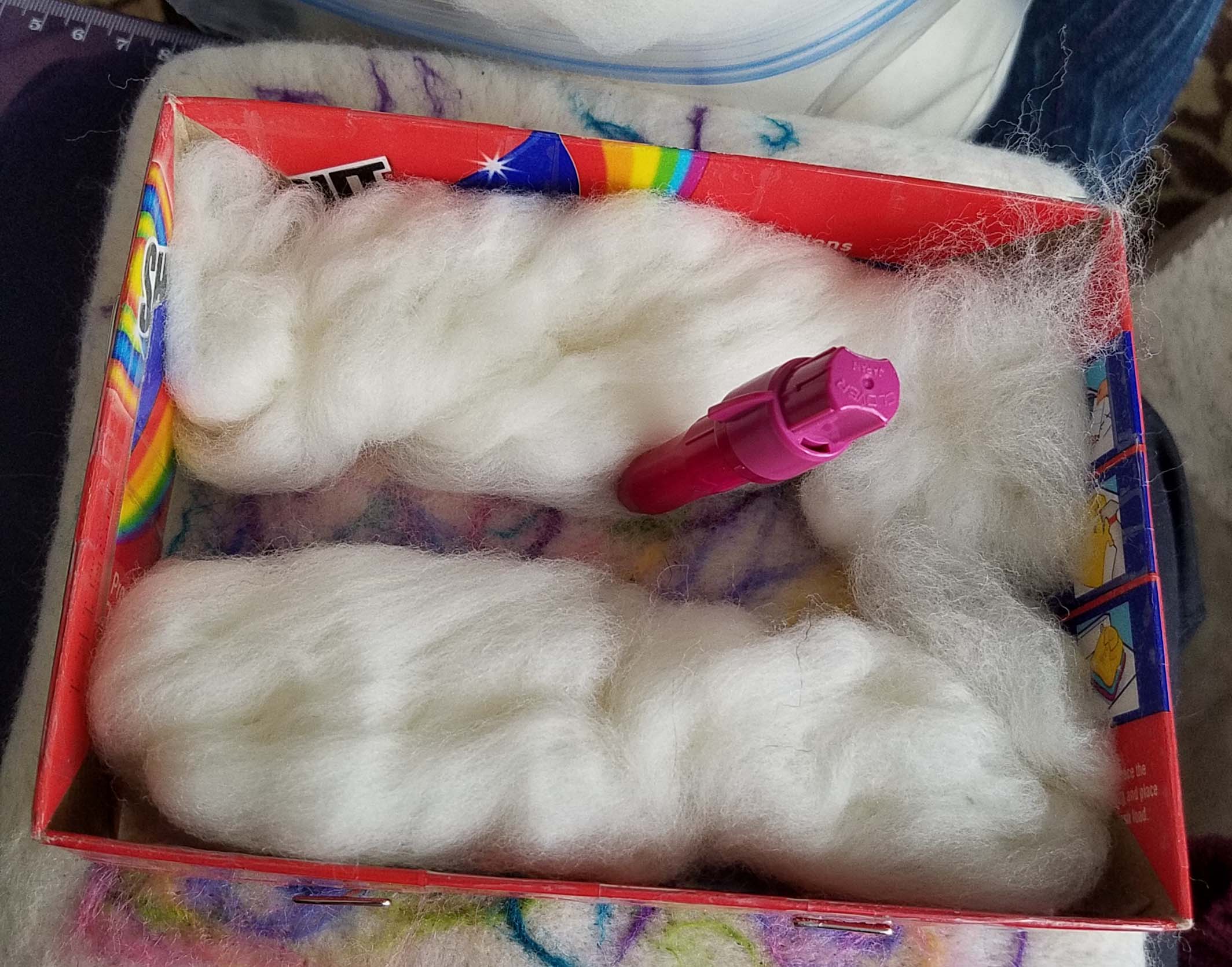
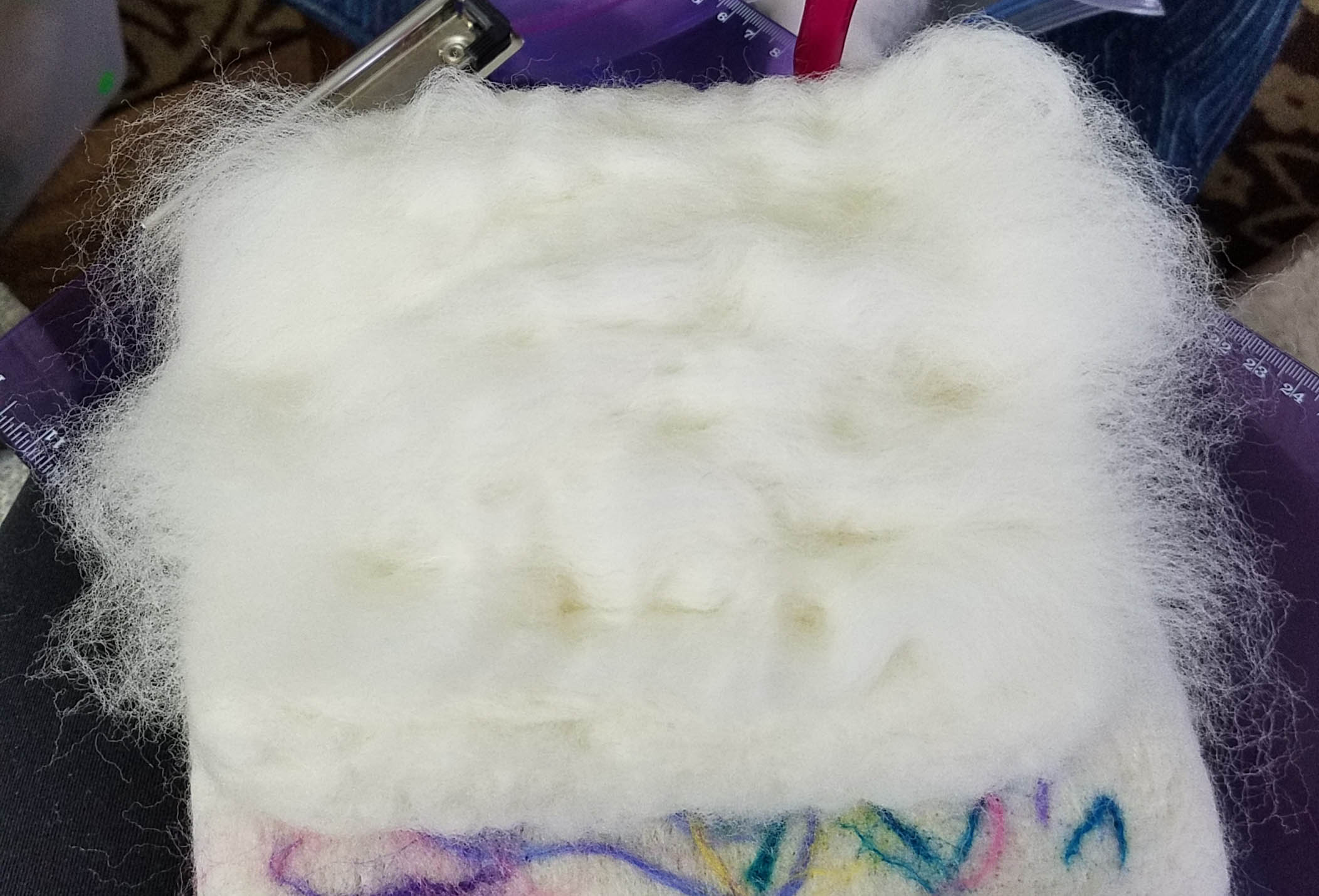
I placed 2 strips of fiber along the long edges and needled them a bit with the single needle to secure them.

Next I filled in the space between, tucking some of the fiber under the edges of the 2 pieces already in the frame. I used the single needle to tack this all down more.

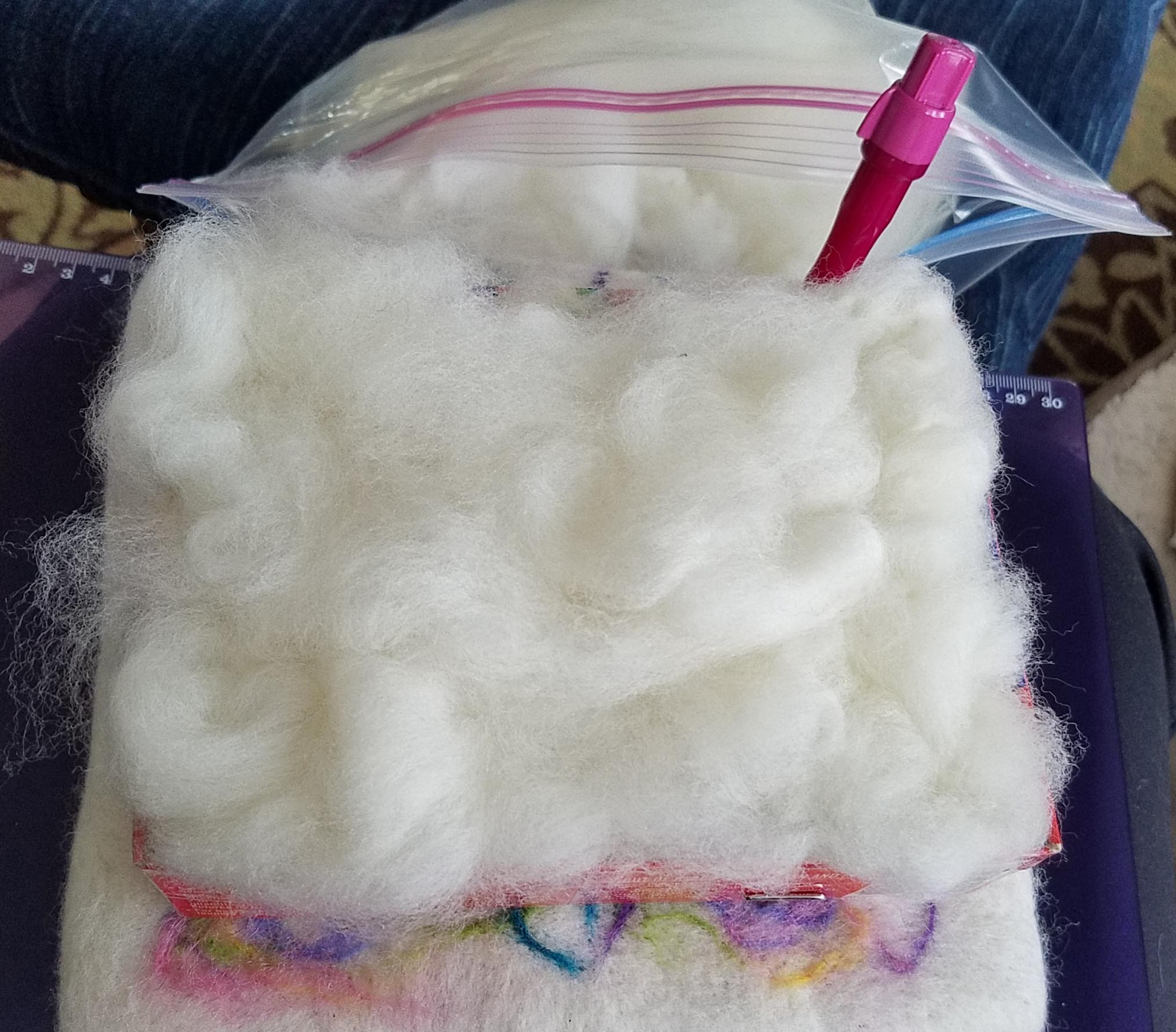
Then I filled the whole frame to overflowing with additional fiber, concentrating it around the edges and corners. Time to do more needling to felt down this fluffy fiber especially around the sides and corners.

Next I used the 6 needle tool, that my friend Pam gave me, to felt the fiber further. The great thing about a multiple needle tool is for every strike with the tool it’s like making the same strike with the single tool 6 times. This speeds up the felting process a lot and is a bit easier on your body.

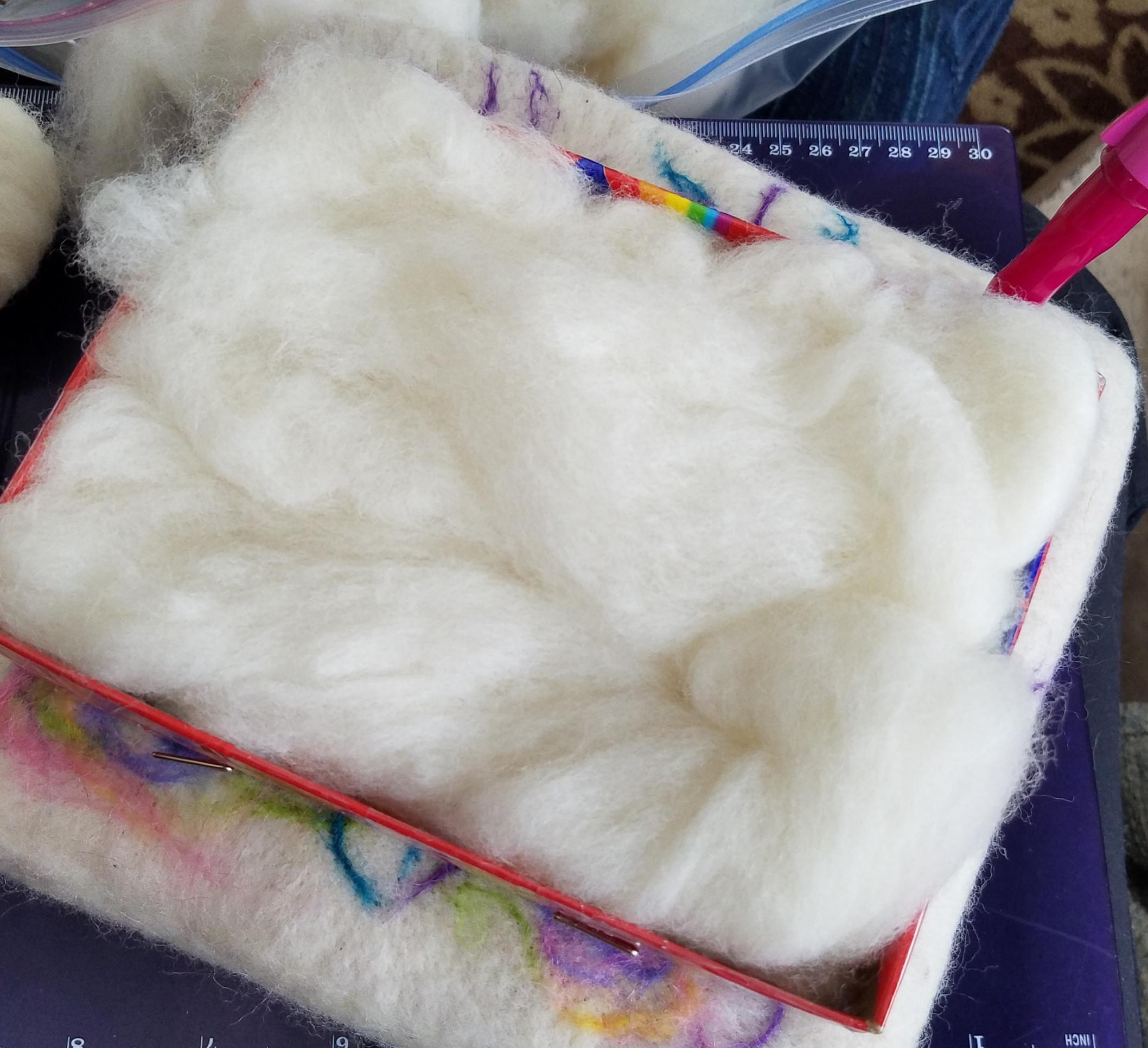
At this point the pad was felted enough that I was ready to flip it over and work from the other side. It is important to keep flipping the pad as you work on it, otherwise it can become firmly felted to the working surface.

I slipped my fingers along the side of a long edge and gently peeled up the pad of fiber from the working surface. Then I flipped it over and re-inserted it in the frame with the bottom on the top.

The fiber that is facing upward now is still pretty loose, I used a combination of single needle and multi-needle tools to felt it down.

These are the corners and edges after some single needle work.

Next I added more loose fiber to the edges and corners.

More work with the single needle to secure this new fiber.

Then I felted it further with the multi-needle tool. The pad is formed enough now that I’m ready for the next stage.

The next stage of making the pad starts with removing it from the frame. You can see in the photo that there was a little hole in my fiber in the lower right-hand corner. I solved that by needling a loose ball of fiber into that spot to fill it in.

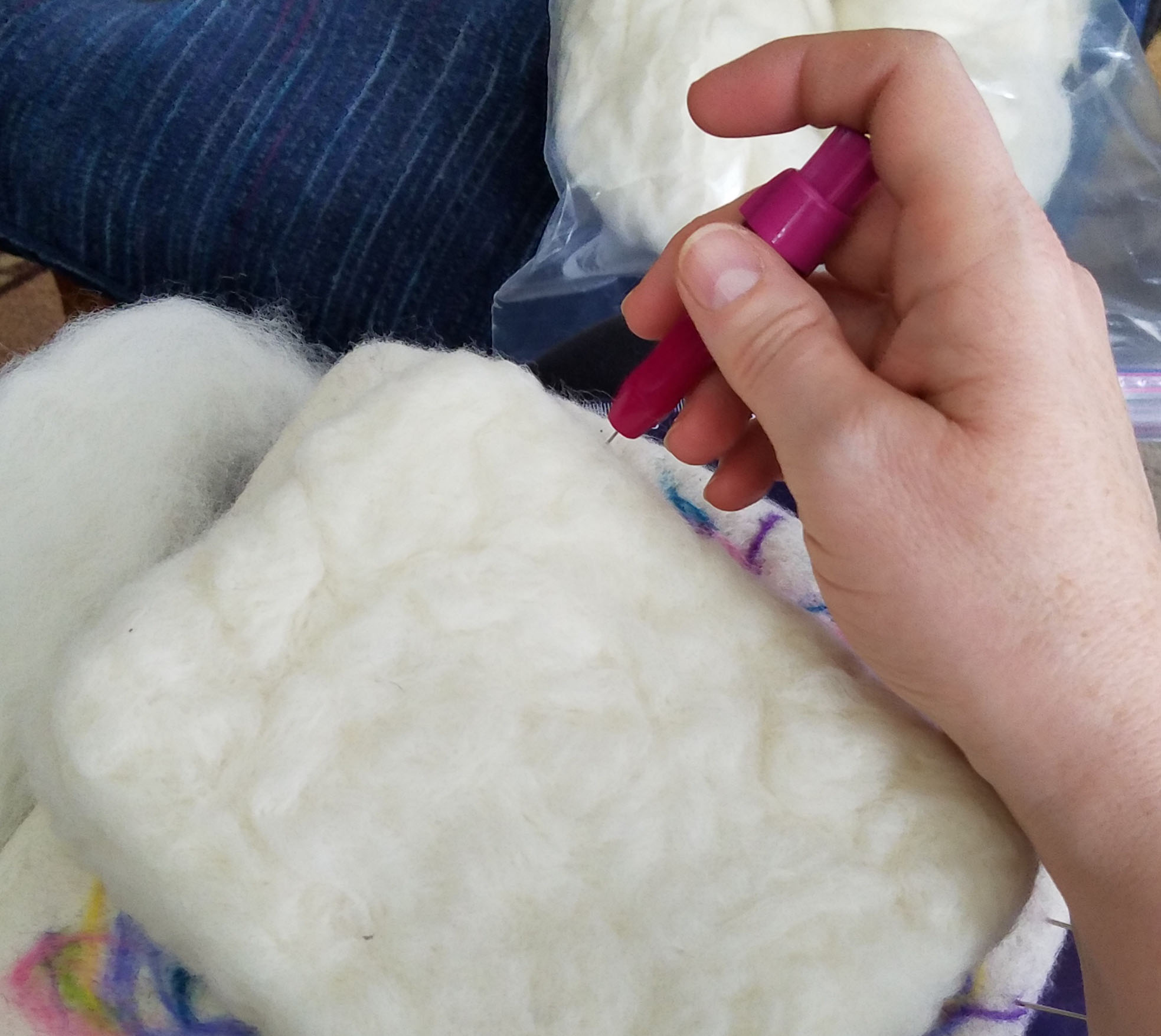
Next I wanted to shape up the sides and corners of the developing pad. I used my single needle to felt them. I use a diagonal strike when working the edges, that way I’m not working straight toward my hand holding the project. When the fiber is still relatively loose the needle can come thru deeper than expected and you’ll stab yourself. I’m speaking from the voice of experience unfortunately.

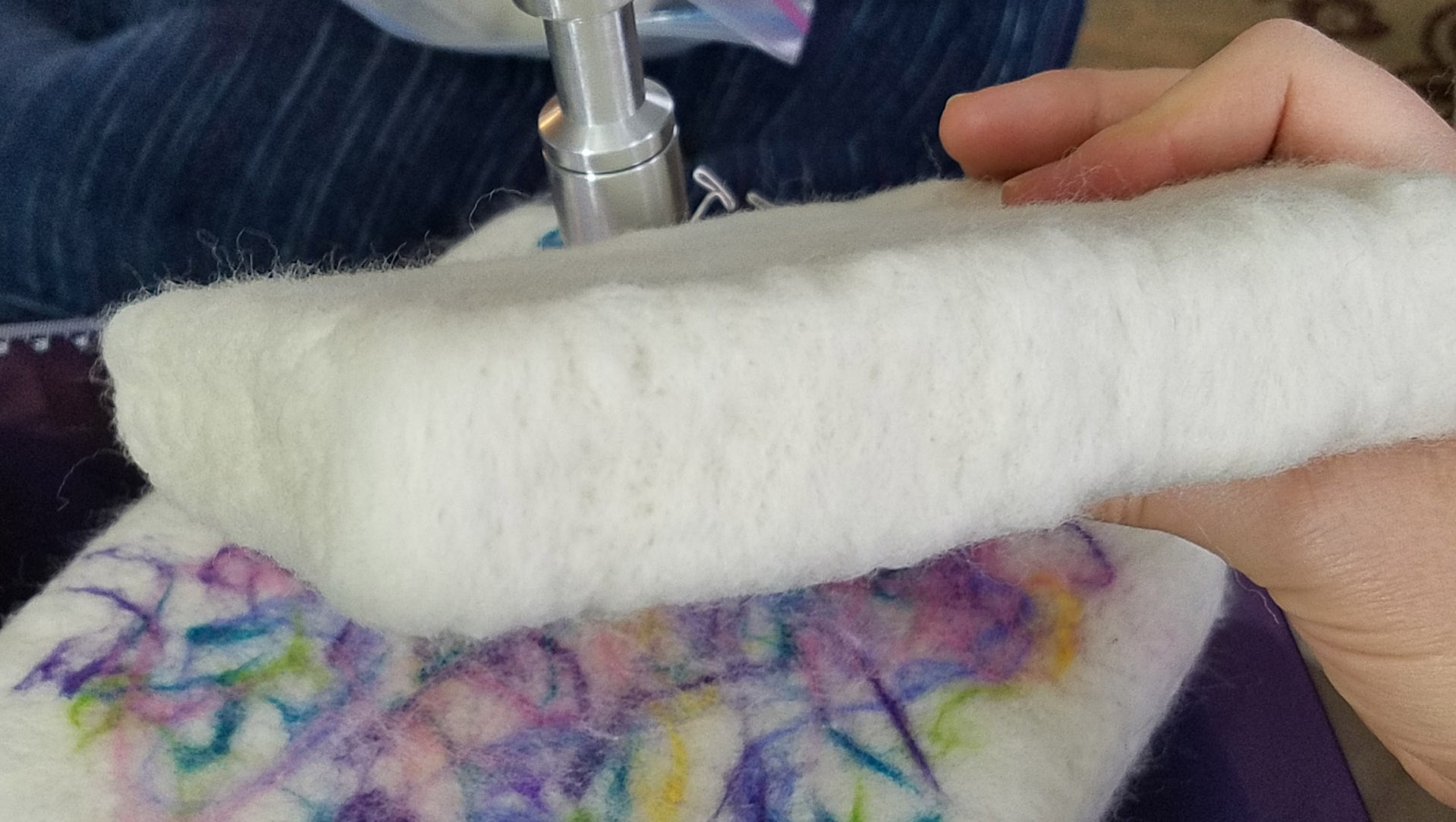
For the pad to be useful it needs to be at least 1 inch thick and dense enough that it takes some force to penetrate the full depth. To that purpose I continued to add more fiber to increase the pad height and density.

I would switch off between the single needle and the multi-needle tools to compress the fibers of wool.

Once I felt like the edges were dense enough I switched my focus to increasing the density of the center of the pad.  This is the section that will get the most action when the pads are in use. Fortunately, with a felted pad it is simple to add more fiber to areas that are getting too worn.

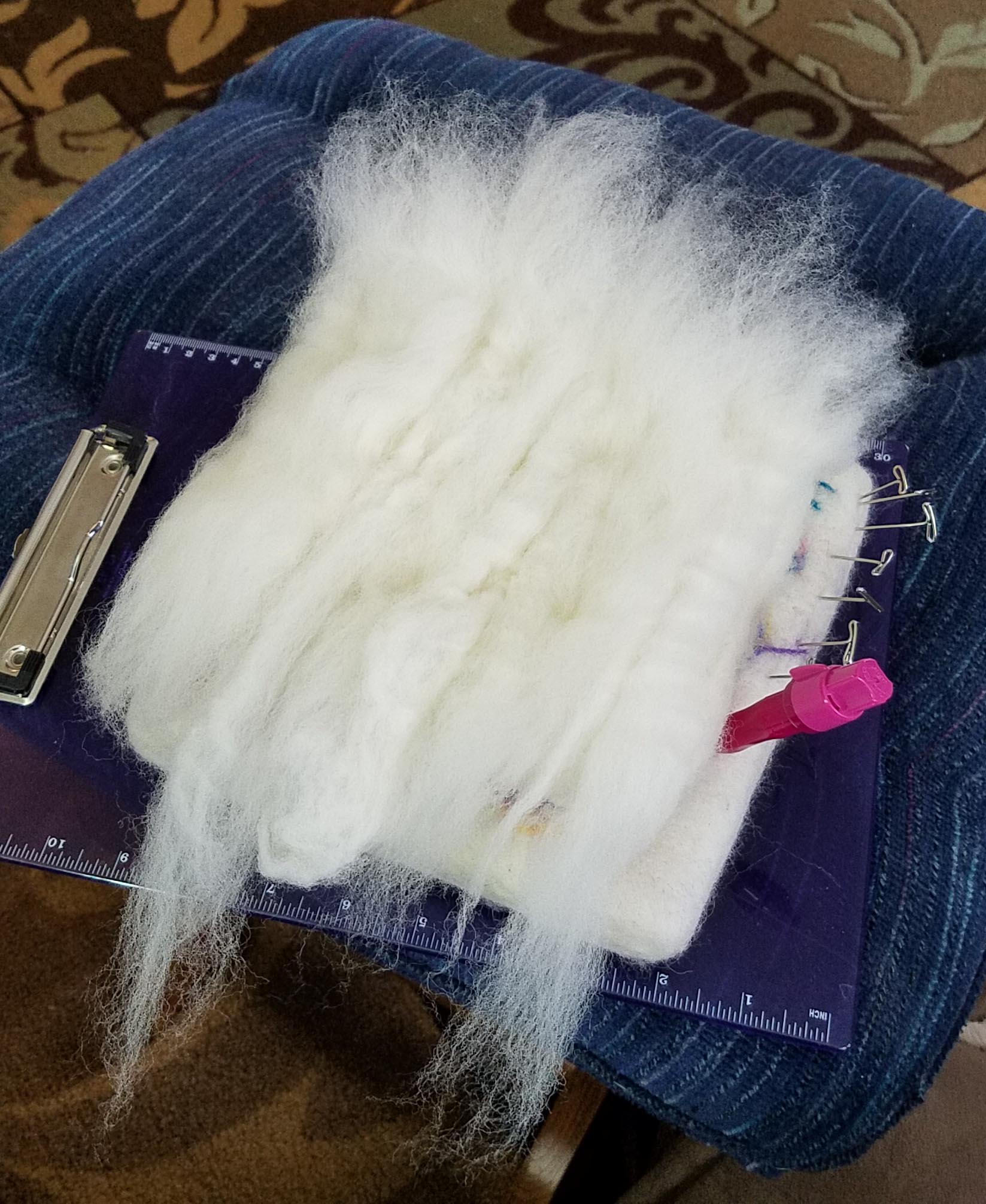
I added loose fiber laid in the same direction and overlapping the edges. I did some rough shaping and tacking of the fiber with the single needle.

Next I concentrated on using my multi-needle tools for compressing the fiber. I used my Clover 5 needle tool (finer needles with more barbs) as well as the 6 needle aluminum tool.

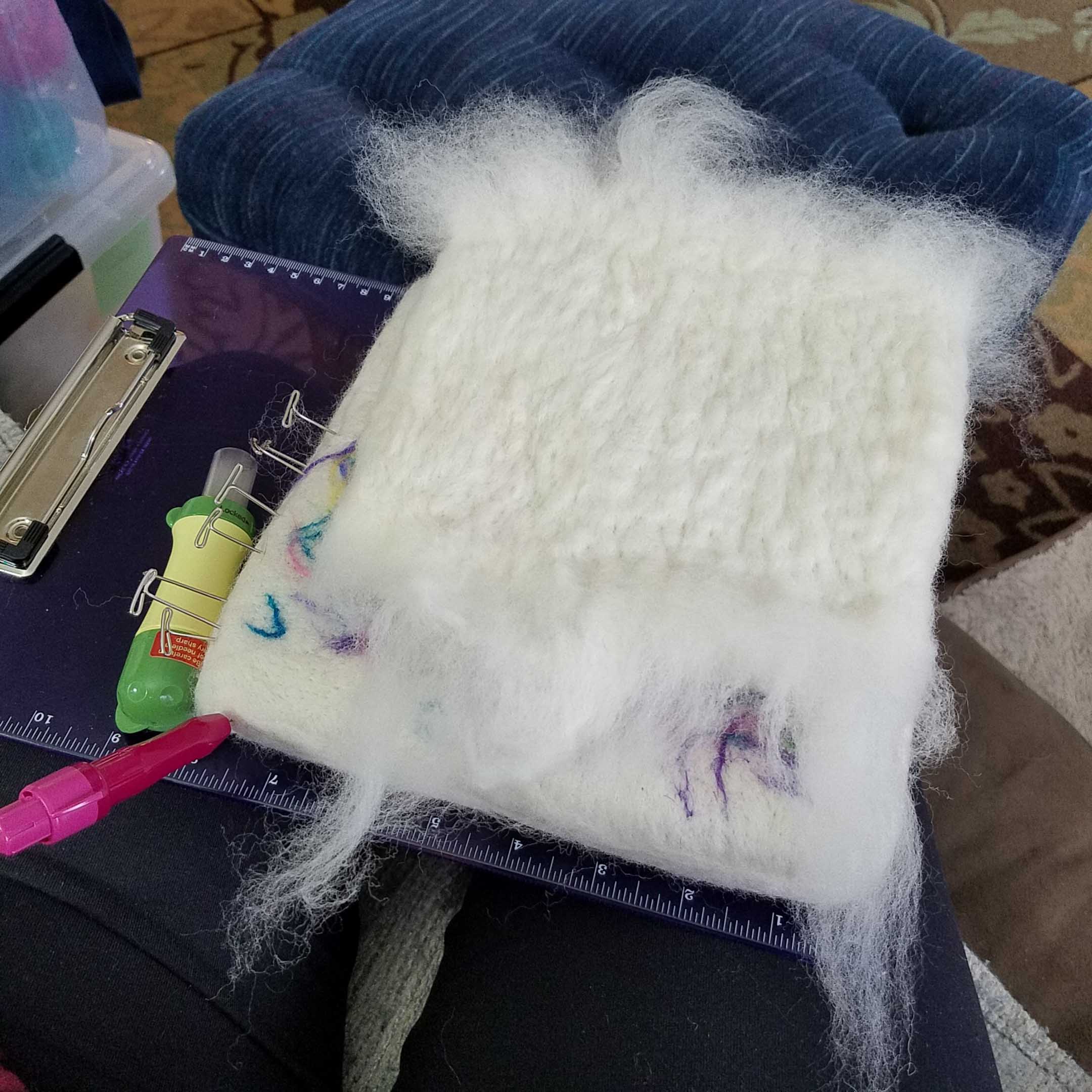
Once the fiber on the flat surface was felted down fairly well, I gently and firmly folded the loose ends around the sides of the pad and secured them on the opposite flat surface.

This is the pad after that step. I needled some more along the sides and on the flat surface to finish incorporating the rest of the loose fibers.

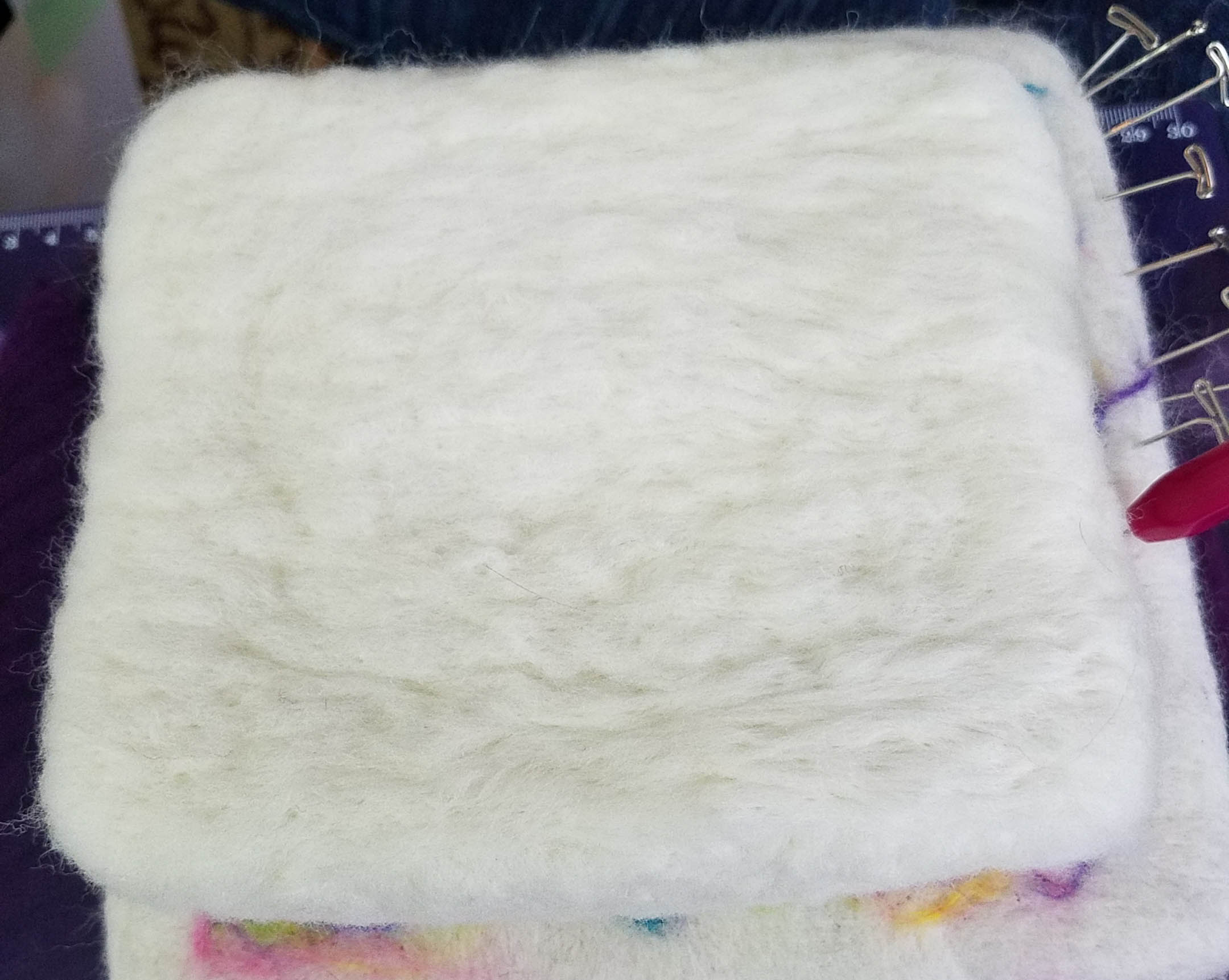
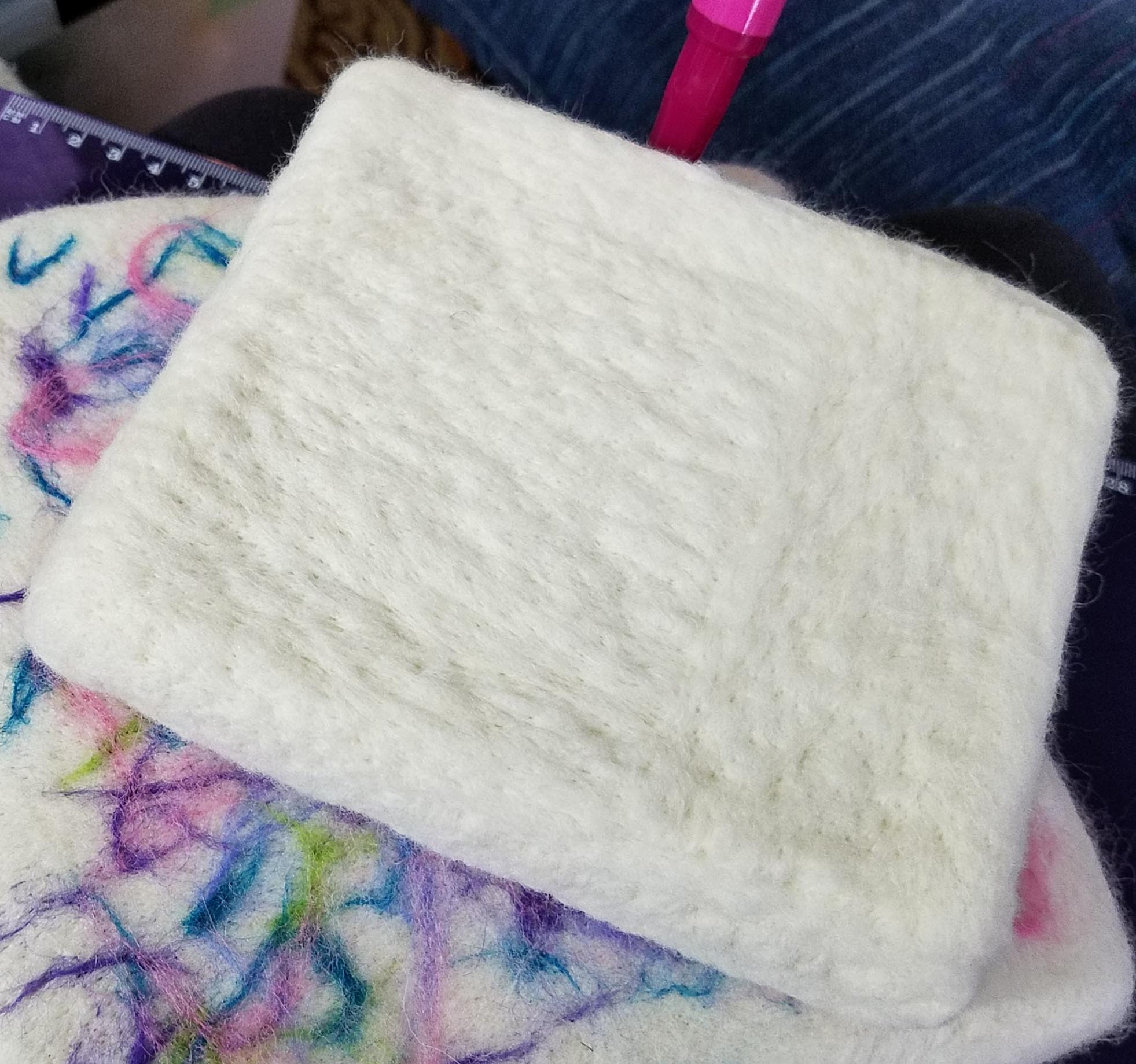
This is the flat surface view at this stage of work. It is getting firmer, but I still have a ways to go.

You can see looking at the edge that the felt is still fairly porous. To complete the pad I continued adding loose fiber on the flat surfaces and wrapping the loose fiber around the edges. I worked both vertically and horizontally with how I lay the fiber down. I also added fiber to both sides as I went along.

This is the finished pad, I will likely continue to work on it with the multi-needle tools to firm and smooth the surfaces. My pad in this post took 3.2 ounces of wool fiber and is 5 1/2 inches x 5 inches x 1 1/4 inch in dimensions.

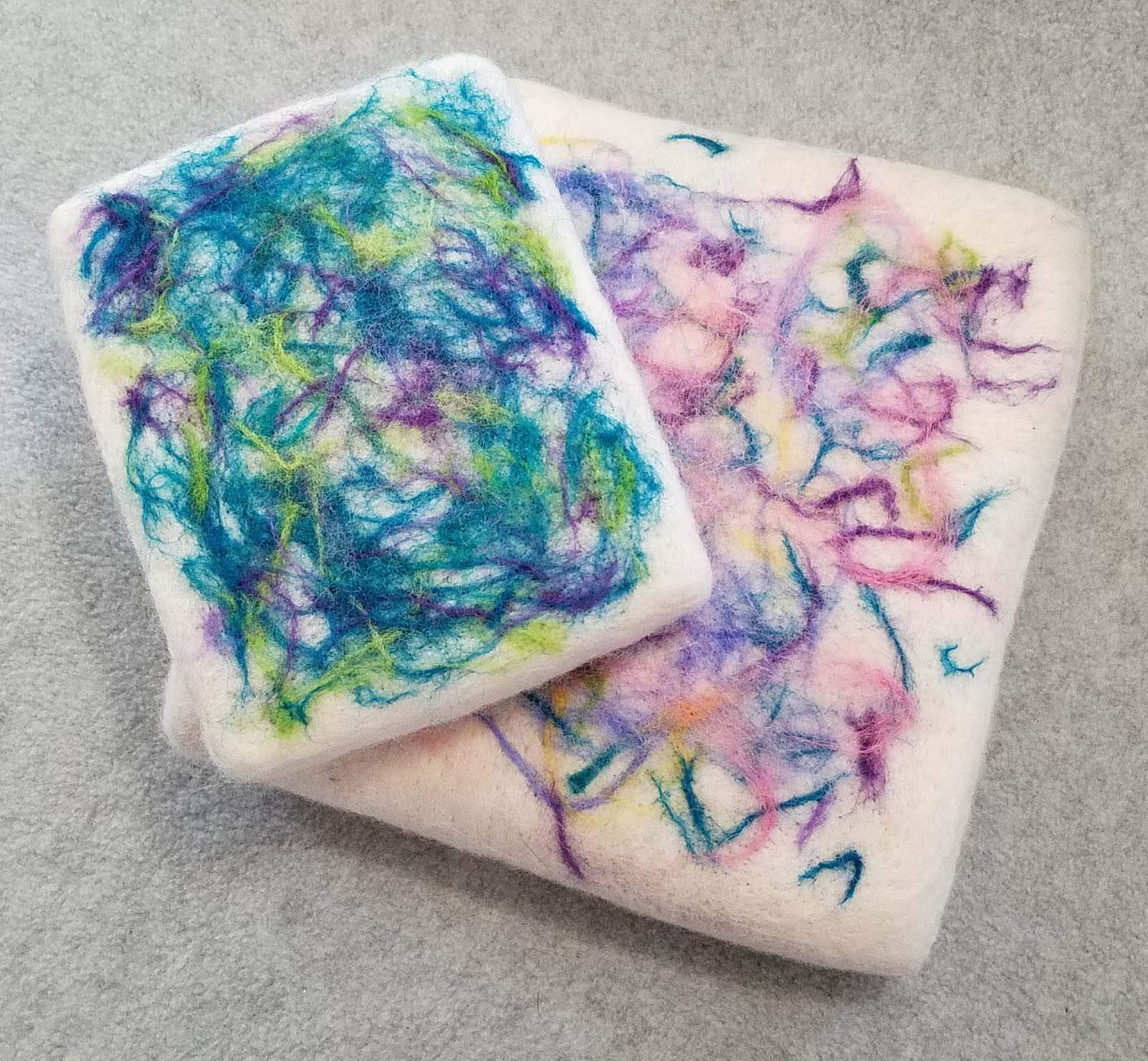
If you are making your own felting pad and want one side of your pad to have some color, making it easier to see natural colored projects, you can felt in some yarn ends or colored fleece. To see an example of how I did that on my pads check out my blog post: “Deconstructed Yarn Painting”.

The Luck of the Irish

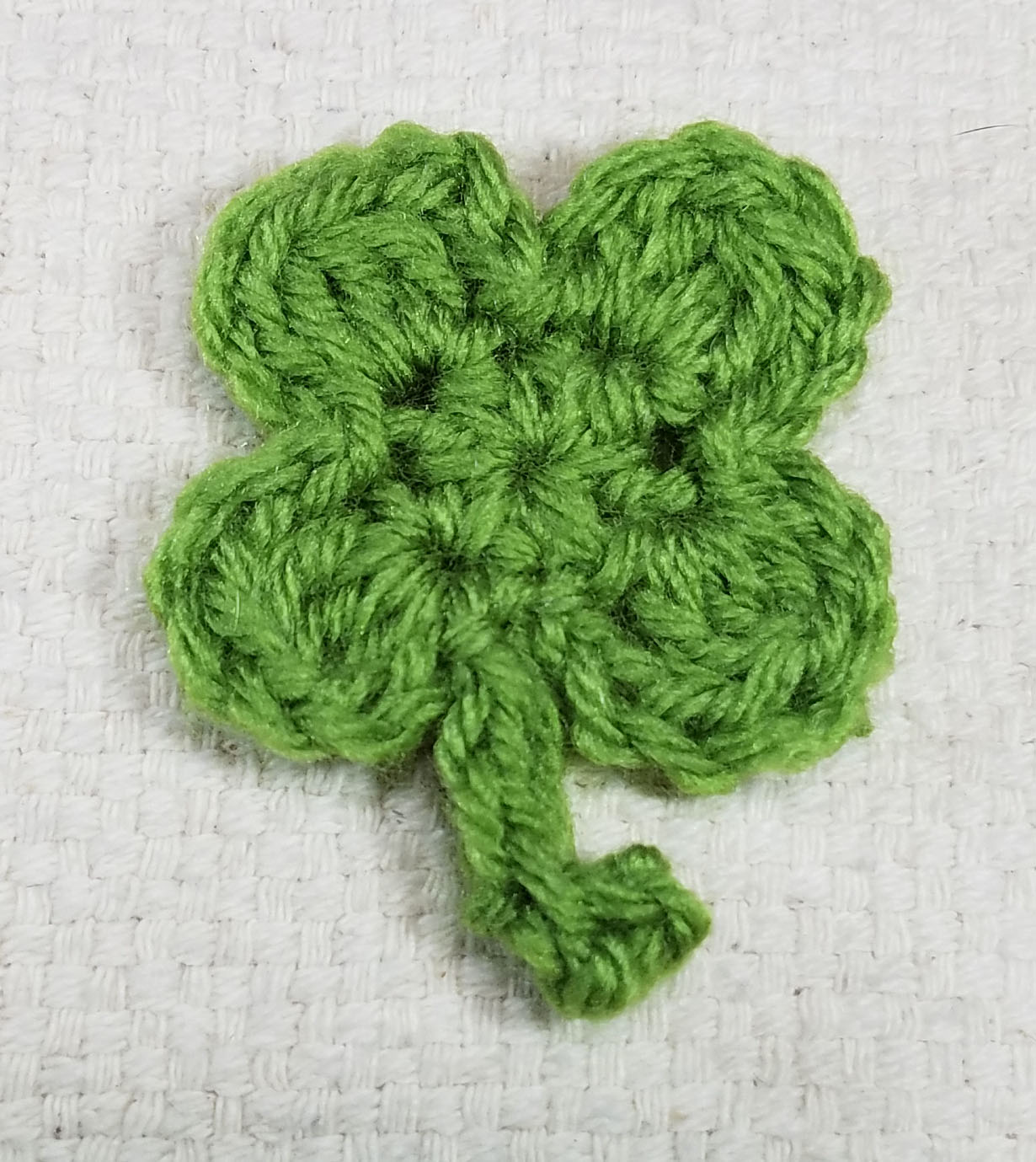
Today is Saint Patrick’s Day, and my family has a little Irish heritage (we are a classic American family with a big mixture of ancestry from all over Northern Europe and the British Isles), so I thought I would come up with a fun little crochet pattern for making a lucky 4 leaf clover.

Funny enough, none of us have much in the way of green clothing, every year I think that I really should at least get the kiddos some green clothing. That thought has not translated to my shopping brain yet. I tend to purchase whichever shirts are on sale, since both of my kids are a bit rough on their clothes.  Instead I crocheted up lucky clovers and made them into pins they could wear.

For those of you that are wondering about Shamrocks versus 4 Leaf Clover. The typical Irish symbol is the 3 lobed clover and is called a shamrock. 4 lobed clovers are much rarer and are not “officially” considered a symbol of Ireland or Saint Patricks day. The shamrock with it’s 3 lobes is said to have been used by St. Patrick to demonstrate the holy trinity of Christian faith. The 4 Leaf Clover is said to symbolize luck because they are so rare.

I had a lot of fun playing with a way to create a 4 Leaf Clover that could be worked in just 2 rounds. This project is rated at the intermediate level, because I used some more advanced techniques like Clusters and working in the back bump of chains.  If you need help with working clusters I have a photo tutorial in the Special Stitches section of the pattern.

Luck of the Irish Clover

Design by Andee Graves

Skill level: Intermediate

Materials:

Yarn – Lion Brand “Vanna’s Choice”, 100% Acrylic (3.5 oz/100g, 170 yds/156m) Color #171 Fern

Hook – I/9 – 5mm hook

Pin back or safety pin to attach to back of clover.

Special Stitches

3 DC Cluster (Cl):

Photo A

To make a 3 dc cluster st, yarn over (yo) like making a dc and insert in st or sp, yo, pull up a loop (3 loops on hook), yo {Photo A},

Photo B

pull thru 2 loops on hook (2 loops remaining on hook, 1st base made), yo, insert in same st or sp, yo, pull up a loop (4 loops on hook), yo {Photo B},

Photo C

pull thru 2 loops (3 loops remaining on hook, 2nd base made), yo, insert in same st or sp, yo, pull up a loop (5 loops on hook), yo, pull thru 2 loops (4 loops remaining on hook, 3rd base made), yo {Photo C}, pull thru all 4 loops on hook.

Instructions:

Round 1: Start with an Adjustable slip knot, ch 3, 7 hdc in 3 ch from hook, gently pull beginning tail to close center,

slip st under 2 loops (the “V” front of the ch st) at top of beginning ch-3 to join the round.

Round 2: {Thanks to Edith for the correction.}  Ch 3, *(Cl, ch 3 and slip st) in next st,** (slip st, ch 3) in next st*;

Repeat from * to * 2 times, Repeat from * to ** once,

Stem: Ch 6, working in back bumps, sc in 2nd ch from hook and in next 3 ch sts, slip st in last ch, cut yarn with 4-5 inches of tail. Stem will curl, it is supposed to.

Weave ending tail toward center, use tails to sew on a pin backing.

I hope you have a very lucky Saint Patrick’s Day, and some fun wearing a 4 Leaf Clover.

Another Pi Day Celebration

Wow! It’s Pi Day again already. Today is March 14 or 3/14 as we Americans like to write it. Pi is 3.14, so some clever mathy person decided that March 14 should be celebrated as Pi day. Being that I am a math geek I’m totally into that.

I use Pi to figure out the geometry for a lot of my design work, especially when I am designing hats and determining how (or IF) my gauge is going to get me the size hat I want. This particularly applies to working crown down hats that involve creating a flat circle to start.

Today I thought we should take a look at crocheting circles. No Pi calculations needed, though you can if you really want.

I don’t recall when I first learnt about the “rules” for getting circles to come out flat in crochet. But I have used those as a guideline in much of my design work over the past 10 years, even before I was designing professionally.  Here are the “rules” with some additional thoughts.

To create a circle, especially when worked into an adjustable slip knot (or magic circle if you prefer), you need to consider the height of your stitches. You also need to consider your stitch tension and consistency. Working circles is one technique that will really show you if you are deforming your stitches. Either making them too tall, too short, too wide or too thin, you are looking for the ultimate “Goldie Locks” zone of your stitch tension to get your circles to come out Just Right.

I’m demonstrating today using the 4 most common stitches in traditional crochet: Single, Half-Double, Double and Treble.

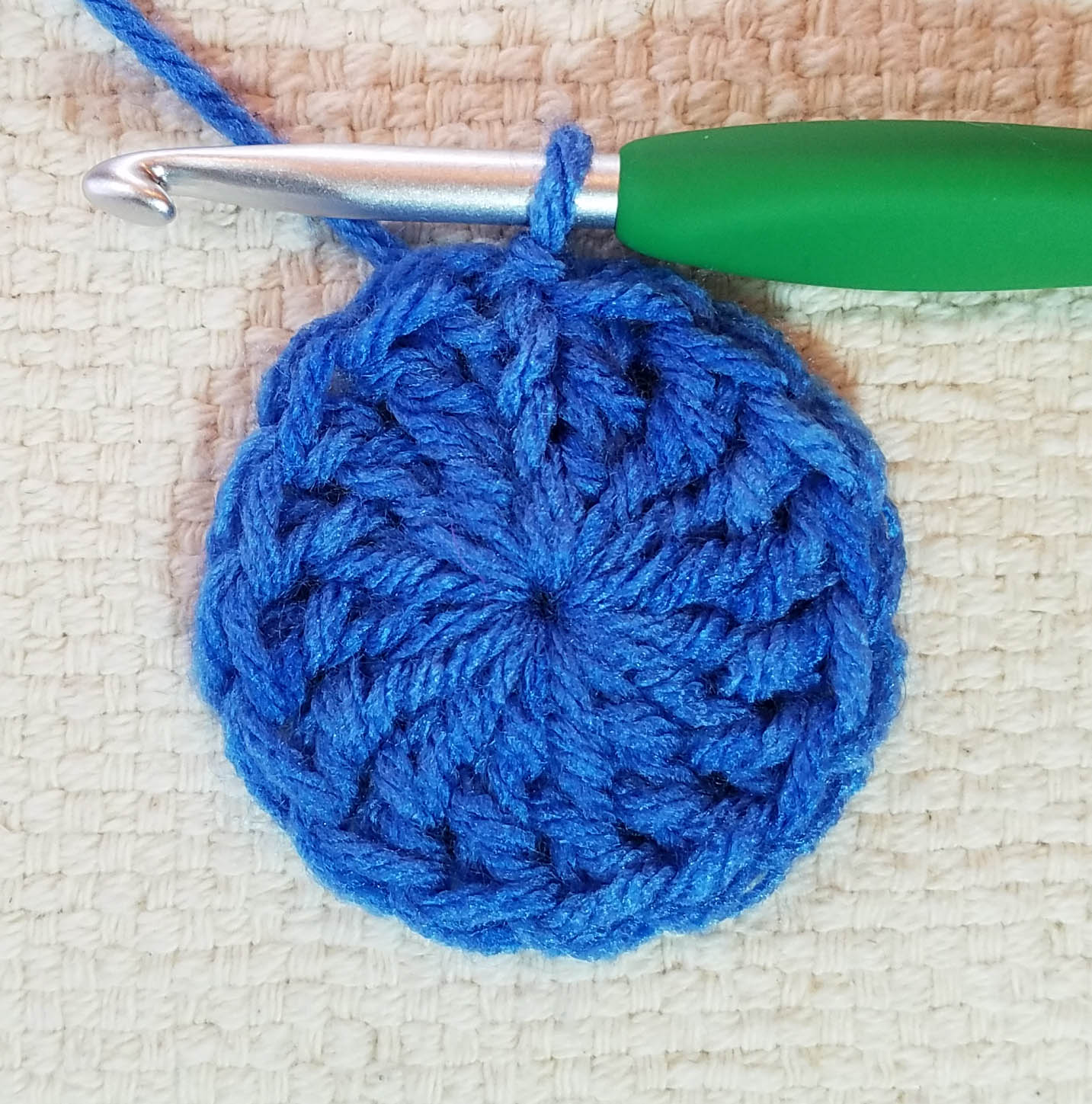
Making a circle using Single Crochet stitches: The magic number is 6, you want to have 6 sc stitches in your first round and you will add 6 stitches to each consecutive round. Round 2 will have 12 stitches, Round 3 will have 18 stitches, Round 4 will have 24 stitches.

Making a circle using Half-Double Crochet stitches: The magic number is 8, you will have 7 hdc and a ch-2 (that counts as a hdc) in your first round and you will add 8 stitches to each consecutive round. You will start each round with a ch-2 that will be counted as a hdc stitch for your end of round counts. Round 2 will have 16 stitches, Round 3 will have 24 stitches, Round 4 will have 32 stitches.

Making a circle using Double Crochet stitches: The magic number is 12, you will have 11 dc and a ch-3 (that counts as a dc) in your first round and you will add 12 stitches to each consecutive round. You will start each round with a ch-3 that will be counted as a dc stitch for your end of round counts. Round 2 will have 24 stitches, Round 3 will have 36 stitches, Round 4 will have 48 stitches.

Making a circle using Treble Crochet stitches: The magic number is 16, you will have 15 Tr and a ch-4 (that counts as a Tr) in your first round and you will add 16 stitches to each consecutive round. You will start each round with a ch-4 that will be counted as a Tr stitch for your end of round counts. Round 2 will have 32 stitches, Round 3 will have 48 stitches, Round 4 will have 64 stitches.

I hope these rules will help you with crocheting circles and that you have a great Pi Day. Maybe celebrate with some crocheted circles and some Pie.

Another Hat for Thing 2 – part 4

Last night I finished Thing 2’s hat. It was just in time as the weather took a turn toward freezing cold temperatures again. This morning he happily wore his new hat to school, though getting a clear photo of him wearing it was a bit of a challenge.

The only part I had to finish yesterday evening was the ribbed band at the brim of the hat. This gives the classic ribbed look around the face, but it also acts to draw in the fabric of the crown and sides for a snug fit around the ears.

For my ribbing I use post stitches. For those of you that have never worked post stitches, their name comes from the fact that they are worked around the “post” of a stitch instead of under the top 2 strands of a stitch. This gives them much more of a textured look and changes how the fabric behaves.

With a taller stitch like the double crochet it is quite easy to see the “post” of the stitch and to work around the center of this post when working post stitches. For a stitch like the Half Double or Single crochet that becomes a bit more fiddly to find.

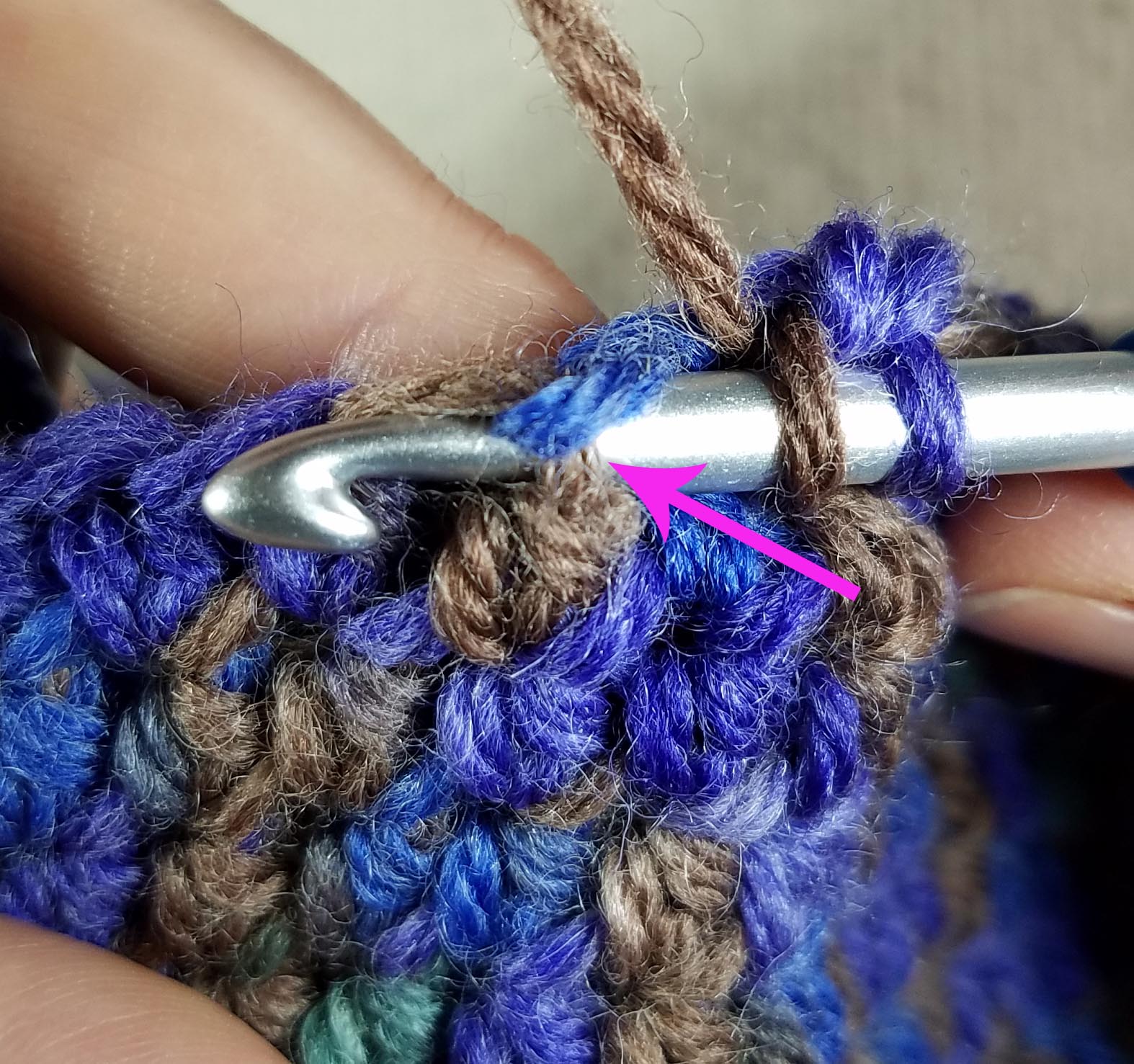
The first time I tried using post stitches for my ribbing I decided to do what I call “skinny” post stitches. Instead of working down into the stitch, I use the very top of the post just under the “v” that makes the top of the stitch (the bit of brown yarn the arrow is pointing to in the photograph above). This creates a slimmer looking stitch because the base of the post stitch isn’t stretched around the thickest part of the other stitch.

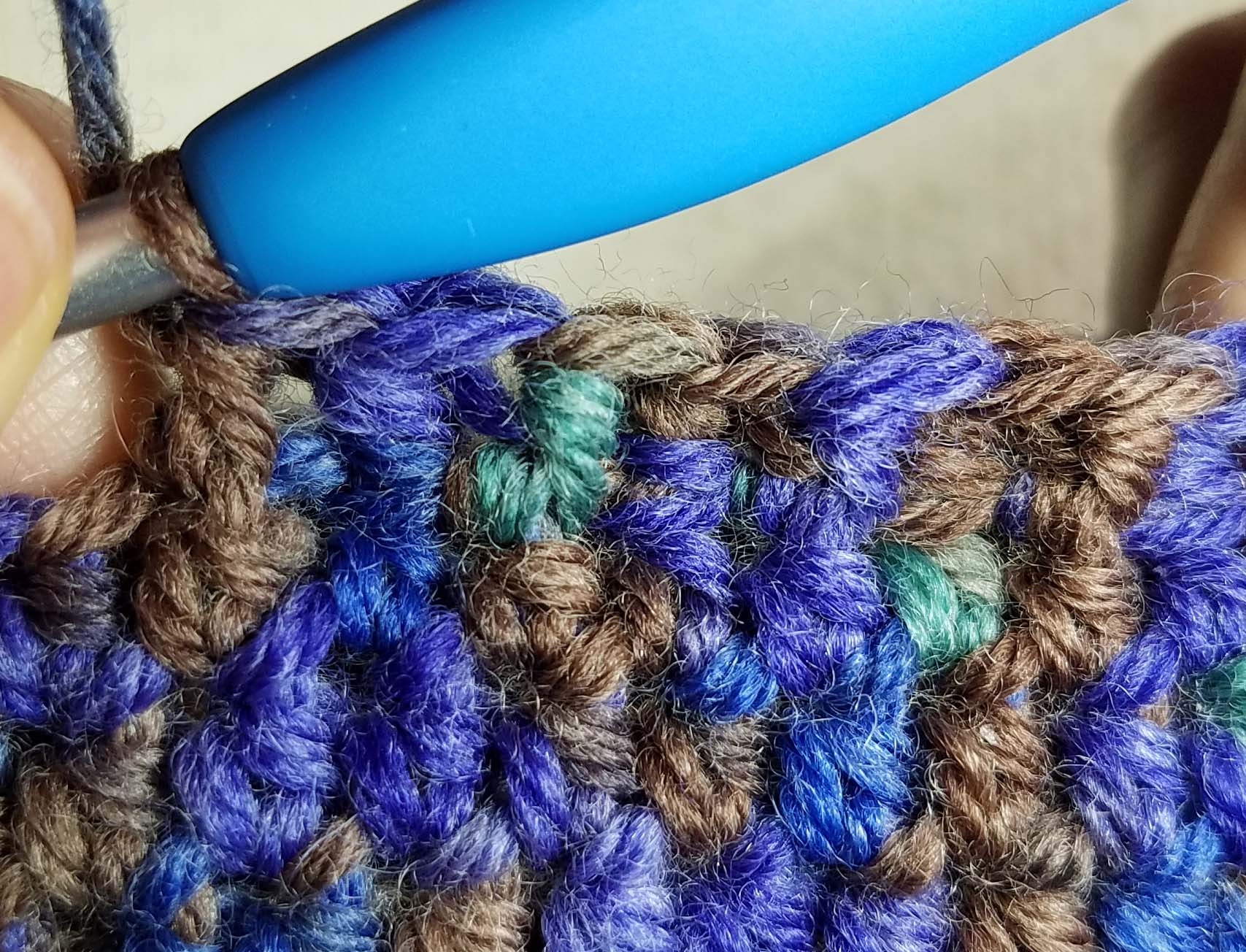
For the ribbing affect I alternate my post stitches, so I needed an even number of stitches. I generally start with a FPhdc, and end the round with a BPhdc. The first round of ribbing is the trickiest.

Once you have finished that round it just becomes a matter of working FP stitches into FP stitches and BP into BP.

For a Front Post half double crochet (FPhdc): Insert the hook from front to back to the right of the post you want to work around, then bring the hook from the back to the front under the top of the stitch to the left of the post (indicated by arrow in photo above).  Yarn over and pull up a loop thru all the stitches, yarn over and complete your hdc. The post of this new stitch will be sitting on the front of your fabric.

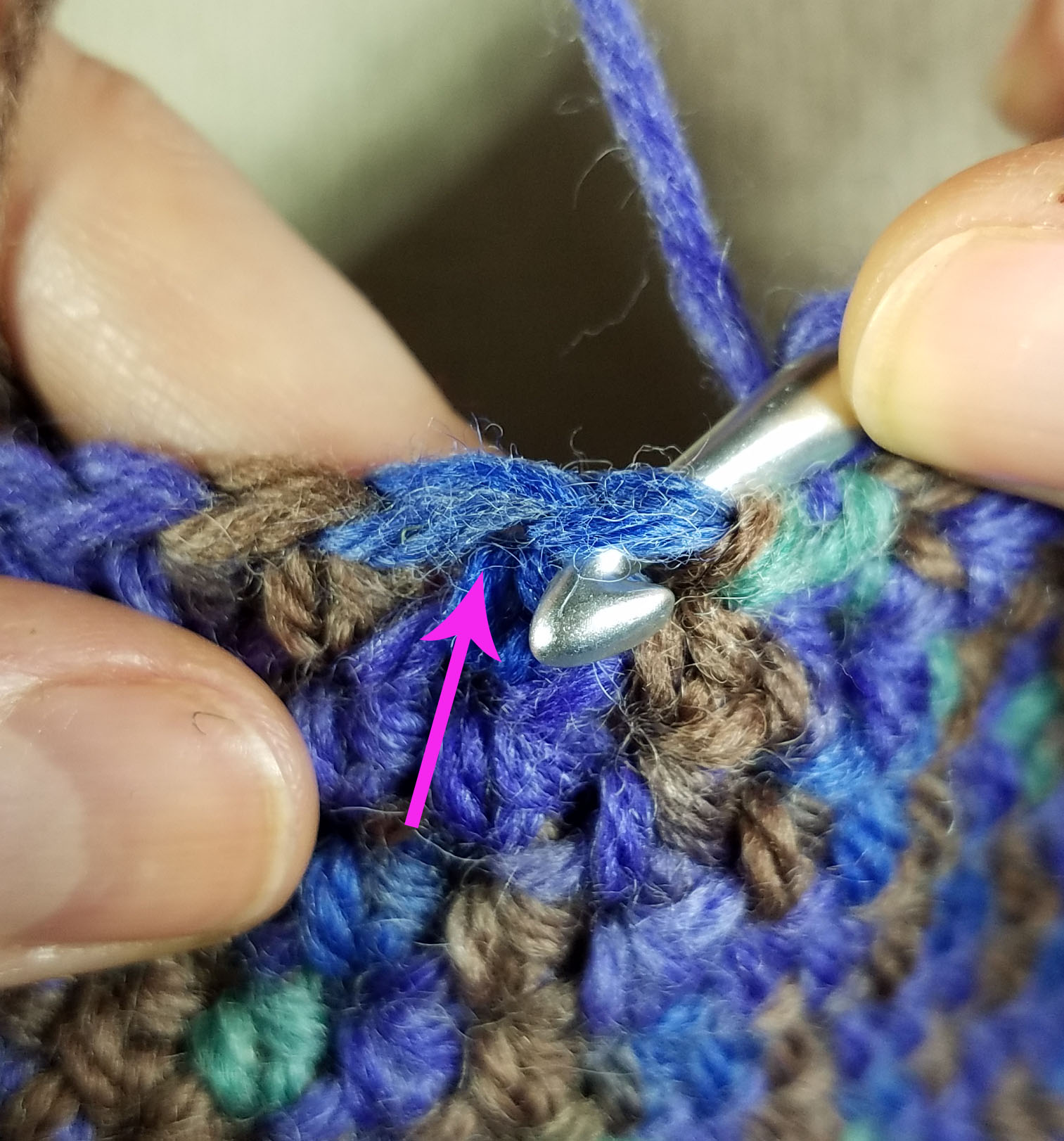
For a Back Post half double crochet (BPhdc): Insert the hook from back to front to the right of the post you want to work around, then bring the hook from the front to the back under the top of the stitch for the left of the post (indicated by arrow in photo above).

Yarn over and pull up a loop thru all the stitches, yarn over and complete your hdc. The post of this new stitch will be sitting on the back of your fabric.

Finished BPhdc.

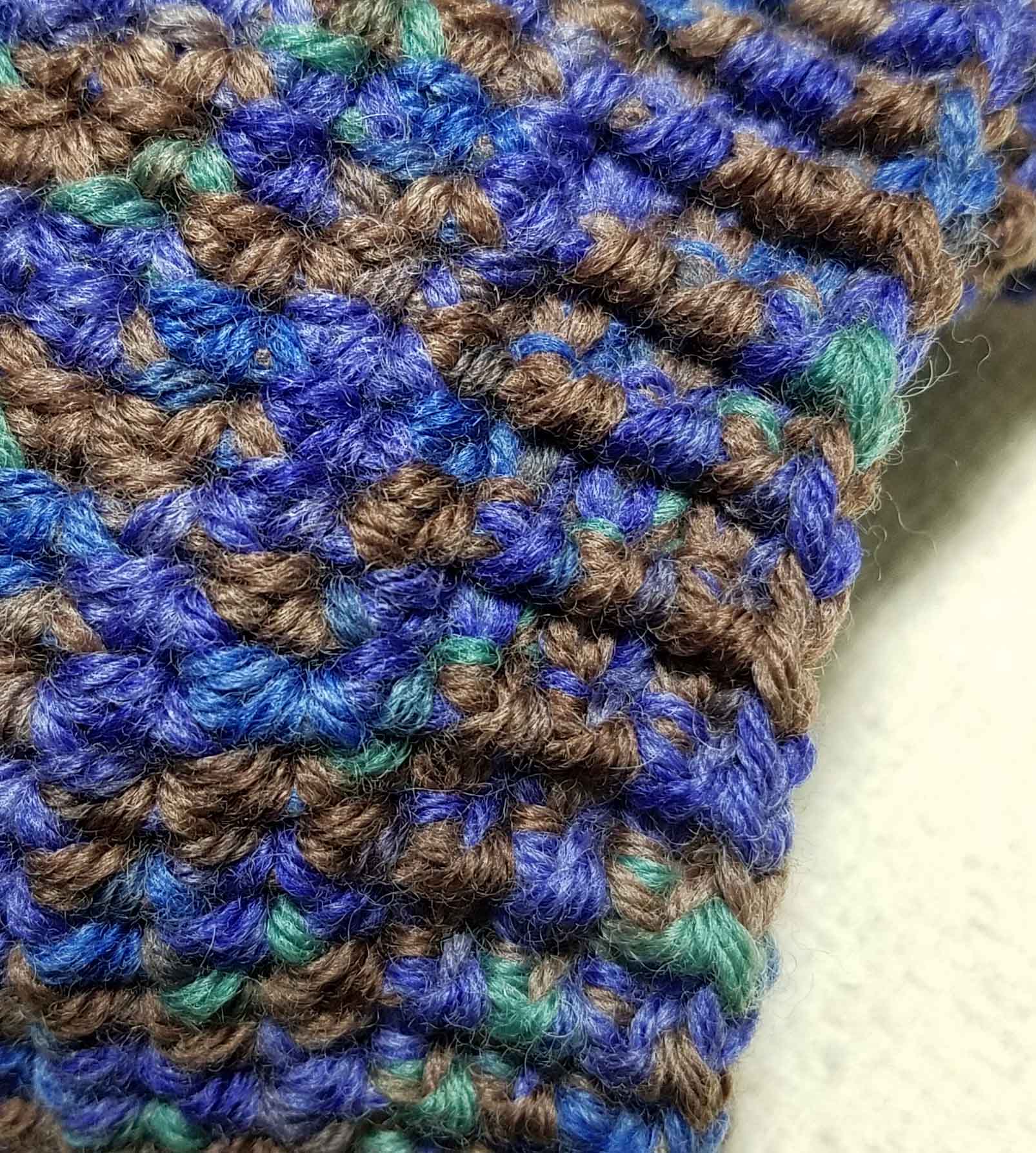
Once I finished the ribbing for Thing 2’s hat all I needed to do was weave in my beginning and ending tails. The tail at the crown is fairly easy to weave in, I’m just careful not to pull the tail too tight and create holes in the crown. For the ending tail at the brim, I want to be sure the tail is woven in so that it doesn’t create a tight spot in the fabric. I weave on the inside of the hat and keep my weaving restricted to 1 “column” of stitches.

I’m always careful with my end weaving to be sure that the tails are well secured. Hats get lots of handling and I want to be sure that this hat doesn’t become un-raveled. The very final step for me was to make an identifying tag that has our family name and phone number, just in case this hat gets misplaced. Hopefully the contact info will insure that the hat makes it back to us.


Another Hat for Thing 2 – part 3

Yesterday I had finished the crown of Thing 2’s new hat. The next step was to crochet “even” rounds until I had reached the length I wanted for the sides of the hat. Crocheting even means that I work 1 stitch in each stitch. But how do I know what length I wanted the sides to be?

I had taken 2 measurements when I was getting ready to crochet this hat originally. One was the circumference of Thing 2’s head, the second one was the “depth” of the hat. Thing 2 likes his hats to cover his ears well. He has short hair and wants his ears well covered.  When I took the depth measurement I placed one end of my measuring tape below his ear and took the tape over the top of his head to the matching spot under his other ear. That measurement was 16 1/2 inches.

When I am working on the hat though, it is less cumbersome to measure the depth by placing the end of the tape at the top center of the crown and read the tape at the bottom edge of the hat. Which means I divide my original measurement in half. My target length for the depth of Thing 2’s hat is 8 1/4 inches.

hat-folded-in-4ths-andee-graves-m2h-designs

As I get closer to the depth I want my hat I fold it in quarters and measure the length to see how many more rounds I need to crochet.

measuring-hat-depth-andee-graves-m2h-designs

I’m going to want about an inch of ribbing at the opening of the hat, so I know I need to work even rounds until my measurement from the crown is 7 1/4 inches. Then I will switch to working Front and Back post ribbing.

My favorite stitch for hats is the half-double crochet. It’s a great stitch for combining flexibility and density. It also makes for an awesome ribbing using post stitches. I’ll show you all about post stitches and how I make my ribbing for my hats in tomorrow’s post.


Another Hat for Thing 2 – part 2

Last night I had crocheted on the new hat for Thing 2 for 10 Rounds. I used the same increase formula I used in my “Little Bitty Noggin Cap” pattern here on the blog, with 8 increases each round.

working-1st-st-andee-graves-m2h-designs

I worked the increase by making the first stitch like a normal stitch, inserting my hook under both strands at the top of the stitch.

2nd-st-bk-loop-andee-graves-m2h-designs

For the second stitch of the increase I work into the back loop of the same stitch. This creates an interesting texture on the crown of the hat and decreases the size of the hole made for the increase.

finished-increase-andee-graves-m2h-designs

The finished increase looks like this. If you look at the hole under the first stitch you will see that it is similar to the other stitches. The hole you see under the second stitch is obscured once the next regular stitch is worked.

I had measured Thing 2’s head circumference (22″) and asked him how he wanted his hat to fit. My husband prefers his hats to be fairly loose, so I actually add ease to the size of them. Thing 2 wanted his hat to be a bit snug, so I calculated that I would want 21″ for the finished circumference, negative ease of 1 inch. That meant a target measurement of 6.69″ for the diameter of the crown before I started working evenly.

Unfortunately, though the math works out, the stitches don’t always cooperate. The expansion of the diameter can be affected by the height of the stitches being used in the hat. Once I had reached 10 rounds for the crown I knew that another full round of increases would make the hat too large. But there is a simple work around for that.

4-increase-points-andee-graves-m2h-designs

In Round 11 I only worked 4 increase points, instead of 8. I used this same method of limited increases in my Simple DC Hat pattern as well. At the end of Round 11 I had 84 stitches around the circumference. Knowing my number of stitches is a great way of checking my target measurement too. I knew that I had 4 stitches per inch, so 84 stitches = 21 inches.

Now I’ve got a lot of rounds of working evenly (without increasing or decreasing) before I’m ready to create a ribbed brim.